
Listening to live instrumental jazz you get a feeling that the music is coming up through the shoes of the musicians and they are standing on portals directly linked to the universal soul. A wave of rhythms and notes rushes through them and you’re swimming in music.
Many of my friends are jazz experts and scholars, but I’m not. I’m an amateur listener, I have no capacity for learning all the nuances and history of each riff that floats by me in the fertile ocean of sound. I listen for pleasure, for inspiration, for love – the true definition of an amateur.
At times I’ve tried to approach it more studiously, to train my ear a little better, to listen for structure, but I never really learn. My husband can determine every fine aspect, every skill the musicians have honed as well as the little thematic nuances and tributes they make. He knows the musicians’ names, their histories and their influences. He can tell me stories of the origin and evolution of standards and the merits of newly developed arrangements. Anything I want to know, I can ask – he’s the jazzernet.
He’s helped me understand a lot, and I have a fair knowledge of Dixieland, and traditional jazz of the 20s and thirties. But I somehow can’t retain knowledge of the improvisational complexities of post 50s jazz.
What I retain is an experiential memory that lifts me out of whatever little club we’re in and into a world of pure exuberance. I just listen like I did as a teenage girl when I stumbled into a bar where jazz was being performed live. It was a Thursday night at the South End in Memphis and for half a decade I spent as many Thursday night’s there as I could.
I also got into the habit of attending jazz brunches on Sunday which usually featured a singer. Vocal jazz is a different animal that I relate to and retain much easier. Words, poems and lyrics stick with me. Also, when I was 19 in the late 1970s, I volunteered for Memphis’s community radio station and there were a few old jazz guys there with their vinyl collections of the 78s and first albums of Armstrong, Waller, Beiderbecke and Shaw. God bless the day I first heard Billie Holiday. The jazz guys talked deep and knew everything about their music and imprinted a lot on my music hungry brain.
The fine instrumental jazz that exploded in the 50s and has grown since is so varied and spontaneous I can’t quite weave it into my accessible memory. But that’s okay. I don’t need to enjoy it based on what I know. I love this music because it takes me somewhere I haven’t been before. It’s wonderful in its immediacy, lack of predictability and spontaneity. I swear I feel it shaping my own soul as it comes up through the earth and out the musicians.
The musicians work hard to seem so fluid. They practice continuously, they learn how to communicate in the language of hundreds of different musical arrangements, and are experts on their instruments. Otherwise, the spontaneity would dissipate into discord – dis-chord. They never diss a chord or miss a chord. More likely, they add more chords, leaving little room for anything but music in your ears or your heart.
They play mostly for love, because I don’t think even the most commercial of jazz musicians makes the kind of money that a rock star would. They play first class music as a backdrop in bars and restaurants, often ignored by the patrons.
I was listening to Portland saxophonist David Evans in a combo at wine bar. In the middle of his solo, a patron’s phone suddenly emitted this loud obnoxious musical ring. Instead of turning off the phone, the guy walked across the bar, in front of the band and out the door to answer it. David took up the melody of the ring and blended it in with his solo. It was sublime and hilarious.
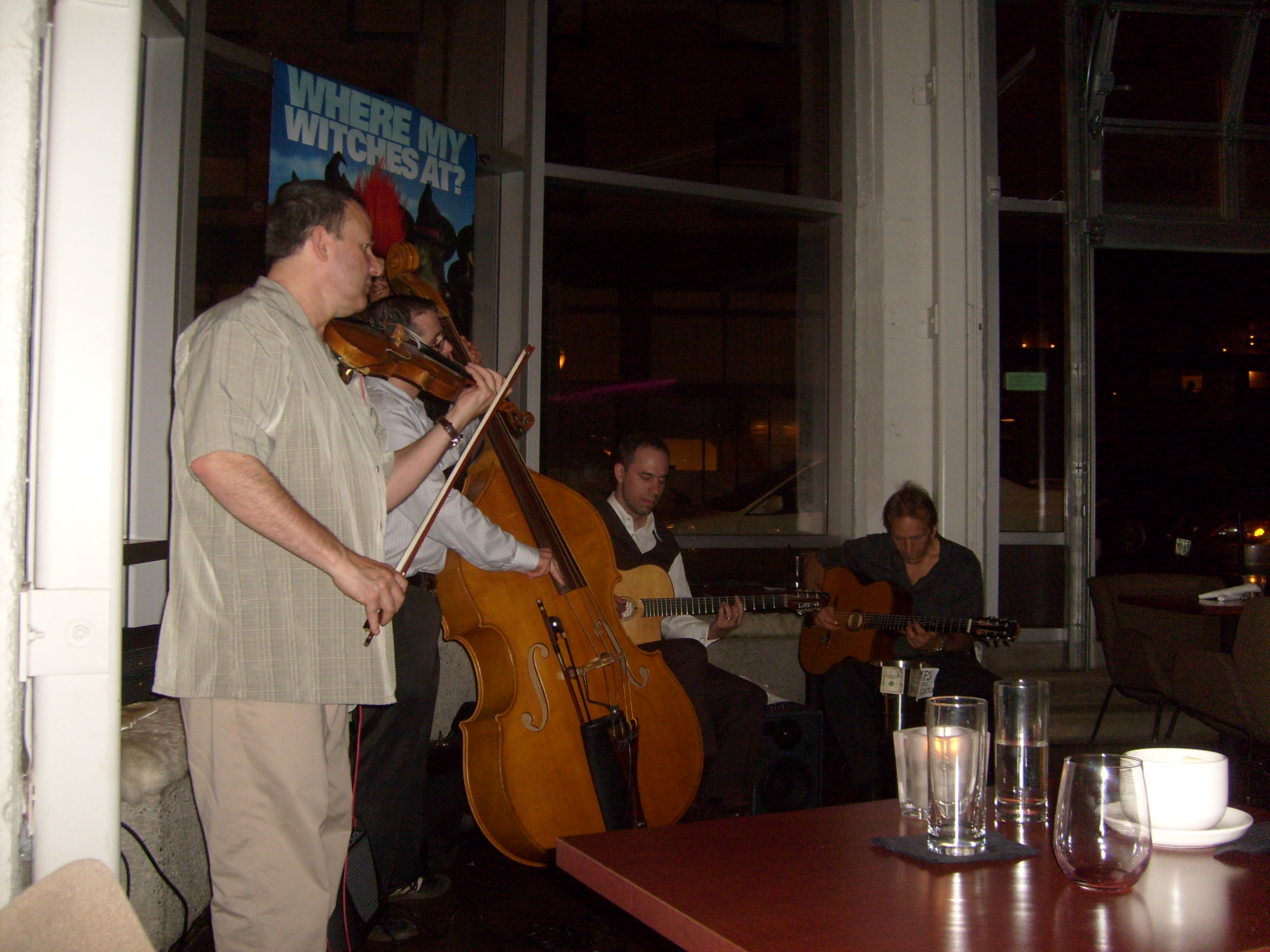
Only a few weeks ago, I got to hear the Djangophiles. It was a perfect warm summer evening with a river breeze cooling off the night and the doors were open at the Living Room lounge. A scruffy citizen of the street came in and danced in front of the band, swirling and snapping his fingers. Then he sat down exhausted and demanded water. While the flustered young waiter hurried off to get it, the dancer shouted, “And no ice!” After he was served and drank his water, he began dancing again weaving through the bar when his pants fell down and he tripped over them.
I gave a little prayer of thanks he wore boxers, and burst out laughing. The guy stood up, pulled up his pants and proceeded into the Living Room Theaters to dance for them. He emerged not two minutes later, firmly escorted out by an usher half his size. A few cuss words were directed at the door but the dancer disappeared into the downtown night. The band never skipped a beat, but finished in fine form and went right into another gypsy swing.
I marvel at the finesse and grace some of our finest jazz musicians achieve as they strive to bring some bit of musical clarity into our lives. I wish they had it easier, but perhaps it’s playing in these edgy and obscure situations that gives them the freedom to create such aural abundance.
I like it best when the bass player does a solo. Everything quiets down, a bit of drum and other instrumental support, then deep chords beat straight along with my heart. I always thought blues and rock had the beat of the human heart, but jazz has the beat of the happy heart. Even when it’s a heart broken song, there’s something of the gladness of life in it’s message. If you’re not listening to live jazz, you don’t know what you’re missing.
At Kogi’s, listening to the John Stowell Quartet, my husband asked if I noticed how tight the drum, bass and guitar played the last movement. I did and I didn’t. I did because I was lost in it. I didn’t because I couldn’t define how I got lost and the question jarred me back, out of instinctive listening and into analytical listening.
I tried very hard after that to listen more intelligently, but fortunately the on-going musical movements were just as tight and I got lost again, my weak analytic mind left behind as I floated on a sea of pure musical pleasure.


 joy murray art~stories~life