<!–[if !mso]> st1\:*{behavior:url(#ieooui) } <![endif]–>
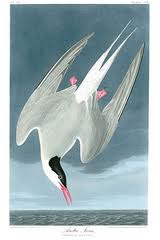
I remember when I first heard of John James Audubon’s hunting skills and how he killed hundreds of birds to get the right specimens to make his beautiful drawings. I was stunned. His work was always so alive to me, it never occurred to me he had to kill the birds first to study and draw them. Of course, I grew up in the city, in the 1960s and there was a completely different ethic around conservation than when Audubon was hunting and creating timeless art. He did immortalize the birds and gave us all a sense of conservation, in that clumsy way that history has of moving forward.
I first saw his prints when I was child, copies of prints.
I remember gazing at them and being amazed.
But not like Doug Swieter in
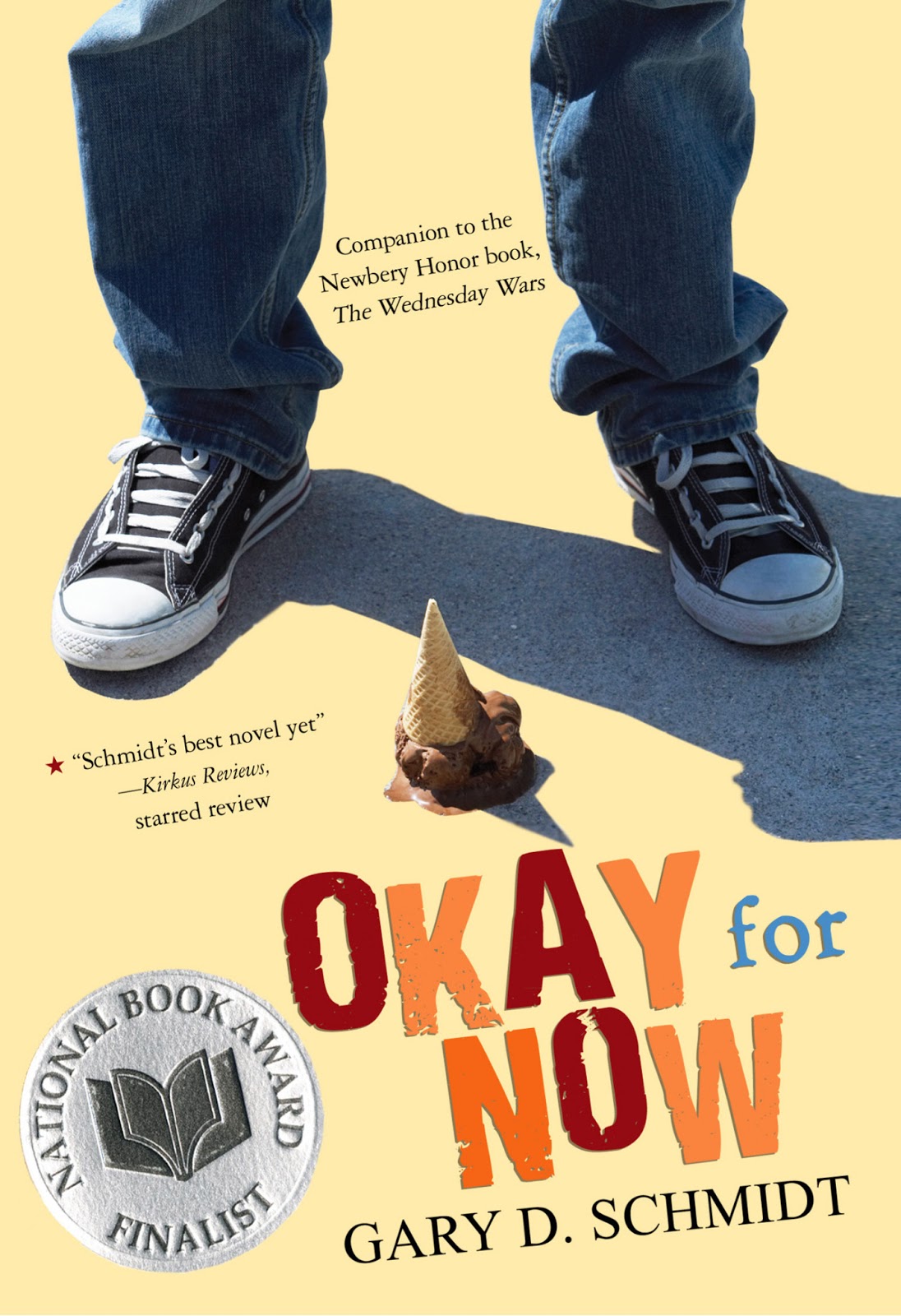
Gary D. Schmidt’s book,
Okay for Now (Clarion Books, 2011), when he first sees the full size plate of the Arctic Tern in Marysville library, in 1968.
To him, the bird is falling into the sea and it’s the most terrifying and beautiful image he as ever seen.
“I leaned down onto the glass, close to the bird. I think I started to breathe a little bit more quickly since the glass fogged up and I had to wipe the wet away. But I couldn’t help it. Dang, he was so alone. He was so scared.
”The wings were wide and white, and they swooped back into sharp rays. And between these, the tail feathers were even sharper, and they narrowed and narrowed, like scissors. All the layers of his feathers trembled and I could almost see the air rushing past them. I held my hand as if I had a pencil in it and drew on the glass case, over the tail feathers. They were so sharp. If my hand had shaken even a tiny bit, it would have ruined the whole picture. I drew over the ridges of the wings, and the neck, and the long beak. And then, at the end, I drew the round and terrified eye.”
Doug’s fascination with the Arctic tern becomes a turning point in his life. At 14, he is already falling into a sea of despair. His family has just moved to “stupid Marysville” to live in the “dump” after his father gets fired for assaulting his boss. The father gets a job through an old friend and moves them to a horrid little shack. His father is a mean and abusive man, his mother is long suffering woman. One of his brother’s is in Vietnam; the other brother uses Doug as a punching bag.
No one, in his young life, has allowed him to keep anything of value. Not his signed Joe Pepitone Yankees baseball cap. Not his sense of self. Not his sense of safety.
Doug finds the library quite by chance, he’s not a fan of books, and it only opens on Saturday. His fascination with the bird attracts the attention of a library volunteer who offers to teach Doug how to draw. Doug resists, but he’s obsessed with that bird’s fall, the shape of it, the feeling in it. He begins a secret life as an art student. Doug also attracts the attention of a girl named Lil, who likes Doug’s wit and gets him delivery job with her father’s store.
What follows is a multi-faceted story of the redemptive nature of human kindness and the power of art over disaster. Help comes to Doug in a lot of different directions, but so does trouble. Each problem is worked out in balanced ways by a masterful writer who refuses to let Doug either give up or get his redemption easily.
Each chapter opens with a reprint of one of Audubon’s birds. Doug learns that the Marysville library is selling the prints whenever the city needs a little cash. Doug can hardly believe it and wants to see the book restored. He wants one thing in his world to be whole. Getting one plate returned to the library gives him a sense of his own strength. Although he catches himself behaving like his thug brother, he finds that adopting a different formula gets him closer to what he needs.
There are magical moments when lessons from art and mathematics (he’s a natural) bleed over into the rest of life. When he learns the composition of the Forked-Tailed Petrels, he says, “The two winds were pushing them in different directions, but the petrels were using them to meet in the center of the picture. That’s what the picture was about: meeting, even though you might be headed in different directions.
“All movement relies on that kind of tension, you know.”
I found this book deeply moving and gratifying. It’s the best one I’ve read on how art and kindness can send out ripples of change. It’s not preachy and is often funny. It doesn’t indulge in gratuitous descriptions of suffering. It does describe real human hardship, cruelty and suffering. It is quite frank about how terrible one’s own family can be.
Schmidt deftly handles the development of the monstrous characters in this book – they don’t become monsters on their own. But he doesn’t over-sympathize or ask the reader to forgive brutalities.
“There are not too many things around that are whole, you know. You look hard at most anything, and it’s probably beat up somewhere or other. Beat up, or dinged up, or missing a piece, or tattooed. Or maybe something starts out whole and then it turns into junk….
“When you find something that’s whole, you do what you can to keep it that way
“And when you find something that isn’t, then maybe it’s not a bad idea to try to make it whole again. Maybe.”
Maybe the thing made out of the many different tensions of Doug’s life portrays all the upward motion needed to avert a plunge into the dark sea.
Doug D Schmidt is the author of many books, including two Newberry winners.
For an interview with him about Okay for Now listen to this story on NPR:









 st1\:*{behavior:url(#ieooui) } <![endif]–>