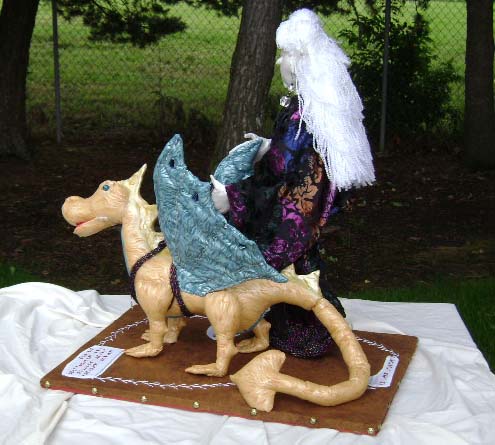
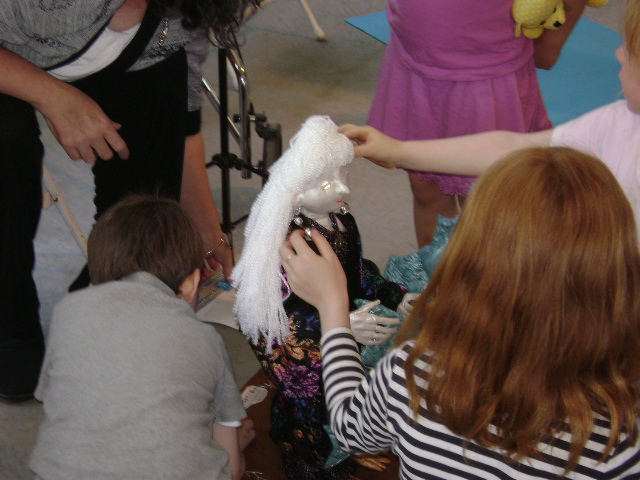
I got a chance to tell my story about Iris and Aurora yesterday at the Disability Arts and Culture Program’s fundraiser for the Inclusive Arts Vibe dance program here in Portland, Oregon. While there weren’t as many children there as I had hoped, it was fun sharing the story and my fabric sculpture with everyone there. I made this for a Somewhat Secret Place Art show a few years ago. I made this particular sculpture very tactile and I embroidered braille tags on it naming the piece, Shared Vision, and Iris, a blind goddess and her seeing-eye dragon.
I have this dream of one day getting the story published in both type and braille with raised relief illustrations, but only time and luck and a lot of haggling would make that happen. Meanwhile, I decided to just share it here. For one thing, it’s much too long for a standard picture book but I like the length. It’s a nice meandering fairytale. So here are some pictures of the art and children enjoying petting the dragon and learning about braille.
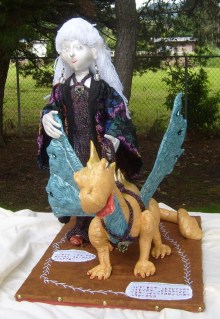 |
| Aurora the Seeing Eye Dragon |
 |
| Iris and her seeing eye dragon |
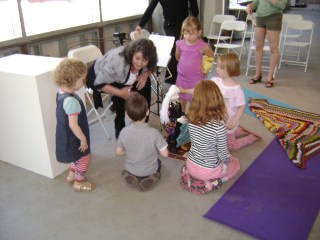 |
| Kids learning about braille and how to touch and learn |
And here is the story. Please feel free to share and retell this story, but give me proper credit. I have a copyright on the story, but a story not shared is no fun.
Iris and The Dragon Aurora
<!–[if !mso]> st1\:*{behavior:url(#ieooui) } <![endif]–>
Long ago and far away, when there were still a few dragons flying around, there lived a young couple named Zelda and Zachariah. Zelda was a medicine woman for her village, and Zachariah grew the plants and herbs to make the medicine.
They were very much in love, and more than anything they wanted to have a child. Soon enough, they were blessed with the birth of a baby girl. She was the most amazing baby they had ever seen, with creamy skin and snowy hair. Her eyes were clear as crystals that danced and sparkled and delighted Zelda and Zachariah. They named their daughter Iris after the goddess of the rainbow.
Their neighbors didn’t like that baby at all. She was strange looking. And it was obvious she couldn’t see with those weird eyes. That baby was blind.
There had never been a person who was blind in the village. Everyone in the village was practically perfect. The village itself was practically perfect. It was nestled in a valley surrounded by fertile fields, lush forests, a clear river and majestic mountains. The land provided everything they needed. Everyone ate well and was healthy. And if they got sick, the medicine woman could fix them right up.
But now that she had the strange child, they began to not trust her. If she really knew how to make people healthy, why did she have a blind daughter? Mayor Bighair stopped buying her hair tonic. It made Zelda and Zachariah very sad. They didn’t want to leave their beautiful village, but they didn’t want their daughter to grow up with people saying bad things about her.
Zelda told everyone she and Zachariah were taking the baby to visit her cousin in a village on the other side of the mountains. They were gone for a long time. Then one morning, the villagers smelled the aroma of good medicine coming from Zelda’s chimney and saw Zachariah tending his garden.
Mayor Bighair visited the couple and saw no signs of the baby.
“We left her with my cousin and who will love her and take care of her even though she’s different.”
“You did the right thing. A child like that is better off with those kind of people,” Mayor Bighair said. He bought his hair tonic and told the villagers they could once again see Zelda for their sicknesses Things went on like they did before.
Except Zelda and Zachariah hadn’t taken Iris away, but had made a room for her in their basement. She slept during the day and played at night. They were sure the day would come when the people in their village would be more understanding; until then, they would protect their precious daughter.
Iris was a happy and helpful child. When she was old enough, her mother taught her all about herbs and how to be a medicine woman. They both worked on medicines to make Iris see, but she never did. They also worked on medicines to make the villagers kinder, but that didn’t work either.
But Iris learned how many footsteps it took to get anywhere in the house. She was a whiz at math. She helped her father keep the accounts and plan his most productive garden ever.
Iris and her mother made pots with images of all the different herbs carved on them so Iris could find the right herb by touching the pot. Iris showed her mother how to arrange the mixing bowls, mortars, herbs, and utensils so everything was in easy reach.
Things went well until one day, a plague of fiery red dragons nested in the mountain forest above the village. The villagers could hear the dragons’ terrible roars and see their hot fire breath billowing into the sky.
The villagers knew those dragons were up there scheming to burn the village and eat them.
Mayor Bighair called a meeting. “If only they knew we are perfect people, they would find another village to devour. Who can we send to talk to them?”
His soldiers and policemen had all fled as soon as they saw dragons fly over the village. Everybody in the village thought they should run, too; there was no other way. Then they heard a small sweet voice sing out, “I’ll go talk to them. I’ll tell the dragons not to hurt us.”
A beautiful young woman with pearly skin and crystal eyes wearing a long dark cloak stepped into the crowd. Zelda and Zachariah ran toward her. The villagers figured out pretty quickly that this young woman was the baby Zelda and Zachariah said they sent away many years ago.
“No wonder the dragons are here! That weird girl brought bad luck to our village! Send her to appease the dragons.”
“I’ll be happy to go. I am not afraid,” she said.
Her parents begged her not to, but she ignored them. Mayor Bighair told her, “If you’re tricking us and plan to run away once you get to the forest, be warned your parents will be jailed if you don’t appease the dragons.”
“Run away?” laughed Iris. “How could a blind girl like me do such a thing? escort me to the edge of town and I will find them and take care of them.”
The villagers did, although they were pretty sure she wouldn’t take care of the dragons — the dragons would have her for supper. Maybe that would give them enough time to pack their belongings and run.
As soon as Iris stepped into the forest, she felt around on the ground until she found a long stick. She used it to find her way along the mountain path. It was not the first time she had been there. Often while her mother and father were asleep, she sneaked out to explore the village and the forest beyond. She counted her steps and followed sounds and smells to find her way around. She loved the sweet air of the forest, the rough texture of tree bark, and the cool touch of the leaves and grass.
Now she followed smell of sulfur and smoke and made her way to the edge of the dragons’ lair. She took a deep breath and almost gagged it smelled so awful. She listened to the roars and grumblings but didn’t hear as much as she expected. She estimated it was only one dragon family – a father, a mother, and a small one.
Iris took a small cauldron out from under her cloak. She gathered leaves and dried sticks and made a fire. She poured water from a canteen and herbs from a small pouch into the cauldron. Soon it was bubbling and filling the air with a sweet minty smell.
The dragons went quiet. They sniffed the air and looked around for what was making that wonderful aroma.
“It’ll be ready soon,” a small voice said. “I know you’re hungry, and this will make everything better.”
The dragons saw a girl hidden in the trees. She was the most unusual looking person they’d ever seen, but whatever she was cooking smelled delicious.
Nevertheless, she was the enemy. The dragons roared and blew fire in her direction, but the girl waved her hands and said, “Wait a minute! If you burn me, I’ll never get it finished.”
The dragons were stunned. People always ran when they blew fire—or attacked them with swords and spears.
“My name is Iris. I know you’ve been suffering, and I want to make you feel better. I don’t want you to set fire to our land, so I brought this tasty medicine.”
She scooped up a big spoonful and held it out. “Father Dragon, would you like to try it first?”
It smelled so good, and Father Dragon was so hungry, but he bore many scars from being attacked by people. “Don’t try to trick me. I know you’re trying to poison us. I should burn you up right now!”
“I am the daughter of a medicine woman; I can’t poison anything. This will make you feel better, I promise. Mother Dragon, will you trust me?”
“Trust a human? Last time we trusted people they stole our lands and…”
Before she could finish, the little dragon flew up and slurped up the whole spoonful.
“No, Aurora, No!” the dragons roared.
“It tastes better than it smells.” Instead of falling over from poisoning, the little dragon did a double back flip and looked healthier than she had in a long time.
Iris scooped up another spoonful and Mother Dragon lapped it up. “Oh, this is that mint that grew in Dragonland.”
Father Dragon pulled the whole cauldron off the fire and tasted it. “You’re right! Aurora, come drink more!”
The dragons drank the entire cauldron and licked it clean. The smoke stopped coming out of their mouths. They were no longer red. They were golden with beautiful blue wings.
“I knew it!” Iris said. “When I first smelled your breath I knew you had indigestion. You should stop eating people; they’re not good for you.”
“Eat people! Nasty!” said Aurora.
“We’re vegetarians,” said Mother Dragon. “You don’t get this big eating people.”
“But people ran us out of our native land, and we can’t find the dragon plants we used to eat. We have to eat anything we find in the forest. It’s miserable.”
“It gives us gas,” said Aurora.
“I think my mother has something you can eat. Let’s go down to the village and see her.”
“We’ll clean up first.” The dragons flew off to a mountain river that lay a few wing-flaps away. When she noticed Iris hadn’t followed them, Aurora came back. “Why aren’t you coming with us?”
“I don’t know the way, and I couldn’t see which way you went. I’ve never been to the river.”
“I’ll take you there,” Aurora said, and she let Iris hold on to her wing and walked with her to the river. Iris was afraid to get in the water, but the little dragon splashed and played with her until they were both good and clean.
The dragons flew Iris back to the village, but nobody was there. “They must be hiding,” Iris said. “They’re afraid of you.” She called out, “It’s okay! They don’t eat people.” Nobody came out.
Iris took them to her house. Only Aurora was small enough to follow her through the door. Iris’s parents trembled in the kitchen. Zelda hugged Iris, and Zachariah tried to chase Aurora out.
“Don’t be afraid. This is my new friend, Aurora. We need some dragon flower.”
“Dragon flower?” her mother asked.
“You know,” Iris said. She felt along the back rows of the shelves and found the pot with the dragon carved on it. “This one.”
“I haven’t thought of that in years. We used to prescribe it for nightmares, but there’s almost no call for it anymore. Your father has lots of seeds, if I remember well. We used the flowers, they’re huge, but if you let the fruits grow they get as big as a house.”
Zelda went out to talk to the dragons and fed them a bit of the dragon flower. Off in the distance they saw some people watching. “It’s okay,” Zelda said. “Our Iris has tamed the dragons.”
Mayor Bighair stepped out of the crowd. “Tamed the dragons? She’s a witch. Anyone who consorts with dragons must be a witch. Her mother’s been a witch all along and has had us under her spell. We’ll all be dragon food if we don’t leave this town right now and enlist another village in fighting this scourge of ….”
He talked on and on. Iris whispered something in Aurora’s ear and Aurora flew up and snatched at his hair which came off in one grab. It was a wig! Mayor Bighair’s face and bald head turned bright red, and he ran out of the city and was never seen again. A few other villagers left, too, but most stayed and found out their village was even more perfect than before. If they had dragons in the village, they knew they would always be safe.
Zachariah planted a big field of dragon fruit so the dragons always had plenty to eat.
Iris never had to hide again. Anywhere she wanted to go, all she had to do was call for Aurora and she would be her guide.
Sometimes Aurora would fly Iris to strange new lands. And if ever people they met were afraid, they would show them that a dragon is not such a scary thing, once you see it clearly.
###







 st1\:*{behavior:url(#ieooui) } <![endif]–>


 joy murray art~stories~life