The Illuminated Brain


<!–[if !mso]>st1\:*{behavior:url(#ieooui) } <![endif]–>

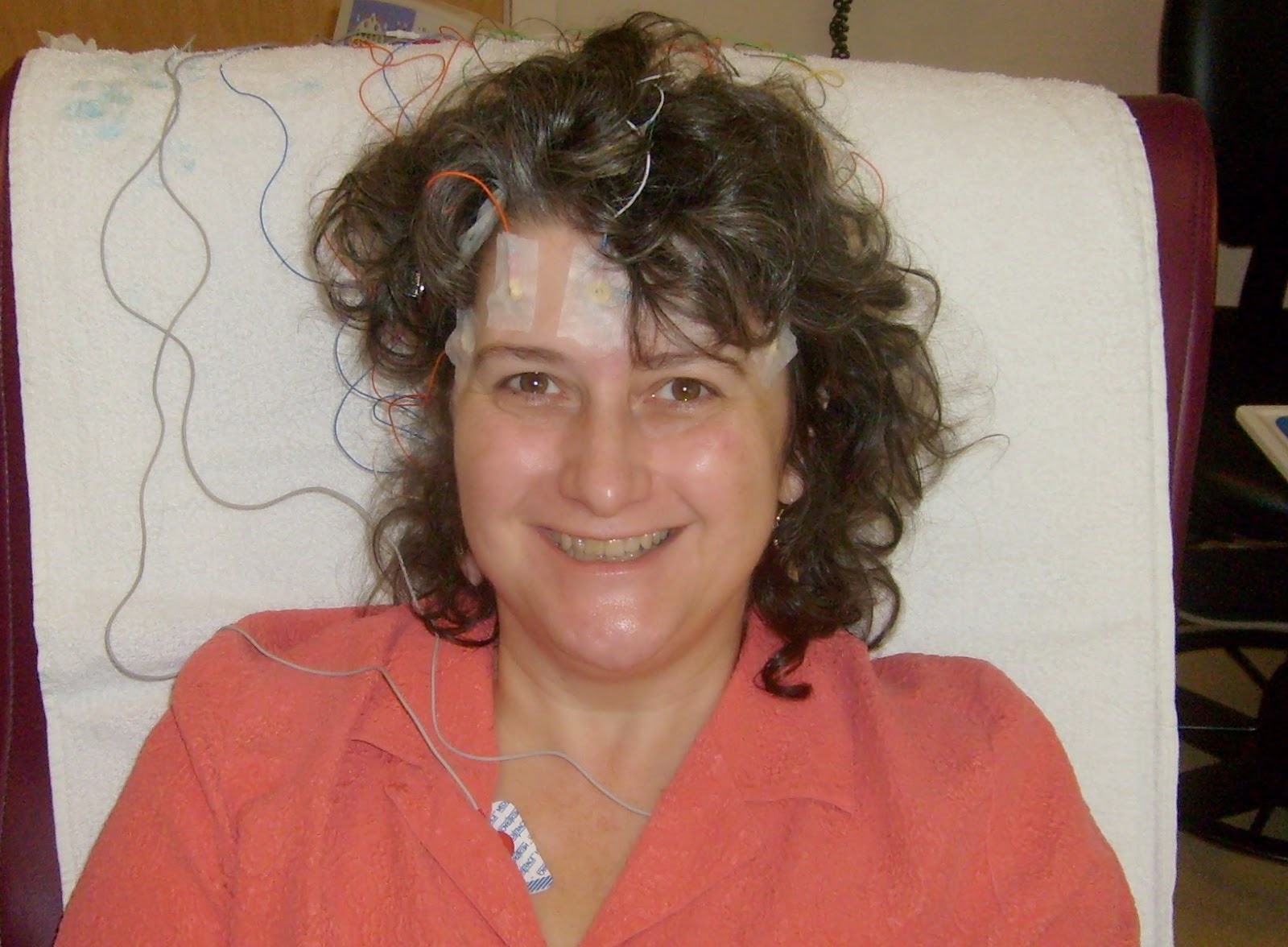
I haven’t always had a good relationship with my brain.  I developed neurological problems when I was 16, including epilepsy and muscle deterioration.  At the time, back in 1976, they didn’t have things like MRIs and my condition remained a mystery most of my life.   
My second neurologist gave me the diagnosis of “abnormal,” which I will always be proud of.  My condition is still a mystery but I now know I have a lesion in my spine, and I have a diagnosis of Transverse Myelitis.  I no longer have seizures, but I have some cognitive blips, and wrestle with fatigue, depression, and occasional mania.  For awhile, I was pretty sure my brain was trying to kill me. 
Luckily I found the books of Dr. Oliver Sacks.  His work made me feel like I would eventually understand my brain.  More importantly, he has such a profound respect for “abnormalities” and all the ways the brain overcomes damage, regenerates itself, and creates new modes of perception, that I began to think my brain and I could be friends. 
I’ve recently fallen in love with the book Neurocomic by Dr. Hana Ros and Matteo Farinella, beautifully published by Nobrow this year.  It combines all the best elements of science, art, humor, story and information.  It illuminates the brain in new and wonderful ways.
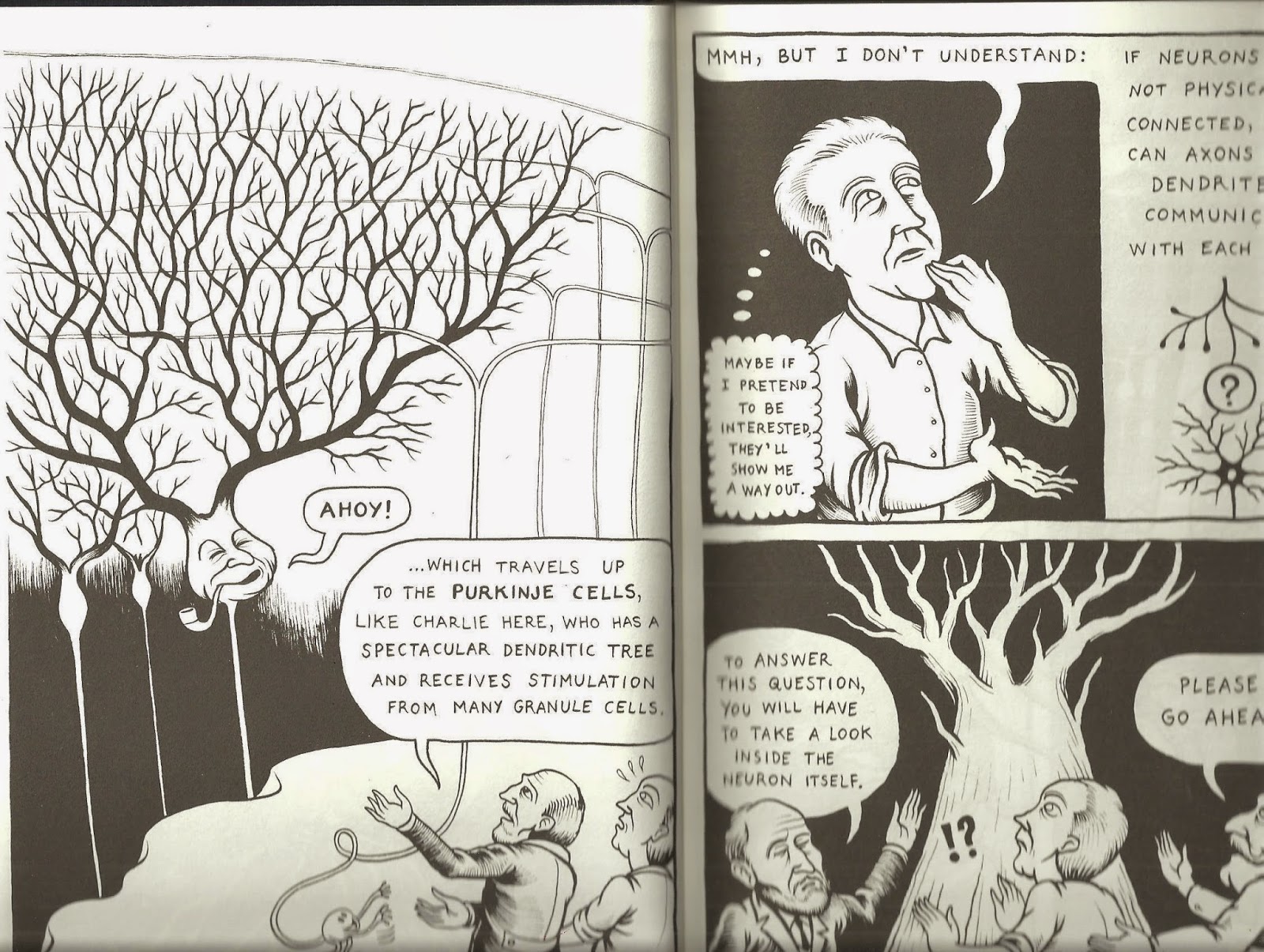
The book opens with a man who starts to flirt with a woman then finds himself sucked into her brain.  His quest is to get back out so he can continue to pursue her.  He has no idea where he is and wanders through a neuron forest until he runs into Santiago Roman y Cajal, a “Spanish neuroscientist and Nobel Laureate (1852-1934)…considered as the father of neuroscience, although he always had a great passion for drawing.” 
Thus begins our hero’s journey through neuron forests, memory caves, and castles of deception.  Along the way, he runs into pioneers of neuroscience who seem to delight in sending him into even more mysterious places.  It amused me to think of neuroscientists spending eternity studying inside a living brain.  Is that heaven for them?  The scientists are only the beginning of the zaniness.  There’s a giant squid seeking revenge for experiments on its giant axons.  There’s an aplysia snail playing banjo.  We run into Pavlov and his dog.
It’s an altogether engrossing and entertaining way to learn about the brain.  We often see science as stuffy and serious, but this book injects so much playfulness and humor into neuroscience, that it’s an irresistible way to learn.  The drawings are lively and expressive.  I love the playful way brain functions are characterized.   
Dr. Hana Ros is neuroscientist with a PhD from Oxford University.  Matteo Farinella is an illustrator specializing in graphic journalism and scientific illustration.  Farinella received a PhD in neuroscience from the University College in London.
The story format helps illuminate both what is known and how much is still not known.  It’s a mysterious world, the world of the brain, and Neurocomic celebrates that mystery as much as the science.  Ros states in a video about the book that it’s difficult to explain what’s going on in the brain without the use of metaphors.  That our brains can make metaphors is miraculous to me, and that we can understand so much more about everything in terms of story and metaphor is, I think, the most comforting thing about this book.
The other comforting thing is the book itself.  Nobrow has done a stellar job in publishing it.  It’s a delight to hold and behold.  I worry that the era of beautiful books has come to an end with ebooks, but publishers like Nobrow are putting those fears to rest.  
Nobrow started 2008 in the UK, with the aim to provide an independent platform for graphic art, illustration and art.  It’s become a leading proponent of quality in book design and a standard bearer for original creative content in print publishing.
Neurocomic’s cover and spine are embossed with gold and silver ink.  

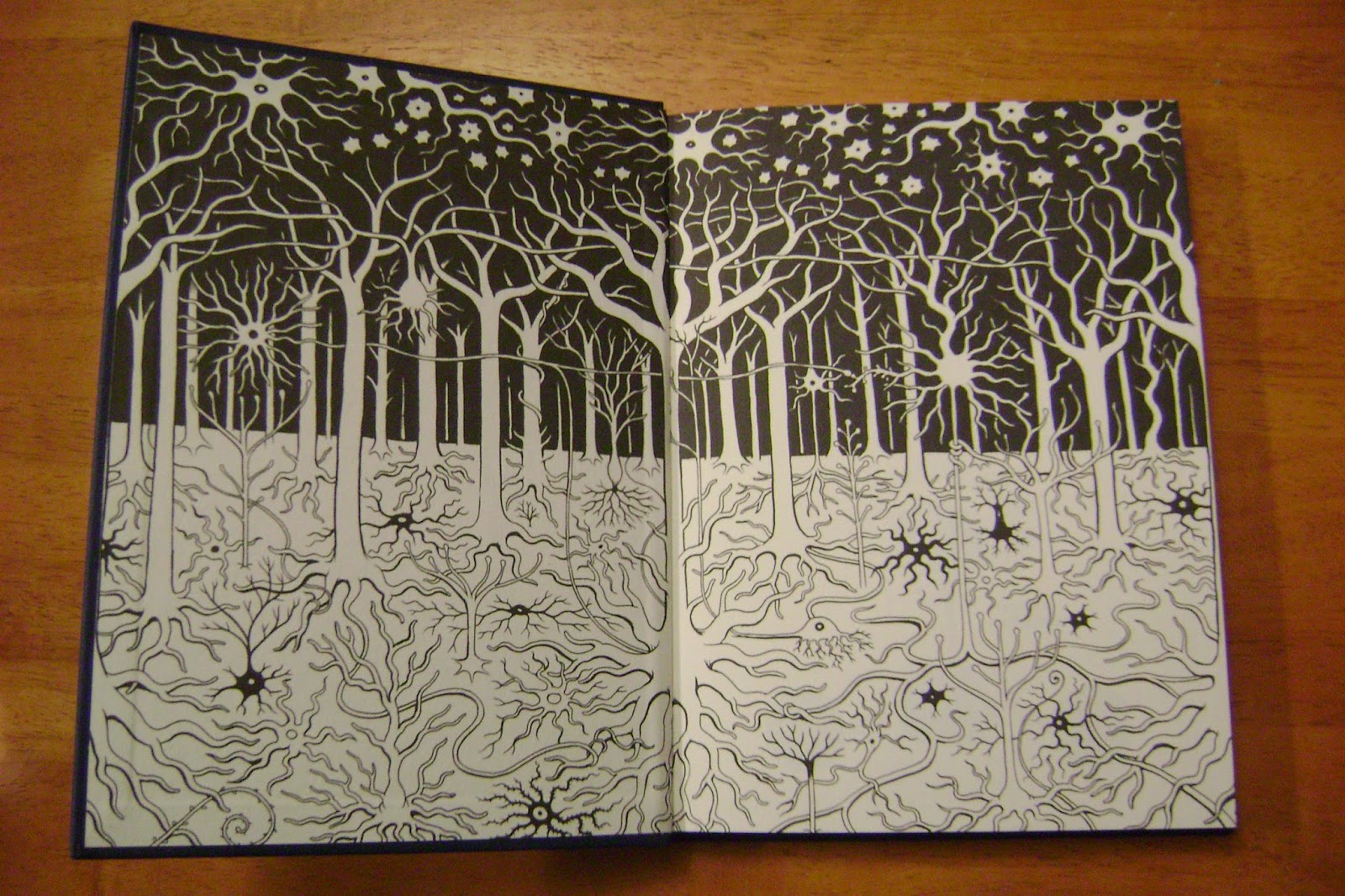
It has beautiful endpapers.
One of the problems with graphic novels is picture size.  Often the panels are so small, you lose impact.  Neurocomic has big panels and whole pages devoted to one frame.
It’s a charming way of learning a complex subject, and invites re-reading.  I think I’ll take it with me to read the next time I go to the neurologist.  
To learn more about Neurocomic, click here.  There’s a great video of the authors done by The Guardian here.
To see more amazing books by Nobrow, click here.    
If you missed my last post on the poetic astrophysics book, The Edge of the Sky by Dr. Roberto Trotta, you can read it here.
Remember, books make the best gifts.  If you liked this post, please feel free to share it. 

Art & Fear Review


The elegant little book Art and Fear: Observations on the Perils (and Rewards) of Artmaking, by David Bayles and Ted Orland was first published in 1993 and it’s been in print ever since.  I first read it when I didn’t really consider myself an “artist,” but I did consider myself a writer.  I was in my late 30s, I’d had a few short stories published in respectable magazines and garnered a few awards.  But FEAR was my constant companion — it still is.  What I was searching for when I read this book was a way to continue to be creative even though I was pretty sure I’d never overcome fear or insecurity or blocks. 

I’d been working in non-artistic fields since I was 16 and dealing with health problems, too, so I had learned that often just showing up makes things happen, even if you’re plagued with headaches, pain and confusion.  A paycheck is a huge motivator.  The paycheck for doing creative work is much more elusive and ethereal.  How do you keep at it when it feels like you have no new ideas and no one cares anyway.  All you get in response is rejection slips if you muster the energy to send things out. 

Art and Fear is like a tonic when I’m feeling depleted.   It explores the way art gets made, the reasons it doesn’t get made, and the many, many reason why people give up.  It gives many compelling reasons why you shouldn’t give up.  Art is part of what makes us human.  Whether it’s writing, photography, drawing, painting, making collages, telling stories, carving, sculpting, sewing — we are hard wired to interact with the materials around us, to redesign and have impact, to work with our hands. 

The authors understand this. They dedicate thoughtful chapters on Fears about Yourself, Fears about Others, Finding your work, The Outside World, The Human Voice.  There are many passages I could quote from this book, but I’ll restrict myself to a few so you can get a feel for how the authors handle things:

 “Admittedly, artmaking probably does require something special, but just what that something might be has remained remarkable elusive — elusive enough to suggest that it may be something particular to each artist, rather than universal to them all….Whatever they have is something needed to do their work — it wouldn’t help you in your work even if you had it.  Their magic is theirs.  You don’t lack it.  You don’t need it.  It has nothing to do with you.  Period.”

“Ask your work what it needs, not what you need.  Then set aside your fears and listen, the way a good parent listens to a child.”

“If, indeed, for any given time only a certain sort of work resonates with life, then that is the work you need to be doing in that moment.  If you try to do some other work, you will miss your moment.  Indeed, our own work is so inextricably tied to time and place that we cannot recapture even our own aesthetic ground of past times.”

This last quote is particularly helpful to me.  It’s part of what I use when I’m incapable of creating anything

Some days a doodle is all there is

that pleases me or makes me want to share it.  I’m sure I’ll never create anything as successful as when I was younger. Or that  my one success was a fluke. I call it “writing around the block,” although I now draw around the block, too.  It’s simply continuing to practice when you don’t have any inspiration at all, when you are blocked.  It’s showing up and doing a little bit, even if it seems like your ruining perfectly good paper.  I need to show up in bad times because, who knows, the moment might come, and I’ll have my paper ready to capture it. 

Three months ago, when my mother died, I hit a creative wall.  Of course, when a loved one dies, it causes major shifts and sometimes painful growth spurts.  I am vulnerable to blurring reality till it seems totally pointless.  Art & Fear is one of the books I reread when I am in that state of mind.  I also read The Re-Enchantment of Every Day Life by Thomas Moore, and A Natural History of the Senses, by Diane Ackerman. These all help to re-focus me on the many precise and beautiful points of life.  And they help me show up for my writing and drawing practice, my writing sessions with fellow writers, my blog — they help me show up for life.  None of them promise money or reward or even understanding by others.  They help me live my life as it is — wonderous, confusing and bubbling with things to make and stories to tell.

The calm, thoughtful and re-assuring essays of Art & Fear help me carry my fear with me to my creative sessions, acknowledge it, and go ahead and make something.  “Artists become veteran artists only by making peace not just with themselves but a huge range of issues.  You have to find your work all over again all the time.”  If you ever feel you’ve lost your sense of meaning and are blocked, read this book.  It will help you move into what ever new phase is waiting as soon as you go forward.


The books discussed in this post are all available at most libraries.  I have included links to Amazon.com, where I am an associate, and get a small, small fee if you purchase through the link.   Just click the book and it will take you to Amazon.com  Thanks!

Cats, History and Libraries


<!–[if !mso]>st1\:*{behavior:url(#ieooui) } <![endif]–>

Do you like stories, cats, and children?  If so, you may be as charmed as I was by the book The Five Lives of Our Cat Zook, by Joanne Rocklin, Amulet Book, 2012. 

“Our cat’s named Zucchini, and we call him Zook, but that’s not the most important thing about him.  And neither is the INCREDIBLE fact that he’s got seven toes on each front foot and six on each one in the back for a total of twenty-six…His eyes are blue, like old faded jeans, and his coat is dark brown.  But when he’s lying on a sidewalk scratching his back, you can see some white markings shaped like the state of California on his belly.  And some black tufts in the spot where Oakland is, which where we live.  One corner of one ear is clipped off.   He’s got shaky teeth, black gums, and breath that smells like the restroom in the Chevron station – a smell we love, because it’s Zook’s.”
Thus 10 year old Oona begins her tale of the illness of her cat. (If you want to know the most incredible thing, read the book).  She’s a consummate storyteller, living in her imagination and helping her younger brother Fred understand life through her stories.  When Zook gets ill and has to be stay at the veterinary hospital, she convinces Fred that cats really do have 9 lives and Zook is only on life 5.  She proceeds to tell the tale of these former lives and to reveal much about herself, her fears and her confusion, as she fabricates her whoppers. 
Oona has a Rainbow Whopper Theory: “That’s another important thing about me, and I have to admit it, even though it doesn’t sound so great.  I tell whoppers.  Whoppers are lies, plain and simple.  Some whoppers are worse than other whoppers, and those are nothing to be proud of.  But some whoppers are stories.  Those are the good kind.  Thinking about different kinds of whoppers can get very complicated and make your brain jump around in your skull, so it helps if you attach colors to them.”
She proceeds to tell the difference between Blue, Red, Black and Yellow whoppers.  But the big true story of her life is that her father died of cancer a few years back.  Now she and Fred are faced with the possible death of their cat and though she is a caring and only slightly manipulative sister, the prospect of losing Zook is very scary.  She has built a whole story for herself about rescuing him.  She had built stories about her mother, her friends, her shirt (she wears the same one every day), her beloved neighborhood, and “the villain.”  The changes that are occurring around her are shattering her little rainbow of theories, the villain is getting too close for comfort,  and she is doing all she can to keep it under control.
This is such a good story.  It flows from page one.  Rocklin uses the power of story and folktales in clever  and seamless ways.  There’s a lot in the narrative on how we use language and grammar to change meanings.  Oona’s father taught her how to read with rebuses (something I hadn’t seen in years) and now she uses them to teach Fred.  The book is illustrated with them and they add another facet to Oona’s character.  Rocklin slyly works magic by using puzzles of language to further the development of Oona’s story.
Serious themes of life and loss, community and family are played out but Oona’s voice is so compelling and authentic, you are only aware of that you are being told a fantastic story.  I think of it often now, it sticks like any good story where the character shines.  I highly recommend this book.  It’s marketed for 8-13 year-olds, a middle grade reader, but it’s written for everybody.  I can’t wait to read her other books.
You can read more about Joanne Rocklin on her blog here:
And you can see a trailer for The Five Lives of our Cat Zook here:  
I haven’t talked about any picture books in a while, but this week I got a chance to read two that I really wanted to share.  The first is the beautiful and poetic Dave the Potter: Artist, Poet, Slaveby Lavan Carrick Hill, and illustrated by Bryan Collier, 2010.  Dave was a potter who lived in South Carolina in 1800s.  Little is known about him but his pots have survived and now fetch extraordinary sums.  The author found out about him through an Antiques Roadshow appraisal for one of his pots.  Dave was one of the few potters of his time with enough strength to make large vessels, sometimes working with 60 lbs of clay at once.  He inscribed little poems on his pots.  No one knows how he learned to write and it wasn’t safe, it was illegal for a slave to learn to write.  Still, on some pots, he began to make his mark with haiku like poems:
          Dave belongs to Mr. Miles/

          wher the oven bakes & the pot biles //
                                      –July 31, 1840
Bryan Collier’s beautifully illustrates Dave with a combination of painting and collage.  His paintings of Dave are striking, especially the hands.  The story follows Dave through the making of a pot, and the tale unfolds like a poem.  Appendixes delve deeper into his life and history.  A bibliography is provided.  This is a subtle, powerful and beautiful book.

Miss Dorothy and Her Bookmobile by Gloria Houston, Illustrated by Susan Condie Lamb, Harper, 2011, tells the story of Dorothy Thomas who started a book mobile service in rural North Carolina, in the Blue Ridge Mountains.
 

There was no brick and mortar library, and Dorothy, a Radcliff graduate and librarian, couldn’t bear it.  She got the community together, raised money, stored books in her basement, and drove around the community bringing sought after books to everyone, including the author when she was a girl.  Delightfully told and illustrated with beautiful watercolors, this is a pleasure for anyone who loves books, libraries and bookmobiles.
Hope you get a chance to read one of these books, or something else you really enjoy. 
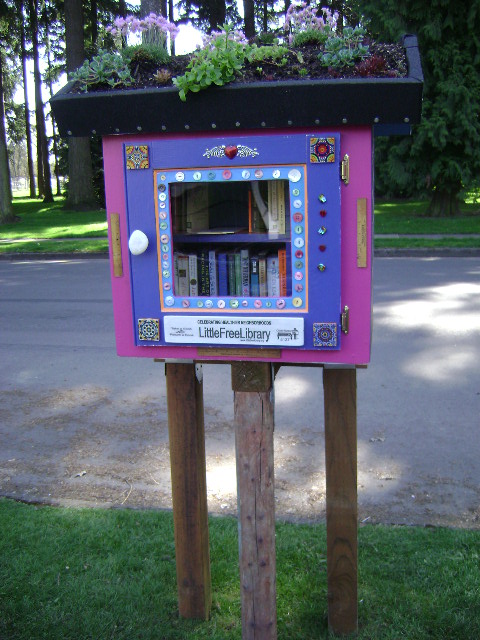
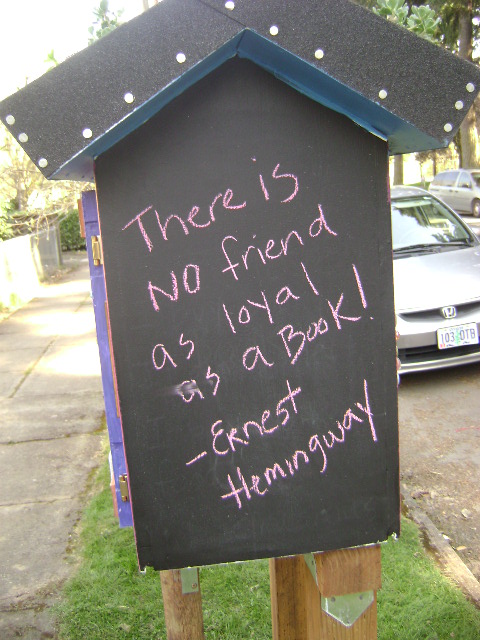
 I wanted to share with you one of the new trends in book distribution, the Little Free Library, one of which opened in my neighborhood in north Portland, Oregon. 

  
These book stations are a new development for distributing books.  In a world where everyone seems to be getting more isolated, these generous little libraries are a great antidote that help build community.  You can read more about the Little Free Library movement here:
A book is always there for you, no batteries required.

Here are links to order today’s book from Amazon.com.  I am an affiliate with them and get a small small fee at no cost to you if you order through this link.  


Head, Tails, Storks

Last week I read two very different books.  One was written last year, and the other in the 1950s.

First the contemporary one, which I found through a book review.

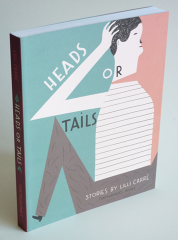
When I first picked up Heads or Tails by Lilli Carre, Fantagraphic Books, 2012, I wasn’t sure I would like it.  The strange graphic style of the cover, especially the nose and facial features, were not really a style that I liked.  But I’d heard great things about it, so I began to read and I was fascinated.  The stories are weird, dream-like and surreal, with a bit of existentialist humor.  They also reveal a remarkable compassion for characters trying to puzzle out their lives.

The cover blurb says, “…the stories contained touch on ideas of flip sides, choices and extreme ambivalence.”   In “Wishy Washy,” a judge of floral arrangements survives a car accident but loses his ability to judge and make decisions.  In “Welcome to my Kingdom” a single snazzily dressed man is increasing boxed in by the borders of his life and the page.  “The Carnival” is a ambling story that combines ideas of floods, flight, romance, family and solitude into a circular story that left me with the same feeling I get when I’ve had a particularly vivid dream.  It’s rife with meanings that I can’t quite put into words.

Which is part of the lure of this book — it’s told in ways that you can’t put into words.  The graphic elements are an integral part of the story.  It’s more than an illustrated story — it’s a dance.  There are a few sequences under the title “Short Bits” that deal with the whole dance of life — the words, the movement, what happens in reality, and what happens in our minds and hearts. In “The Thing About Madeline,” a woman finds her own double working at her customer service desk one morning.  She becomes a spy in her own life, then develops a whole new existence. In spare prose and jittery drawings, ideas of identity are deftly explored and exposed.

Then there are moments of great humor — my favorite being the last drawing The Woman With Something Stuck Between Her Teeth.

Lilli Carre won acclaim with the graphic novel The Lagoon.  Her work has appeared in The Best American Comics, 2008, and the Best American Non-Required Reading, 2010.

You can find out more about her here:
http://lillicarre.com/heads-or-tails#/t/9

Here’s a little video of how the book looks:
http://lillicarre.com/heads-or-tails#/i/10

***

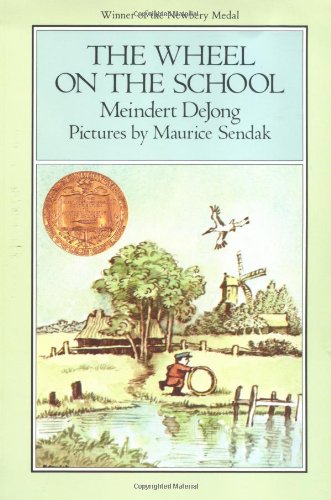
The other book I read was much more traditional.  The Wheel on the School by Meindert DeJong, Illustrated by Maurice Sendak, was published in 1954 and won the John Newberry Medal.  It’s a  novel for ages 10 and up, and is still in print.  I got mine at the library. I found it by googling “children’s book fishing village,” since I’m working on a picture book set in a fishing village.  I love the way books come to me.  It didn’t have the pictures I was looking for, but it had everything I needed in a good story.

At almost 300 pages, it is a warm, sweet book that follows a group of school children in a small Dutch village.  Lina, one of six children in the village school, wrote a paper on storks, but admitted to only knowing what her aunt from another village told her.  In that village, every Spring, people put wagon wheels on their roofs, as a foundation for a nest. “(Storks) build great big messy nests, sometimes right on your roof.  But when they build a nest on the roof of a house, they bring good luck to that house and to the whole village that that house stands in. Storks do not sing.  They make a noise like you do when you clap your hands when you feel happy and good…on your roof they are noisy.  But it is a happy noise, and I like happy noises!”

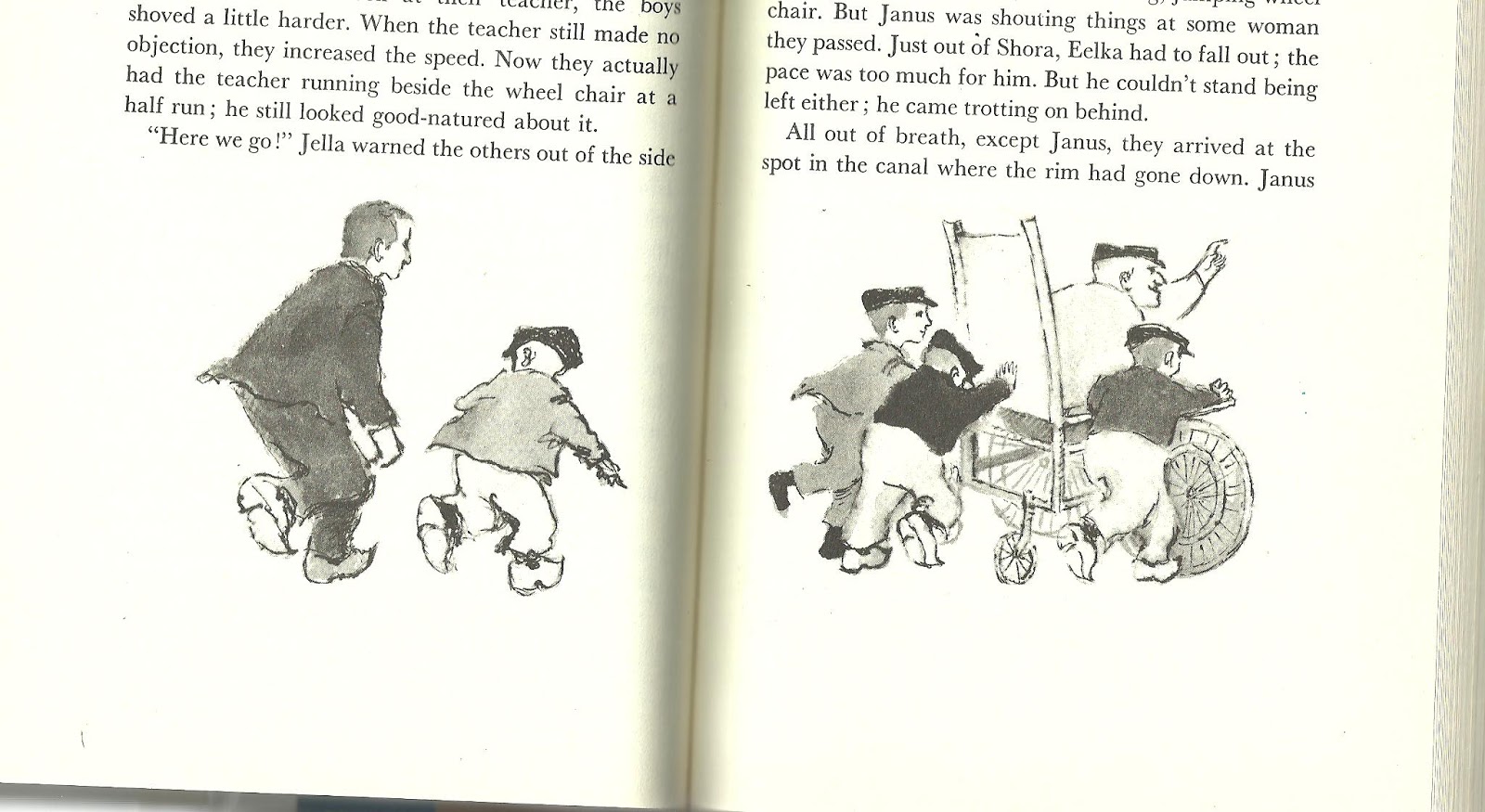
The children are instructed to try to figure out why storks no longer visit their village.  Lina finds out from an old woman that there used to be storks but the village trees had been lost in storms and no one even put a wagon wheel on their roof anymore.  What ensues is an adventure that takes each child out into the village to find a wheel to put on the school and lure a stork couple to the village.  They are told  to look “where one could be and where one couldn’t possibly be.”  In their search, they learn about their elders, their history, and their own bravery.  In a charming turn of events, they discover the meanest man in the village, who uses a wheelchair and is rumored to have had his legs bitten off by sharks,  is in fact, their best ally.  The storks begin to bring good luck even before the first ones fly overhead on their migration from Africa.

Encounters with irate farmers, terrible storms and grumpy fathers keeps the children on their toes.  Each child is developed in the course of the story and the village comes to life in the masterful storytelling of DeJong.

It was delightful to read this — it was slow paced and soothing at times, at other times an engrossing page turner.  There were moments when the children’s ears were boxed and they were paddled when I wondered if such scenes would be acceptable in a contemporary children’s novel.  There were vivid and detailed descriptions of the buildings, boats, tides, dykes and terrain — descriptive elements often left out in the fast pace of modern novels.

I loved reading it in bed with a cup of tea.  It has community and environmental themes that are very contemporary and valuable, but it has a nostalgic feel to it. The illustrations for this are very spare, rendered  in ink and wash by Maurice Sendak and add to the quaint. cozy feeling of the book.  I hope I get a chance to read it out-loud to someone someday. 

***
One more thing, I found this article on the film “Girl Rising” in this morning’s paper.  A trailer for the film is included.  It’s a documentary addressing the question “What would happen if more of the world’s 66 million uneducated girls were allowed to receive the same schooling as their male counterparts?”

I look forward to seeing it and I hope we all get a chance to help improve the lives of girls.

http://www.oregonlive.com/living/index.ssf/2013/03/girl_rising_film_championing_g.html#cmpid=9547239

I hope you get to read something wonderful soon.  Remember, books require no batteries and transport you through time and space in the most magical way.