The Bug Chicks

You know you’re living an extraordinary life when you get to the end of the day and realize you’ve had a meaningful conversation with a friend, heard great live music, and gotten to pet a Madagascan giant hissing cockroach. 

The hissing cockroach was only one of the exotic creatures I got to see and touch, thanks to Bug Chick Kristie Reddick, MS, an entomologist who brought a small collection of Amazing Arthropods to the Kenton Library here in Portland.  She’s an expert on solifuge arachnids, or camel spiders, also known as jumping spiders or wind scorpions. 
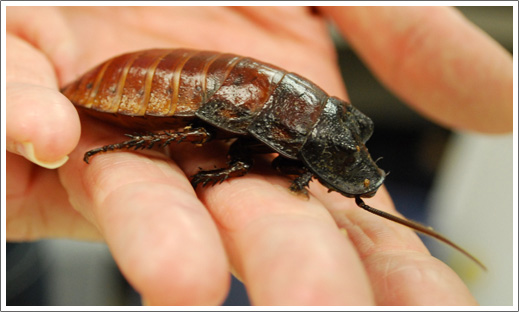
from wikipedia
The Bug Chicks teach about the world of insects and try to instill a sense of respect for these little creatures that are a vital part of our Earth’s ecosystem.  Reddick and her partner, Jessica Honaker, M.S., create fun, accurate science media.  Their sci-comm articles can be seen on NPR’s Science Friday website and their videos are teaching the next generation of entomologists and bugdorks. Throughout the year they teach in every venue imaginable- from schools and libraries to camps, museums and festivals.  Their business is located in Portland, Oregon, but they travel all over the world to film, photograph and teach about insects, spiders and other arthropods.
I had planned to take one of my young friends from BridgeMeadows to their program, but none were available, so I went by myself.  I may have been the oldest person there.  
My attitude toward bugs has changed a lot over the years as I’ve learned more about how interrelated and interdependent all beings on this planet are.  There was a time when I thought slugs (because they’re gross) and mosquitoes (because their bites itch & they carry diseases) were some kind of evolutionary mistake. 
I’ve always loved beetles, butterflies, dragonflies and moths, though. 

From Biophilia by Christoper Marley reviewed here

Then a few years ago I was given a book called The Sound of A Wild Snail Eatingby Elizabeth Tova Bailey.  It was a memoir of Bailey’s struggle with “a mysterious viral or bacterial pathogen, resulting in severe neurological symptoms…”  While the illness kept her bedridden, she observed a wild snail that had taken up residence in a pot of violets on her nightstand.  By observing the snail’s “molluscan anatomy, cryptic defenses, clear decision making, hydraulic locomotion, and mysterious courtship activities, Bailey becomes an astute and amused observer, offering a candid and engaging look at the curious life of this under-appreciated small animal.”
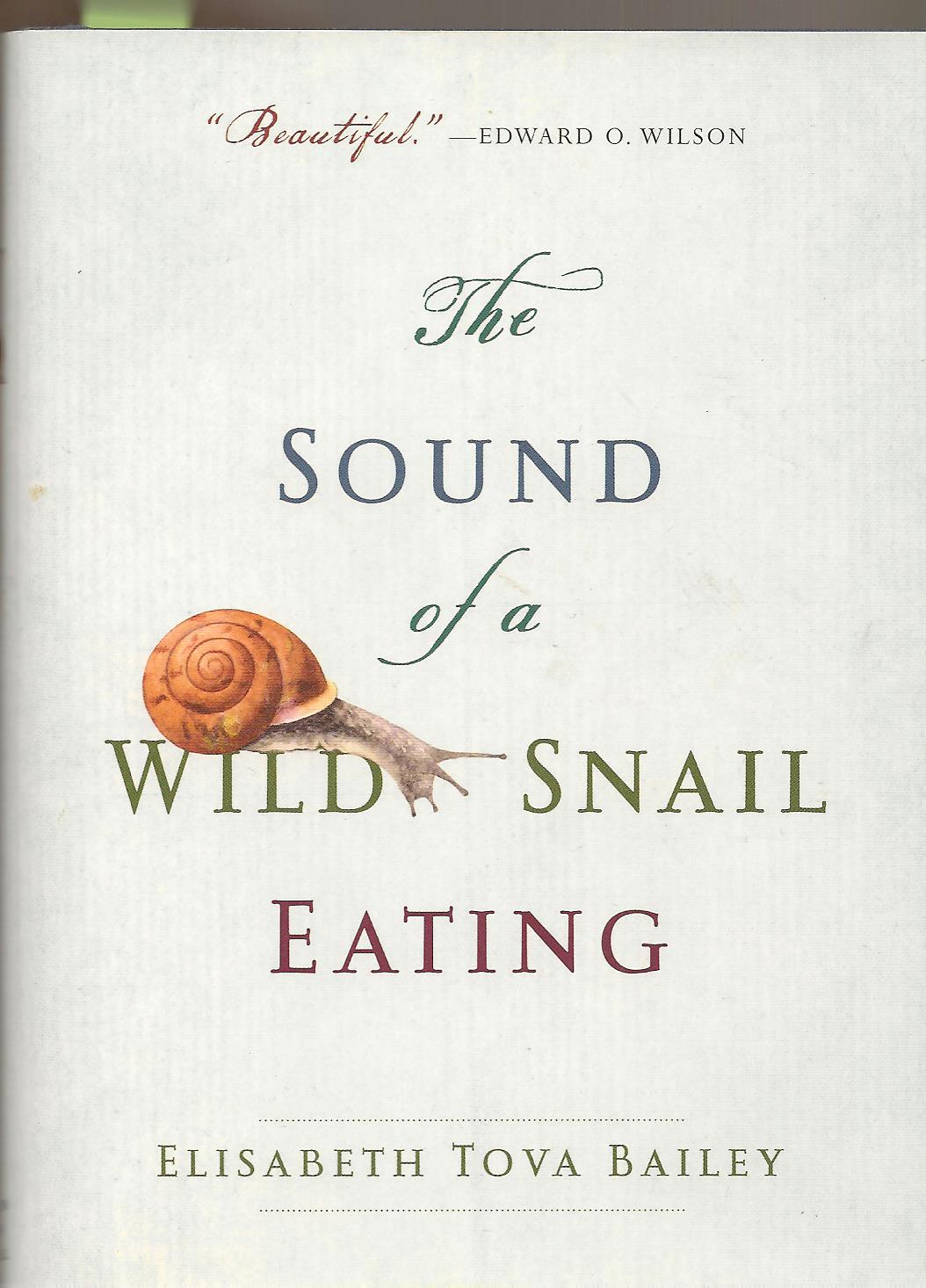
It’s lovely book.  I keep it on my anti-depressant bookshelf.  Life brims with amazing creatures and beings.  Even when we’re at our most powerless, if we are observant, we can glimpse the miraculous in the ordinary.  Nature is the ultimate teacher, and now I don’t think any living thing, even the ones that try to kills us, are a mistake.  It’s more that I haven’t yet learned enough about them and the mysteries of life and death.
That said, I don’t actually want to touch a slug, which isn’t an arthropod, but a gastropod, but falls under my personal definition of a bug.  I still swat mosquitos, and I deeply dislike cockroaches.  I lived in too many squalid infested places to ever have any respect for them.  I always hope that it’s beetles, not roaches, that will inherit the earth.
According to Reddick, though, only about 30 of the 4,000 species of roaches are associated with human habitats and only 4 of those are considered pests.  They’re probably pests more because of our own living conditions and diseases than anything they are doing by being roaches.  Still, they can’t live in my house.
I always love it when my mind is pried open a little.  That’s one reason I loved the Bug Chick’s presentation.  She was funny (you should see her imitation of a crab or a cicada) and helped us understand exactly what an arthropod is. She had us pet our own fingernails.  That’s what most bugs feel like, the smooth hard skin of our fingernails.
What impressed me the most, however, was how Reddick recognized and addressed fear.  She was great at getting control of a room of rambunctious children and took their fears very seriously.  She told us about her own fear of bugs when she was a child, but she made a conscious decision to not live in fear.  She was told she was no good at science, now she’s an award winning scientist who has discovered a new species of solifuge. 
Saying things like it’s gross, I’m afraid, and I can’t just put limits on your life.  When a child was afraid to touch the specimens Reddick gently passed around (“stroke them don’t poke them”), she would ask that child to put his or her hand under her own.  “We’re holding it together.  It’s not so scary now, is it?”
One child was absolutely resistant and said she wasn’t going to touch a bug under any circumstances. She had “a thing” about bugs.  Her eyes were wide with a deep fear, but after some gentle education from Reddick, she became enthusiastic and petted the giant hissing cockroach.
And so did I. 
When Reddick was closing the presentation, she told us not to limit ourselves and to be proud of overcoming our fears.  For a brief moment I wondered what would happen if, when I was kid, I went home and told my mom I pet a giant cockroach at the library.  She probably would have sprayed me with disinfectant and called the doctor for a thorough examination of my crazy little head.  I don’t know what she would have made of my description of the vinegar spraying uropygi. 
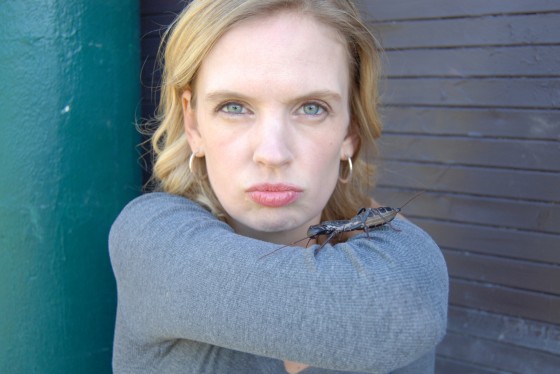
Kristie Reddick and her uropygi
Interested in learning more about the insect world?  Check out The Bug Chicks and their fun videos here.  They have a great blog with craft ideas and they also have an arthropod coloring book.
If you’re interested in learning more about the world around you, you can also look at my review of this gorgeous book on Beetles, some of the more beautiful bugs on Earth.  You can also check out books on botanists and botanical art here, the brain here, and images of the cosmos here

Whether you’re big or small, it’s an amazing planet.
Monkey Business


“Have you ever wondered why monkeys have such a reputation for being mischievous?  Well, quite frankly, it is a title well deserved…

Monkeys lie to each other.  When searching for food, monkeys often travel in groups with a leader at the front.  If this leader has a dishonest streak and discovers a delicious treat, sometimes they will tell their fellow monkeys that they’ve seen a predator.  All of the other monkeys will scatter to safety whilst the leader casually gobbles the treat alone.  Sneaky little devils!”
One of the challenging things about reading with children is that they expect you to have all the answers to their questions.  But in Mad About Monkeys, written and illustrated by Owen Davey, questions are answered before they even think them up.   This gorgeous and informative book is a delight from cover to cover. 
Fantastic and simple way to understand that humans are primates but not monkeys
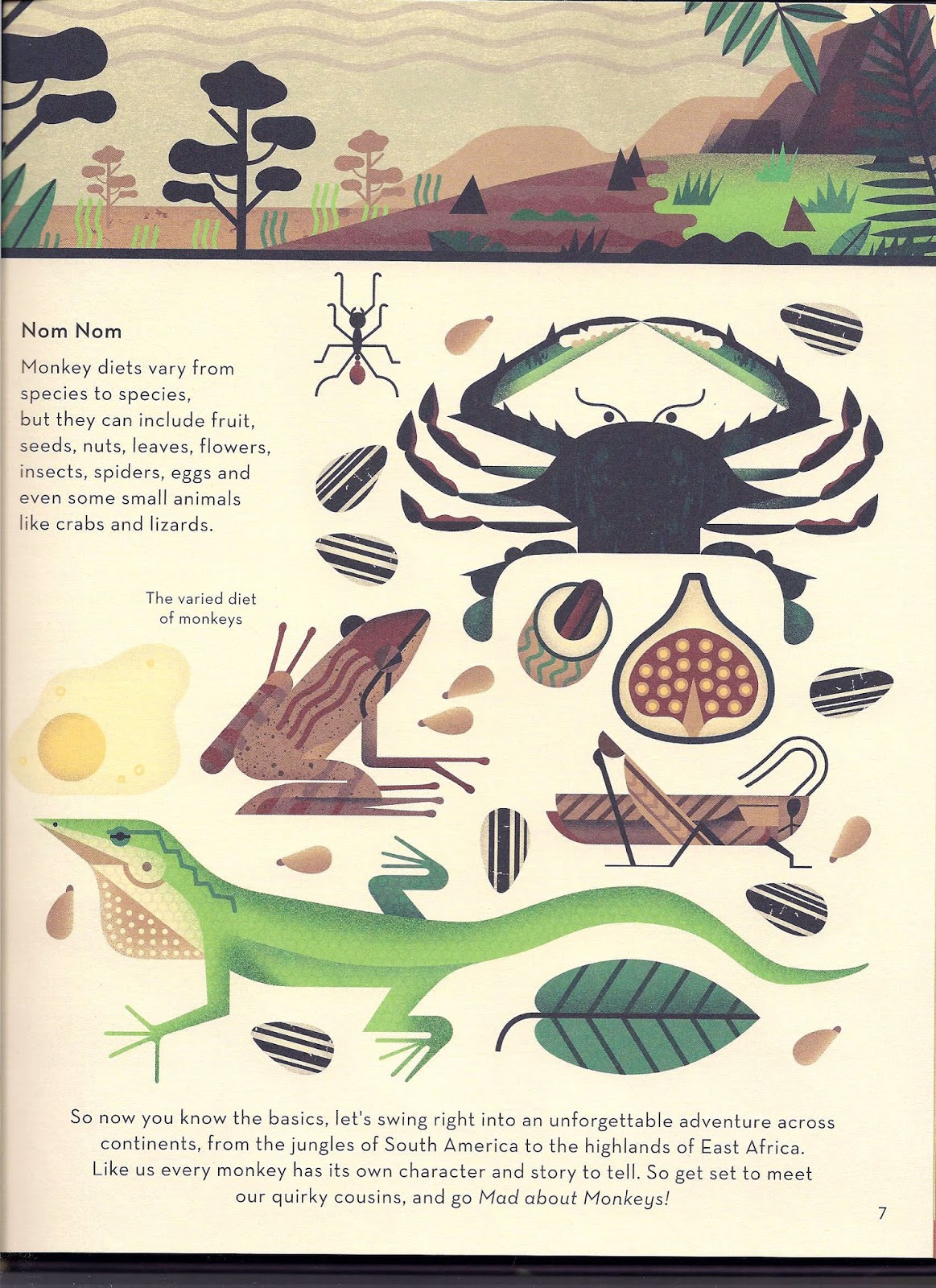
The book defines monkeys, when they evolved, their habitats and what they eat. 
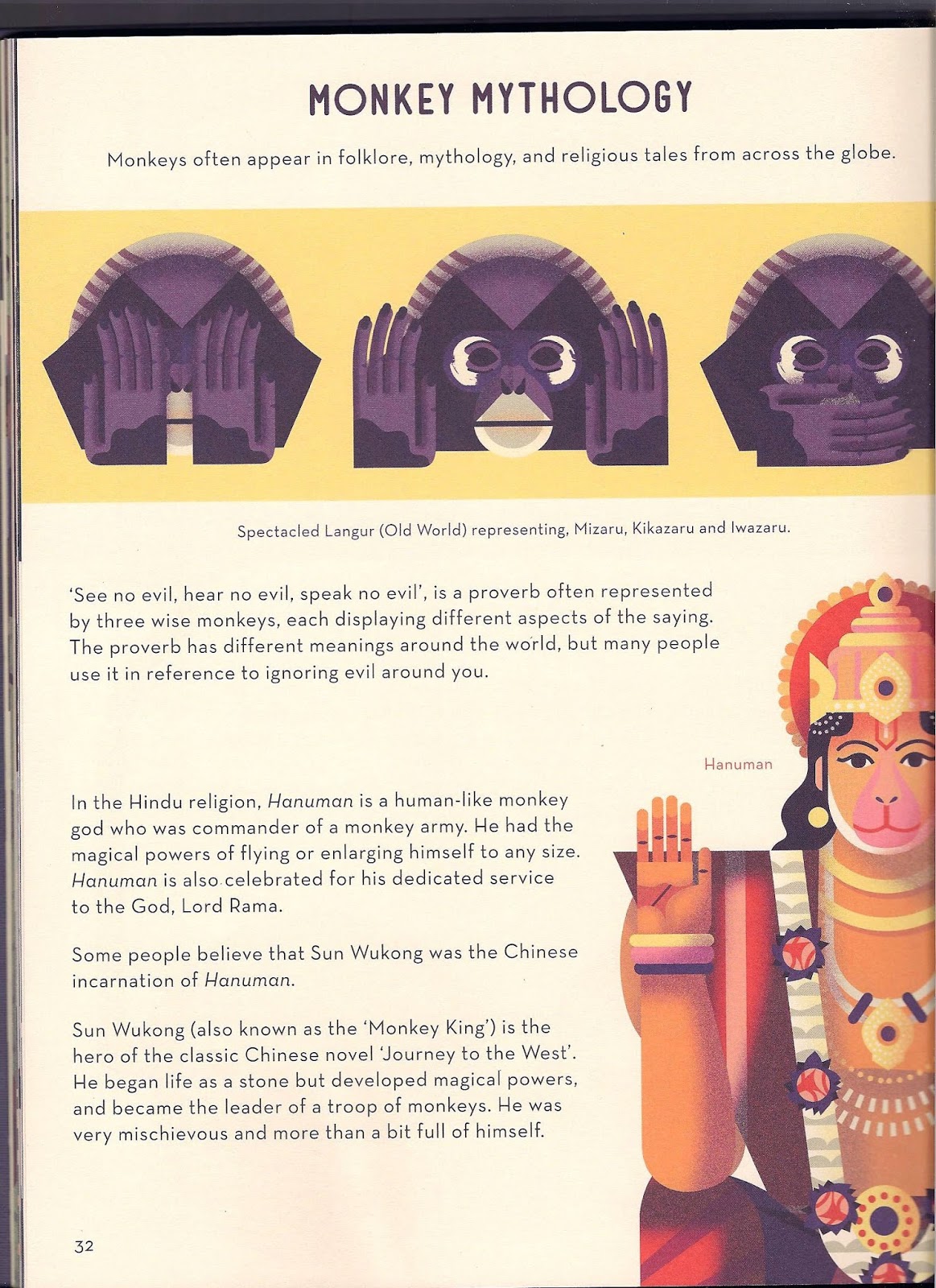
Davey’s writing style is engaging and conversational as he explains the differences between Old and New World monkeys, how monkeys socialize, their size and peculiarities.  He gives a brief look at monkeys in mythology. 
He ends with a sobering but hopeful look at the shrinking habitat of monkeys due to deforestation. 
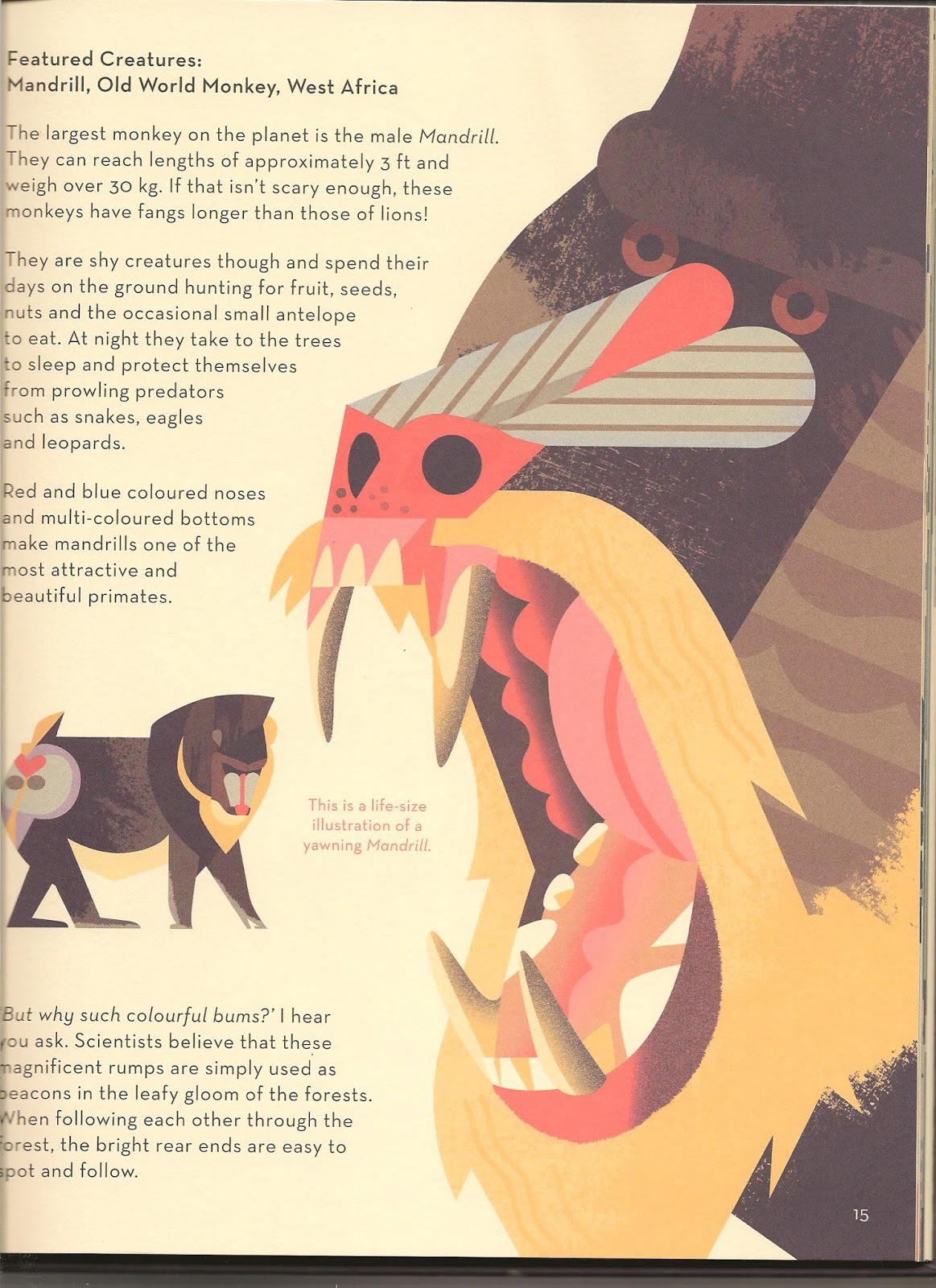
Davey even answers questions kids might be too embarrassed to ask, such as “Why such colorful bums?”  In my case, the question lead to much hilarity in discussing the difference between American and British English and the many words there are for bottoms.
The stylized illustrations are warm and detailed.  Text and pictures are interwoven, so it’s easy to get immersed in the page.  My scans do them no justice, you really must see them live — luckily that’s as easy as going to your bookstore or library.  This book would be a wonderful gift for a reluctant or avid reader — it works on many levels.
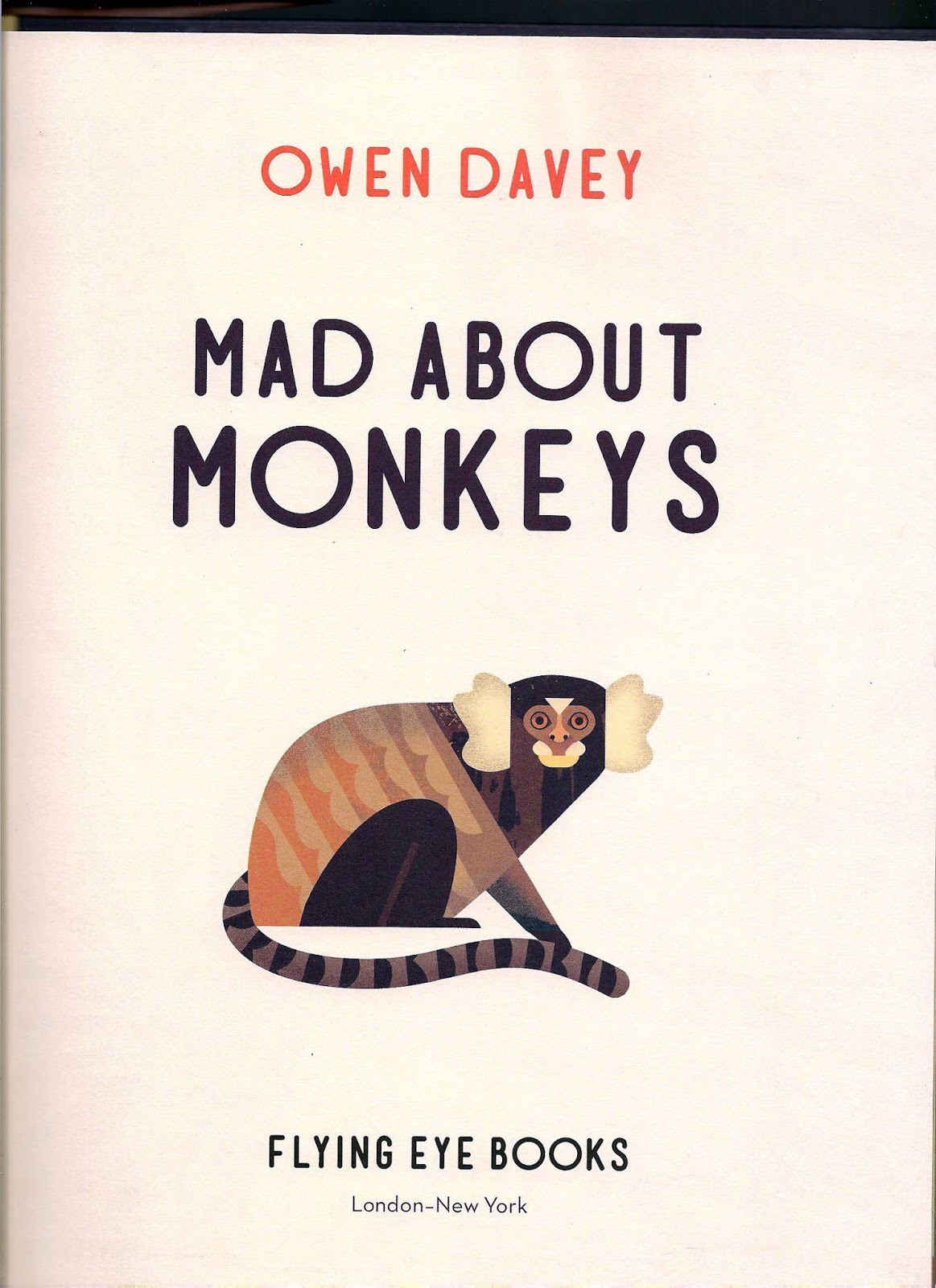
It’s published by Flying Eye, so the design is exceptional, with compelling end papers and title page.
End paper

Title Page
On his website, Davey says:
“I am an award-winning Freelance Illustrator, living & working in Leicester, UK. I have a First Class BA(Hons) Degree in Illustration from Falmouth University. I am the illustrator for the fiendishly addictive puzzle game TwoDots which has been #1 in over 70 countries. I was also the illustrator for Tinybop’s brilliantly fun Robot Factory app. My work has been published in every continent except Antarctica, including picture books in UK, America, Australia, Germany, France, The Netherlands, Portugal, China & South Korea…. In my spare time, I write and play in a band called LOM, bake cakes & quickly consume them, swim & run, play nerdy computer games, read books intended for teenagers or children, and watch a variety of HBO programmes in my pyjamas.”


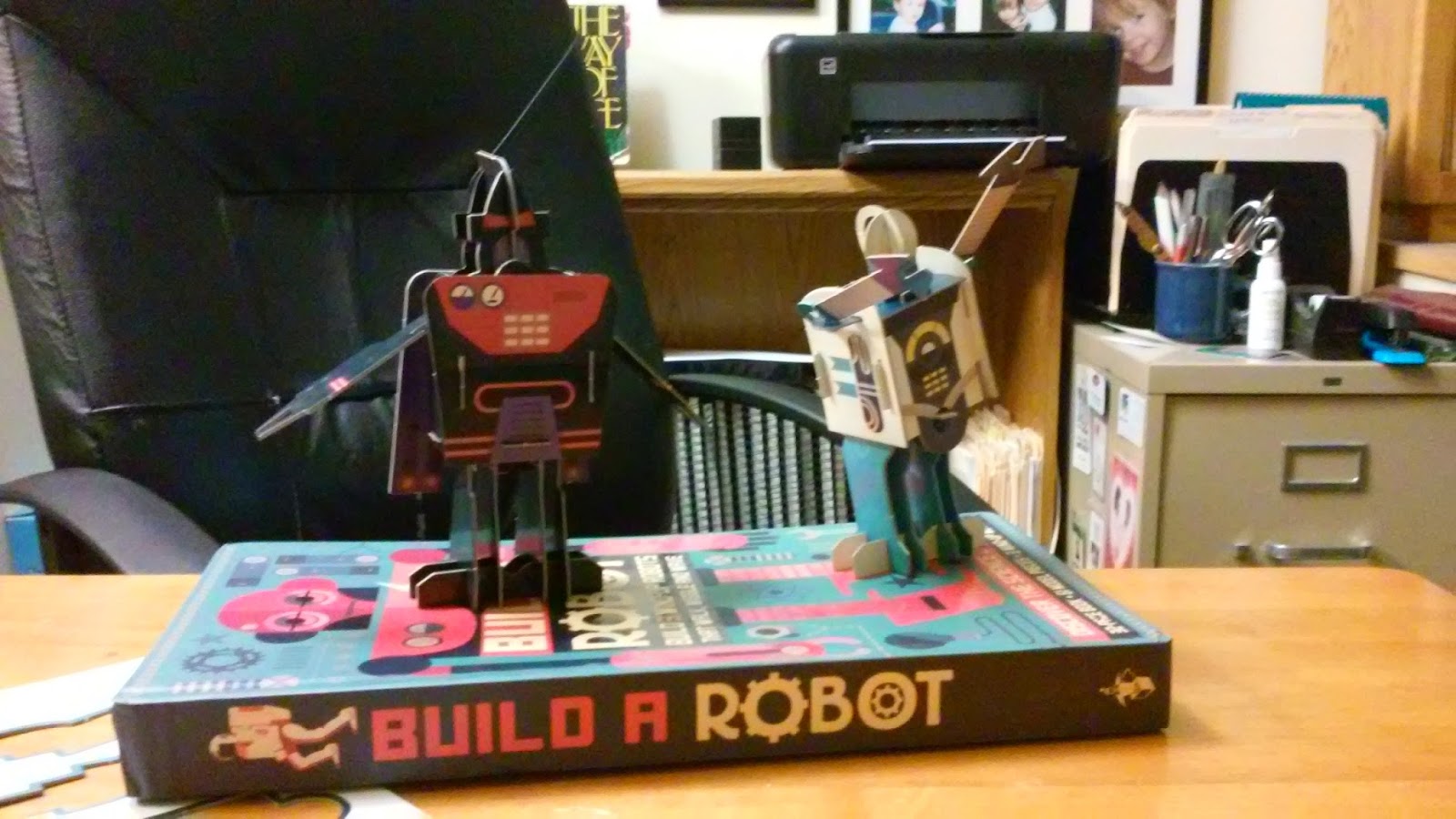
I recently bought the book Build A Robot: Build 3 Wind-up Robots That Walk, Wiggle and Wave, by Steve Parker, that Davey illustrated and designed cardboard robots for.  Published by Templar books in 2014, it was a great hit with one of my video game addicted 10 year old friends.  The book has history of robots, integrates the illustrations with the text  and it has the excellent interactive element.  So far, my friend and I have built two of the robots and he’s totally sold on the idea of interactive books – since when you finish the challenge of building the robot, it’s something real that you can play with even when your mom won’t let you have any more screen time.  And the designs are fantastic. 
From monkeys to robots, Owen Davey is definitely an illustrator and writer to look out for. 

Leif the Lucky and the Pleasure of Long Books

Cover
It’s increasingly difficult to find picture books that you can sit down and read with a child that takes more than 10 minutes to read.  I love many of these short books, and I realize that people’s relationship to time has changed, but I also love sharing a long story with a child.  
The great thing about being an older person is that I have a little more time.  Folk tales and stories of the olden days are a particular pleasure to share because it gives the child a chance to ask lots of questions.  It’s also pleasure to introduce them to black and white illustration and different ways of using color.
I was delighted to see that the University of MinnesotaPress has reprinted 1941 book, Lief the Lucky, by Ingri and Edgar Parin D’Aulaire.  A big gorgeous book that tells the Norse folktale of Erik the Red and his son Leif the Lucky, and how they discovered Greenland and North America. 
I often get books by mail, and when this one came in, I opened it in the lobby of my building.  One of my ten year old neighbors here at Bridge Meadows saw me opening the package, saw the cover and wanted to read it with me immediately.  (Bridge Meadows is a community that supports families adopting children from the foster care system, so it’s not unusual for me to have encounters with bored kids.)
I had the book, I had the time.  And I was as taken by the gorgeous and inviting illustrations as my friend was.  We sat in the alcove in the lobby where there’s a couch and we were both transported to an enchanted past, discovering uncharted lands, learning about the tribal nature of Norsemen and their customs. 
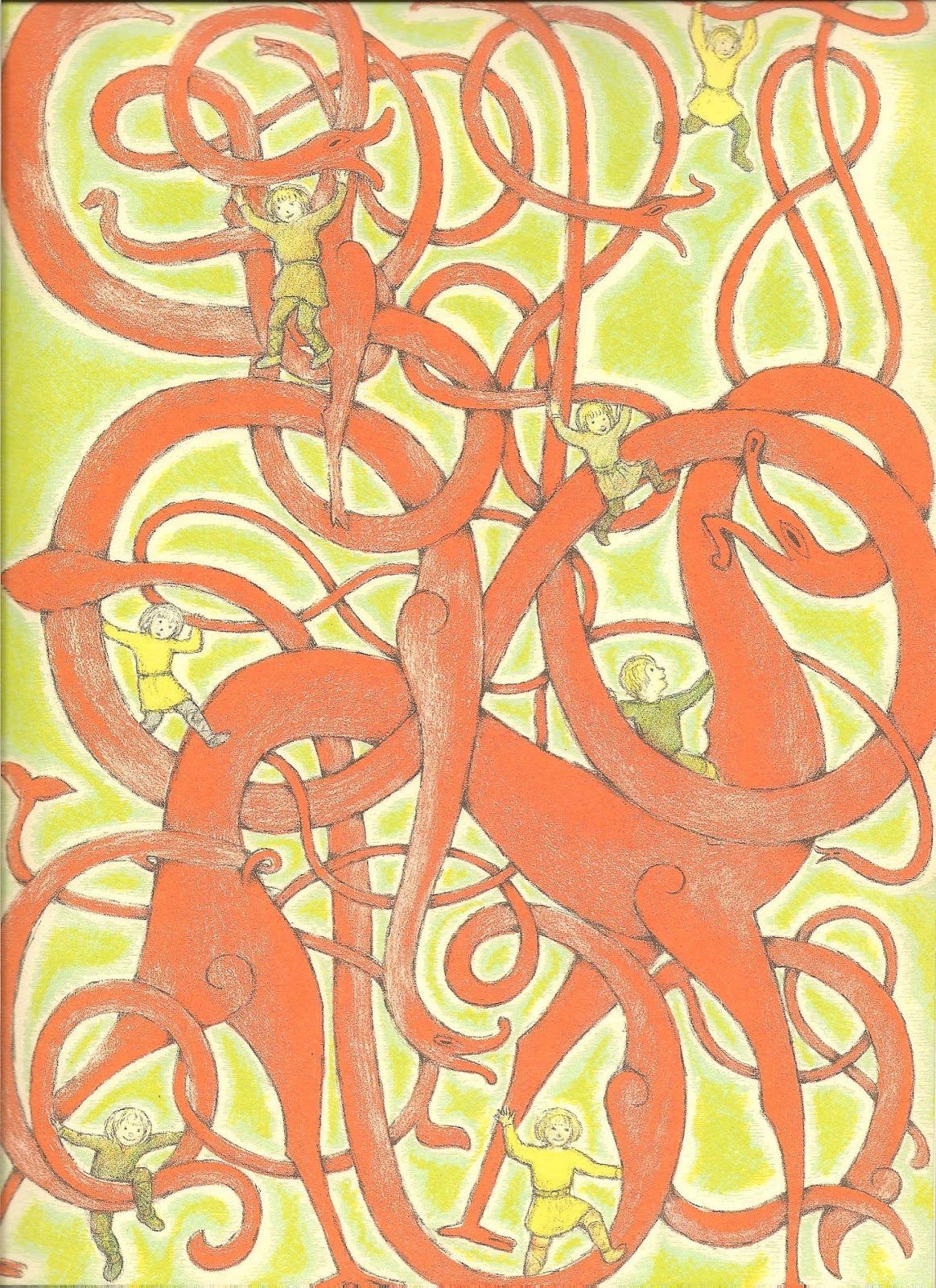
End paper

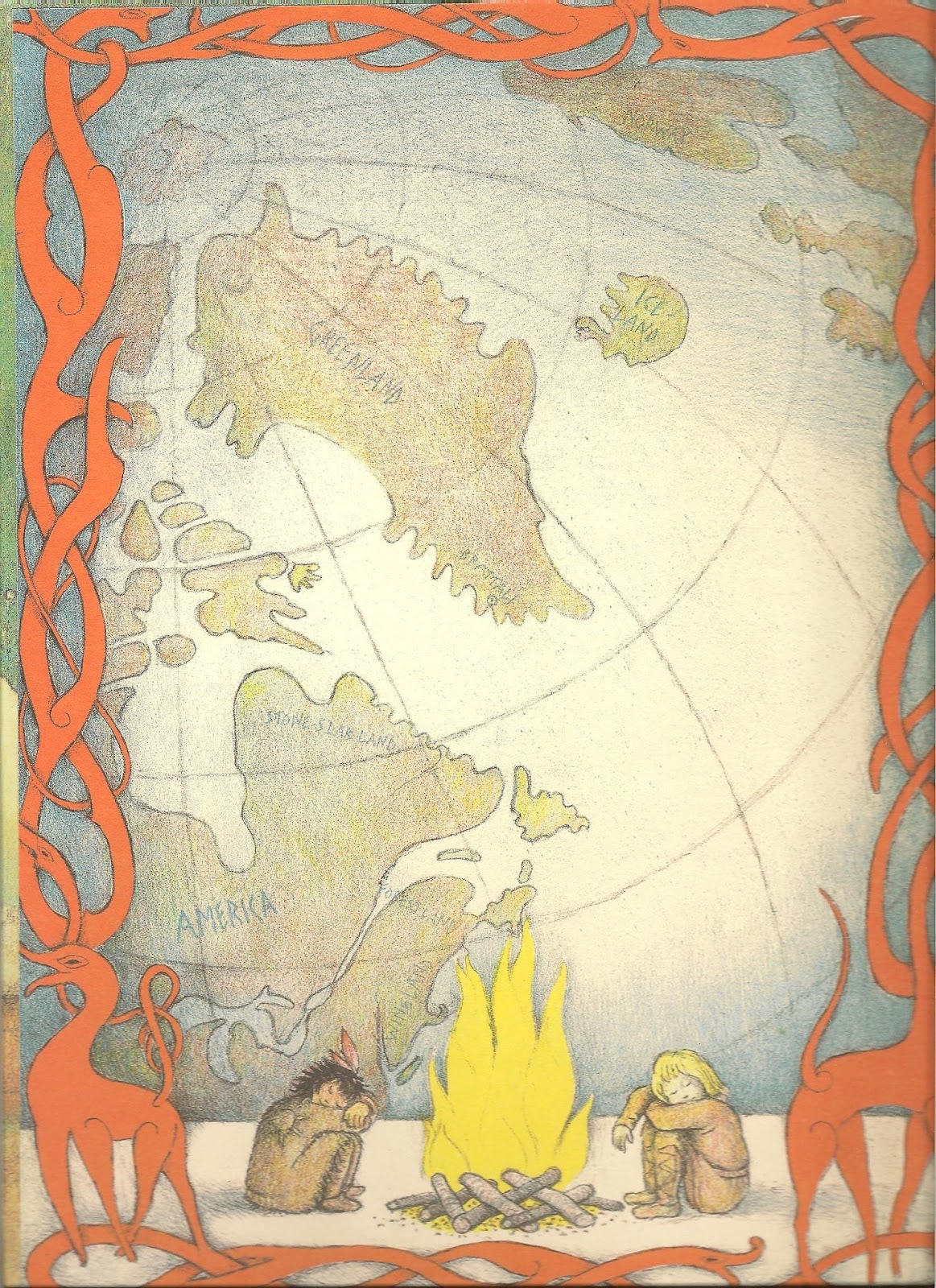
End Paper
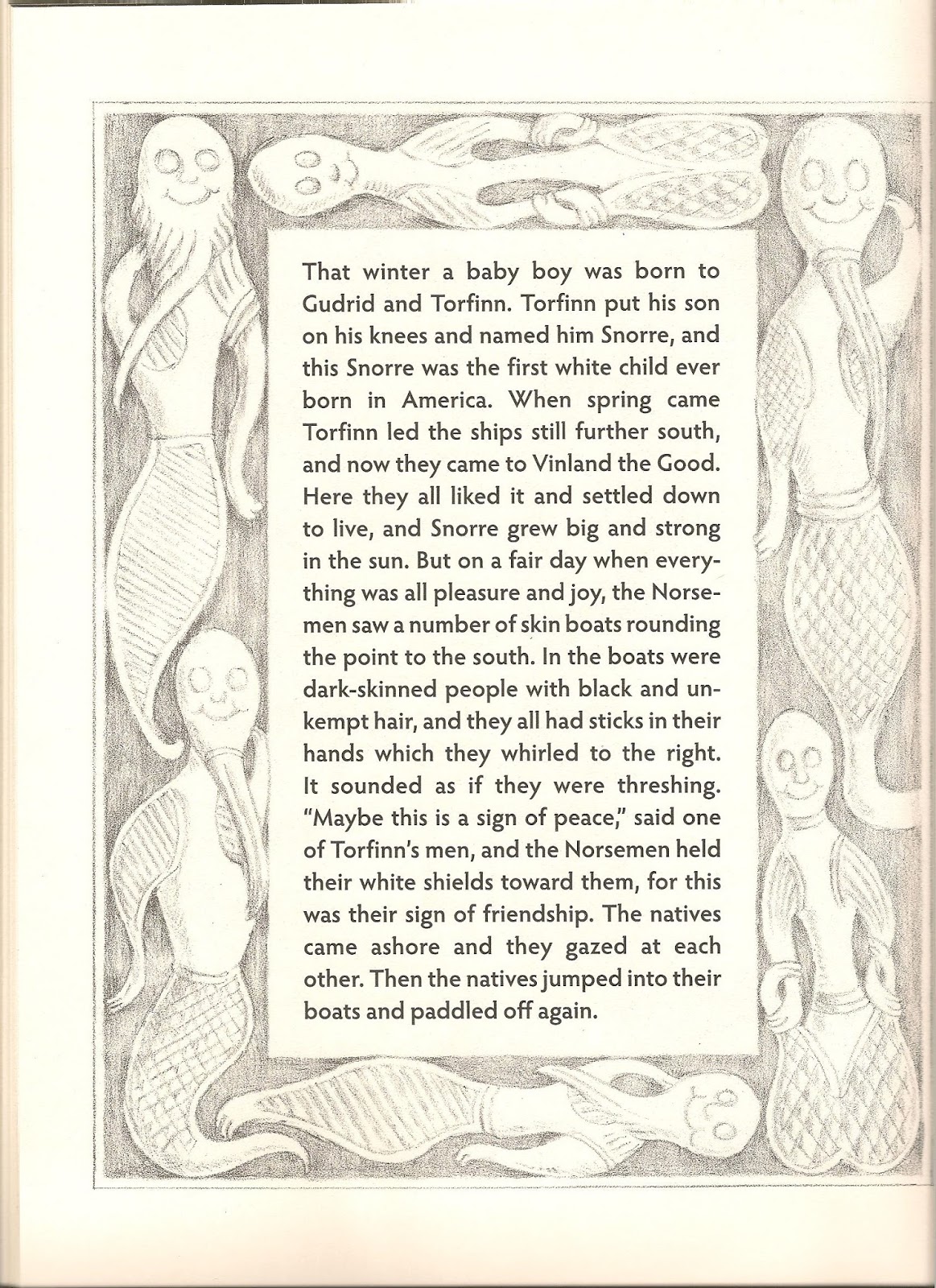
Leif was raised by his father in Greenland, where he wrestled with polar bear cubs, watched the Norse gods race in the glow of the Northern Lights, then sailed out on his own.  He bestowed gifts to King Olav and on the way back he discovered “a beautiful land with forests of strange trees growing all the way down to the shores.”  The encounters with Skraellinger, the dark men, of this “Vinland,” were at first peaceful, but soon things degenerated.  The D’Aulaire’s poked a bit of fun at the battle that sent the Norsemen back home.  We also are told how some Norsemen evolved into Eskimos. 
The illustrations are breathtaking throughout the book.
About every other page, my young friend asked a question.  Why did they need to take the dragon head off the boat?  What are Northern Lights?  
Why did the king punish the man for eating after the king had stopped?  We were introduced to strange new words and images. 
I was so glad I took the time to read this book to my young friend.  I know he has a mild case of dyslexia and attention deficit disorder, so sitting with him, involving him in a longish (60 pages) book was more than magical.  I was so pleased to hear him request more books like this.
We were both amazed by the illustrations.  I wondered if they were pencil sketches with watercolor, but the technique was a little more complex than I knew.  I got this information on the D’Aulaire’s on the New York Review Books website: 
Ingri Mortenson and Edgar Parin d’Aulaire met at art school in Munich in 1921. Edgar’s father was a noted Italian portrait painter, his mother a Parisian. Ingri, the youngest of five children, traced her lineage back to the Viking kings.

From around 1960, Wikipedia
The couple married in Norway, then moved to Paris. As Bohemian artists, they often talked about emigrating to America. “The enormous continent with all its possibilities and grandeur caught our imagination,” Edgar later recalled.
A small payment from a bus accident provided the means. Edgar sailed alone to New York where he earned enough by illustrating books to buy passage for his wife. Once there, Ingri painted portraits and hosted modest dinner parties. The head librarian of the New York Public Library’s juvenile department attended one of those. Why, she asked, didn’t they create picture books for children?
The d’Aulaires published their first children’s book in 1931. Next came three books steeped in the Scandinavian folklore of Ingri’s childhood. Then the couple turned their talents to the history of their new country. The result was a series of beautifully illustrated books about American heroes, one of which, Abraham Lincoln, won the d’Aulaires the American Library Association’s Caldecott Medal. Finally they turned to the realm of myths.


The d’Aulaires worked as a team on both art and text throughout their joint career. Originally, they used stone lithography for their illustrations. A single four-color illustration required four slabs of Bavarian limestone that weighed up to two hundred pounds apiece. The technique gave their illustrations an uncanny hand-drawn vibrancy. When, in the early 1960s, this process became too expensive, the d’Aulaires switched to acetate sheets which closely approximated the texture of lithographic stone.
In their nearly five-decade career, the d’Aulaires received high critical acclaim for their distinguished contributions to children’s literature. They were working on a new book when Ingri died in 1980 at the age of seventy-five. Edgar continued working until he died in 1985 at the age of eighty-six.
This book will delight anyone interested in book arts and illustration.  The University of Minnesota has also republished the D’Aulaire’s Children of the Northlights, and Ola, both of which I look forward to.  
Leif the Luckyis a great book to share with someone on a cold winter night, or a warm summer one, or in an apartment lobby, where it might transport you to a new world, an old world, and a place of enchantment.  

Delta Jewels Review

I fell in love with the book Delta Jewels from the moment I saw the cover, the sweet face of Mrs. Annyce P. Campbell, age 90, staring out at me with an expression both welcoming and reserved, with both sorrow and joy in her eyes. 
Delta Jewels: In Search of My Grandmother’s Wisdom – Portraits and Interviews with My Eldersby Alysia Burton Steele, (Center Street Books, 2015) is a deep warm look at elder women of the Mississippi Delta. 
I lived in Memphis for the first 46 years of my life.  Memphis is really more North Mississippi than Tennessee.  I’ve never driven, so I rode the bus a lot.  It always amazed me that it was the elder Black women on a crowded bus, who, seeing my limp, would quickly give up their seats for me.  I told them I was fine, but they kindly and firmly insisted I sit myself down.  
There’s something in Mrs. Campbell’s face gazing from the book that reminded me of those kind women who showed great dignity in everything they did.
Steele says
“My paternal grandmother died in 1994.  Although I’ve taken photos since I was fifteen years old, I never thought about taking Gram’s photo or recording her voice.  Those were the days before cell phone cameras!  I thought there would be more time, but instead I took her for granted.  I’ve missed her increasingly over the years.  Time didn’t stop my brain from trying to remember, having regrets, wondering what I could have done to preserve every single thing about her, before she became a shadow of a memory.

I could honor – and perhaps recapture – her memory by recording stories from other women of her generation, I thought, so I began to interview and photograph grandmothers in Mississippi, my new home state. 

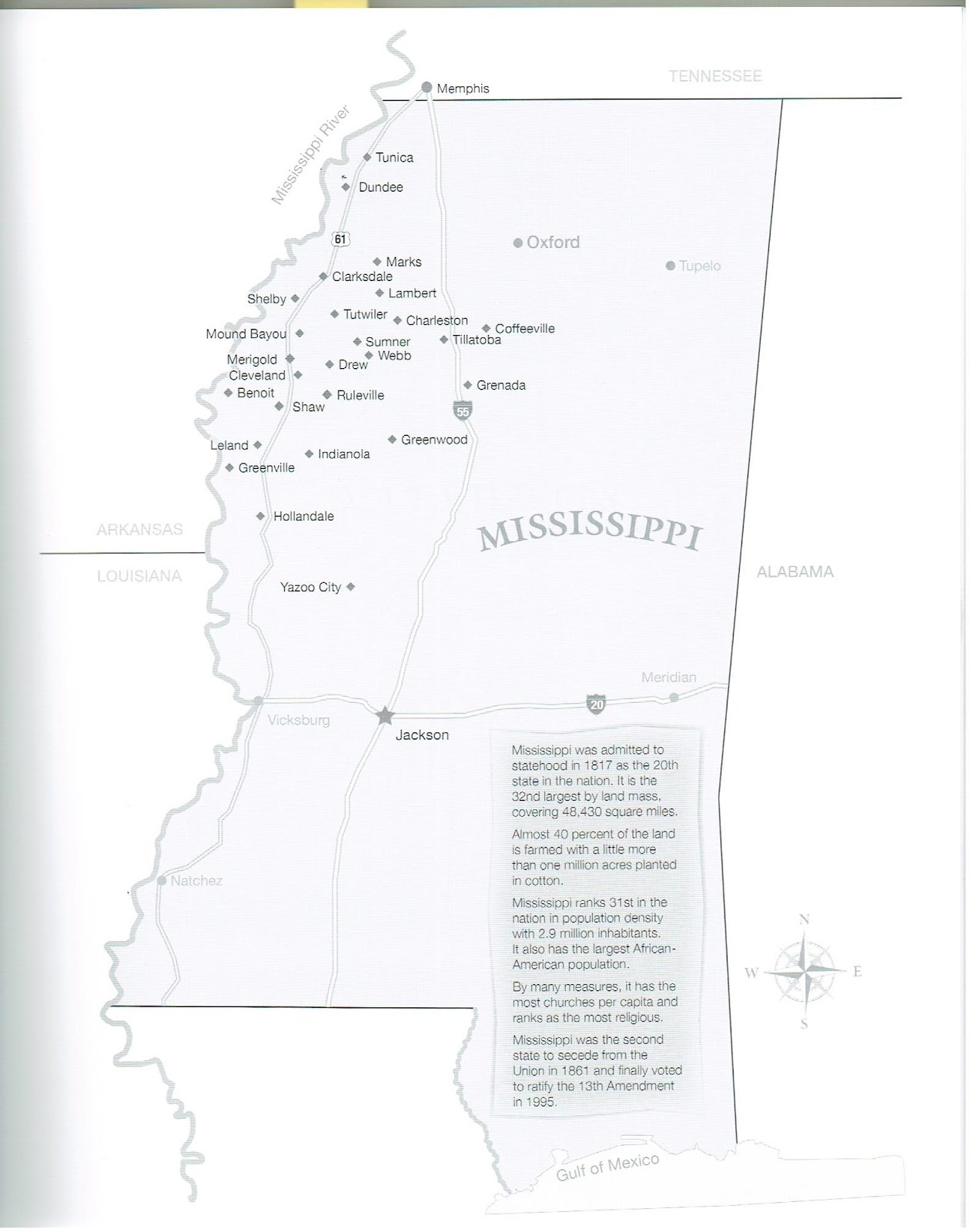
From Mississippi Delta National Heritage Area and Delta Center for Culture and Learning 
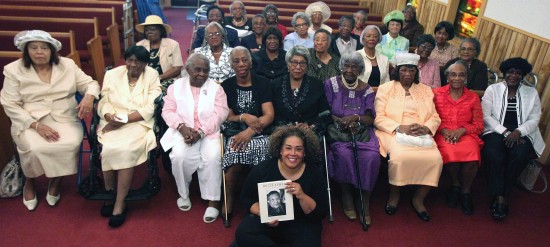
These Delta Jewels are matriarchs of their families, like my grandmother.  They are church women, female elders, living witnesses to history.  They are ordinary women, who have lived extraordinary lives as they courageously faced the injustices of the Jim Crow era and experienced the hard-won changes and victories of the Civil Rights Movement.

I now have more than fifty grandmothers who have revealed to me the significance of being a woman – child, daughter, sister, wife, mother and grandmother.  They’ve helped me — a biracial woman born to an interracial couple – embrace and understand more of my black identity.  These Delta Jewels, photographed and portrayed here in their own words, provided me with wisdom and strength to engage the world with power and to encourage the next generation.”

Steele weaves her own story through the book and so it becomes and odyssey of identity as a well as a tribute to grandmothers.  Steele’s writing is lively, personal, and gracious.  She doesn’t keep a detached distance from the women she interviews.  

The voices and history of elderly Black women in the Mississippi Delta are particularly poignant and important.  As we still struggle to become a nation that respects every American, it’s vital to capture the history of people whose voices have largely been ignored.  
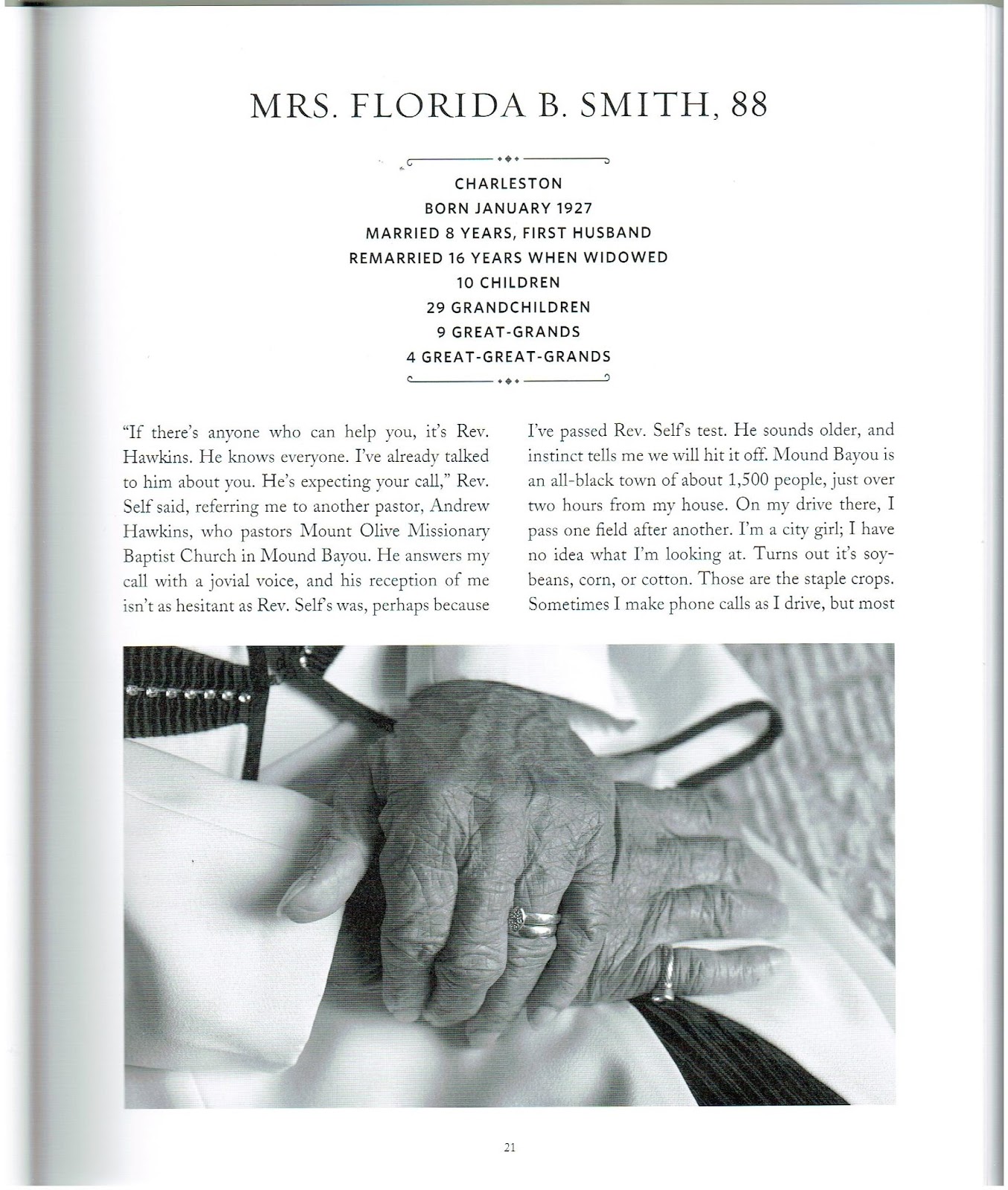
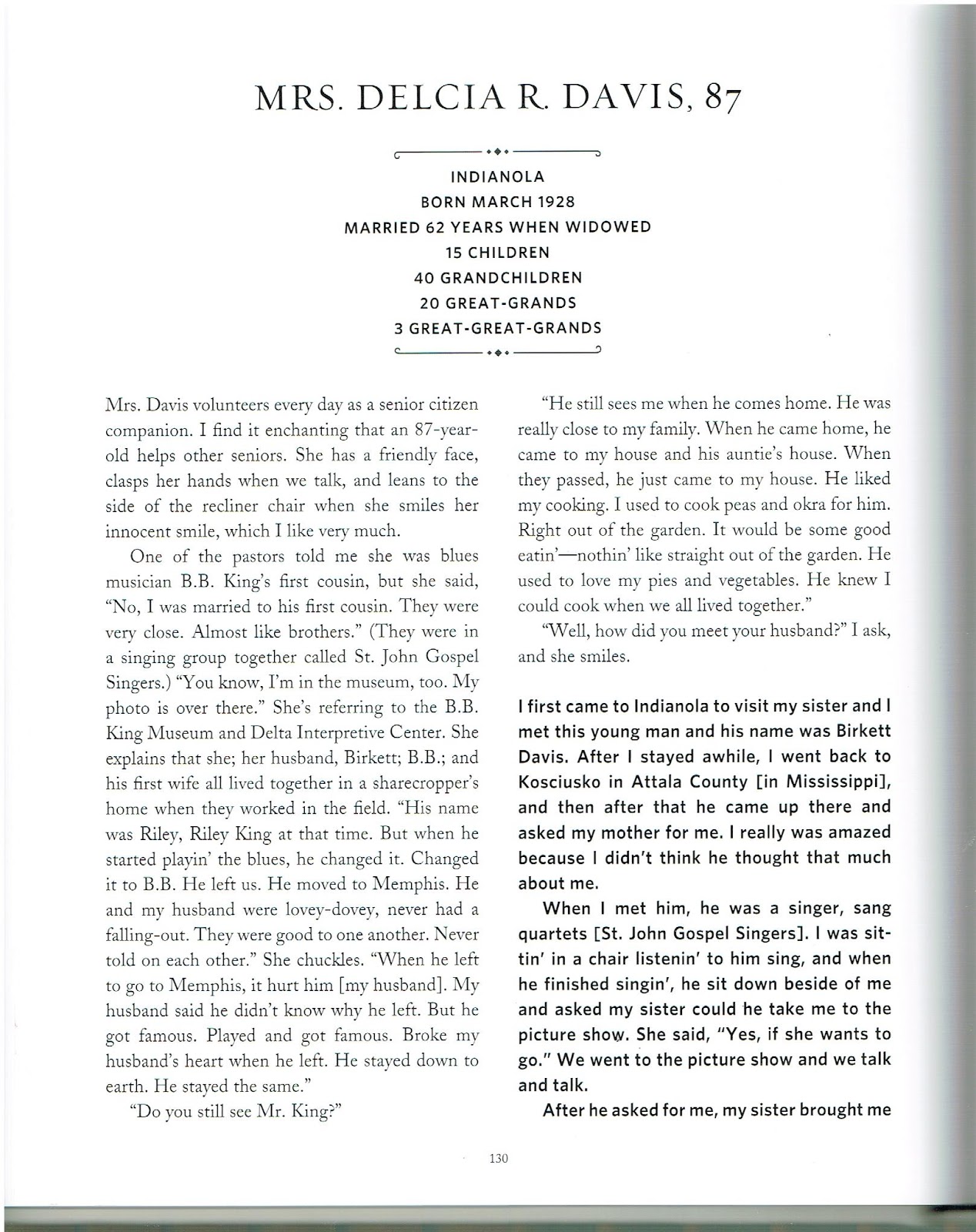
These are endangered stories that need to be preserved so that we can see where we came from and what the future might hold for us.  These women have shown grit, determination, and faith.  They’ve faced turbulence all their lives, without the blinders we have now that we are saturated by technology.  We’re a richer nation because of them. Take the story of Mrs. Delcia Davis.  You can click the pictures to enlarge them:
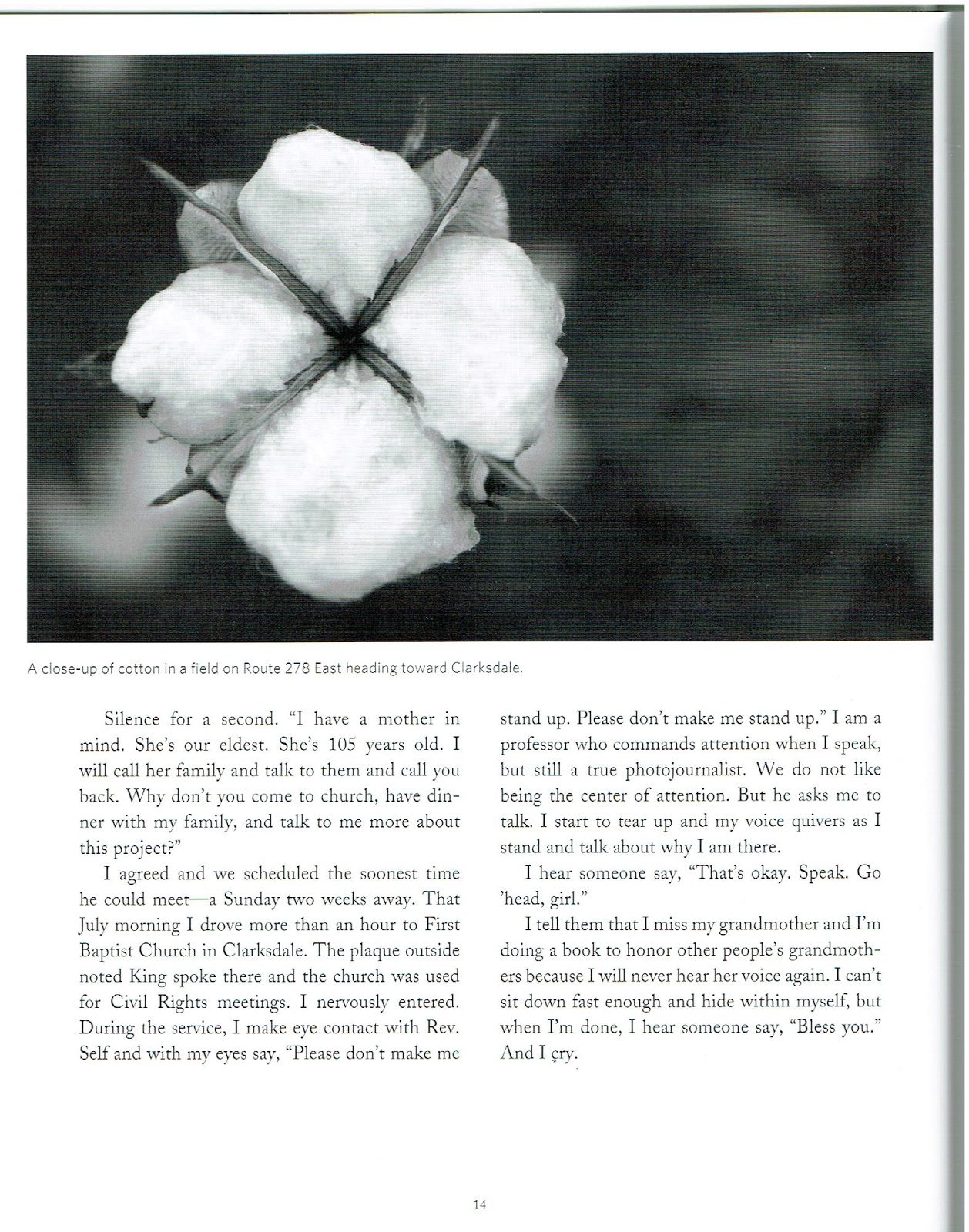
I love the black and white photography and the presentation of each jewel’s story.  Some of the photographs are full page, some are tucked into corners of the text — it’s a lovely and elegant book. Here’s a video trailer where you can hear and see more: 
Alysia Burton Steeleis an award-winning photographer and author.  In 2006 she won a Pulitzer Prize as part of the picture editing team with The Dallas Morning News for their coverage of Hurricane Katrina.  Steele is currently an assistant professor for The Meek School of Journalism and New Media at The University of Mississippi.  Born in Harrisburg, Pennsylvania, she now resides in Oxford, Mississippi.

You can read more about her and the Delta Jewels on her website by clicking here.
Love & history are powerful things