<!–[if !mso]> st1\:*{behavior:url(#ieooui) } <![endif]–>
Back in the late 1980s, produced a radio program called Reading Aloud Here, for Memphis Community Radio. I got a chance to do an interview with the Chilean-born writer
Ariel Dorfman.
He predicted that the comic book would be the most popular form of literature in the future.
It combined language and images so that people with limited reading skills could still enter the world of books.
Although he liked the idea, it seemed a grim prediction because my hope was that people would become more literate not less.
But I had to admit, I really enjoyed the cartoon histories that
Larry Gonick created.
Now, some 30 years later, with the explosion of graphic novels and illustrated books, I am delighted that the language of pictures is becoming a part of literature.
After all, the first books were illustrated and illuminated.
Of course, we can all make pictures with our minds and sometimes that’s the most sublime way of enjoying a story. But I love art, especially narrative art and illustration. I’ve long thought some of our best contemporary artists are working in the field of children’s illustrated books. I am delighted that the world of illustrated books is expanding into more mature stories.
Which brings me to the exquisite
Little White Duck: A Childhood in China by Na Liu and
AndresVera Martinez, published in 2012 by Graphic Universe, a division of Lerner Publishing Group.
This is a wonderful book for older children and readers of all ages.
It’s a series of stories about the author’s childhood growing up with her sister in Wuhan, China in the 70s.
The first story pulls you in with a dream sequence of Da Qin – Big Piano, and Xiao Qin – Little Piano, flying a giant golden crane over the muted city rooftops.
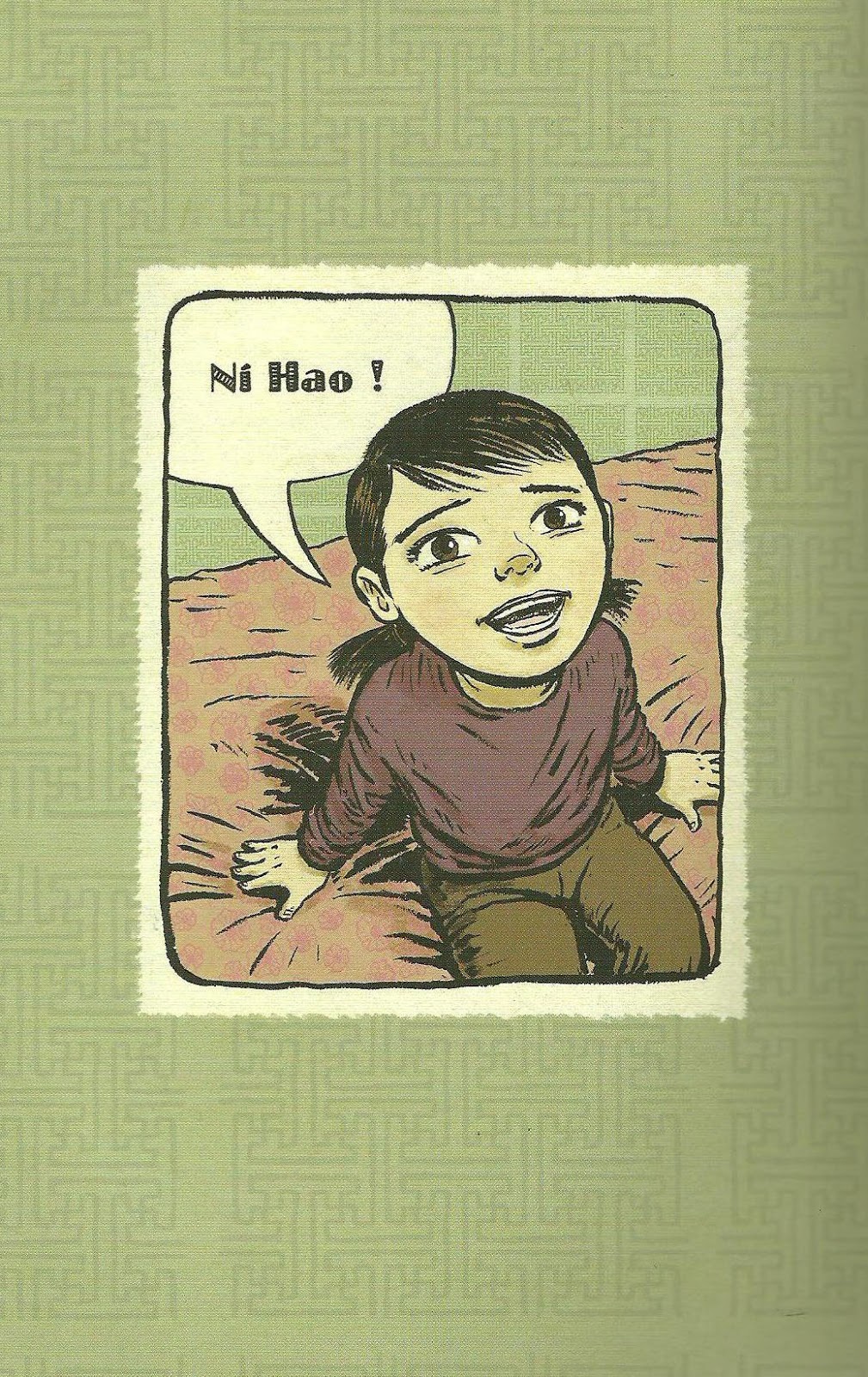
Na invites you in with a friendly “Ni Hao!” and explains why she is called Big Piano. “Children are hardly ever called by their real names. All children are given nicknames…because it was thought that bad luck and spirits couldn’t find you if your true name was never spoken out loud. Everyone calls me Qin.”
Though the stories are set during a time of turmoil for China, the child’s eye perspective keeps it from being maudlin or severe. The girls are loved by their parents, they want to be heroes, they want to have adventures, and they have lots of lessons to learn. Their sweetness shines through the beautiful muted watercolor and ink illustrations of Martinez.
Although the children seem to be “poor” – with outdoor plumbing, modest homes and very basic furniture, we come to understand through the stories how the family is rich – not only in the love that they share but in contrast to the peasant life of their parents.
“Don’t Waste Your Food – Children are Starving in China,” tells the parents’ tales over the dinner table as the girls are reprimanded for not finishing their rice. The children starving in China are not remote foreigners, they are beloved relatives. The fragile relationship between modern China and peasant China is again beautifully told in the final story of the “Little White Duck.” Da Qin has a fine warm jacket with a beautiful white duck appliqued on it. On a trip to her father’s village she comes to understand how much of a luxury it is.
Na Liu’s short biography in the back of the book tells what it was like growing up in Wuhan in the 70s as China slowly began to open up to the world. “My parents grew up during a time when Chinese leaders wanted to put an end to old traditions and replace them with a nation where all people are treated equally. My parents benefited from the changes that took place. My sister and I are from a newer generation…under the surface, my childhood stories reveal the drastic shift from how my parents grew up to how children of China live today.” Her storytelling is engaging and spare. It works seamlessly with the illustrations.
This is a “new world” sort of book in many ways. The graphic novel format sets it apart, as well as the weaving together of history and personal story. It’s also a collaboration between the author and her husband. Na Liu is a doctor of hematology and oncology. She moved to Austin, Texas, in 1999, to work as a research scientist for MD Anderson Cancer Center. In Austin, she met and married the illustrator Andres Vera Martin. He was raised in Austin and has created comics and illustration for Scholastic, Simon & Schuster, CBS/Showtime, and the New York Times. The couple lives in Brooklyn, with their daughter, who inspired them to write this book.
“My husband, Andres, says he loves to hear stories about my childhood…’It’s stuff I can’t learn in books.’”
They talk about their process in an interview at the
School LibraryJournal website, “Whenever he talks to someone, he wants to know all about them. He was curious about my family stories. I don’t think many children know what was going on in China at that time—it wasn’t an open society.”
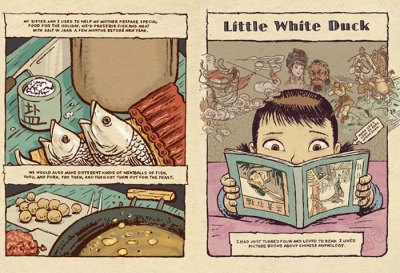
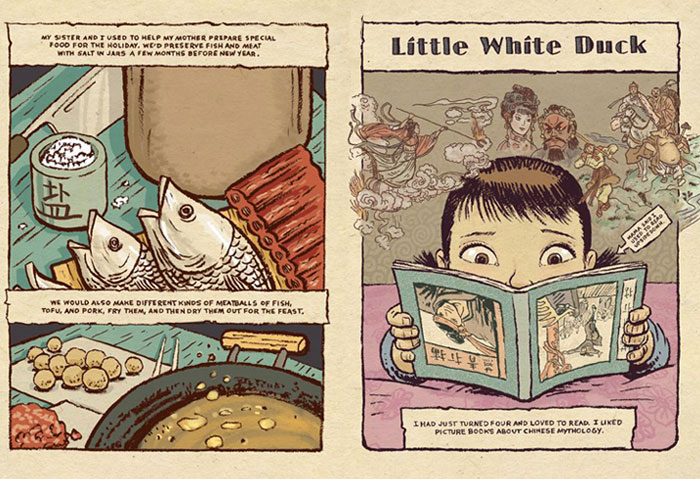
Martinez’s palette for this book is muted and subtle with moments of brightness. I particularly love the way gray skies sometime glow with the hint of sunlight. The girls are drawn with big expressive eyes and round faces. They exude energy. In the “Four Pests” and “Lei Feng Day”stories there are wonderful reproductions of Chinese educational posters. Grim pictures of famine, peasant life, sparrow and rat hunting, are elevated by the detail and comforting use of color. The details of everyday life pull you right into the story. The panels lead readers into strange circumstances then back to the tender relationship between the girls, their parents, and their dreams.
We get so much of our information on other cultures through news of conflict. Our understanding of other governments is often skewed to our own sense of how life “should” be. This is a clear window into a culture that seems so different from our own. The universal themes of love, and of family, resonate subtly through the work like a dream, like the viewpoint of a golden crane where perspective isn’t limited by borders.


 st1\:*{behavior:url(#ieooui) } <![endif]–>










 joy murray art~stories~life