Diminished Scale

I’m still somewhat in a daze after the death of my mother.  The veil between life on earth and the afterlife still seems thin.  It’s a time of growth, contemplation and reconnection.  So much love is available to me through my friends and family that I am unable to write clearly about it.  I spent a week in Memphis where I’m from and where my mom spent her entire life.  Everything flowed together like a golden river — grief, affirmation, and growth. 

I got back home to Portland, Or,  the day before Valentine’s day, which is my wedding anniversary — 3 years and still on our honeymoon.  My husband was so great — he had vacuumed and cleaned the apartment, bought flowers and made himself available to my every need.  We had a subdued celebration of our love with moments spent honoring my mother.

 It happens that the Portland Jazz Festival occurs in February, so we went to see an interview/masterclass with pianist Barry Harris last night.  I sketched while he talked and realized it’d been almost 2 weeks since I’d done any drawings from life.

I decided to post this sketch of Mr Harris for Paint Party Friday as my work in progress — my sketchbook, which will never be more than a work in progress.

Mr. Harris is 84 now, slightly stooped from age, but exudes an ephemeral strength.  He’s a kind and forthright teacher, with a great love of  jazz.  He said it hurts him when he goes to other countries and sees musicians that sound better than Americans — “Jazz is our music.”  We should always be the best — this was his way of urging students to practice, practice and learn the standards.  He was very clear that musicians, even if they weren’t accompanying a singer, should know the lyrics so they know more meanings of the songs. 

I usually don’t post my quick sketches of people because I worry that I don’t capture them accurately.  But this week I am not so much concerned with accuracy as I am with energy, and in this pencil sketch, I like the energy.  Barry Harris has such elegant hands but they look rough in this sketch because he moved them all the time, as if he was plucking music and meaning out of the air.  I hope I captured that energy.

I didn’t get my favorite quote on this sketch:

“The diminished scale is the world.”

In the diminished scale the music is more alive — that was such a good thing to hear when my life seems diminished by a loss and yet more lyrical for having honored that loss.

Let me know what you think.

Barry Harris – The diminished scale IS the world

Go to Paint Party Friday for links to a whole world of art created in the past week.

For My Mom

I will be off line till February 13th or so.  I’m traveling to Memphis to celebrate my mom’s life.  She passed away peacefully in her sleep February 4.  We will miss her bright eyes and sweet smile, but she will always be with us.

Elaine Murray Bullard  1939 -2013

Review: Summer of the Mariposas

I was a little skeptical about the premise of this book.  It was hard to believe that a group of girls would plot to transport the corpse of a stranger from their home in Texas to his home in Mexico.  However, the story is based on the Odyssey, and promised magic and divine encounters, so I gave it a try.  I was hooked from the first page.

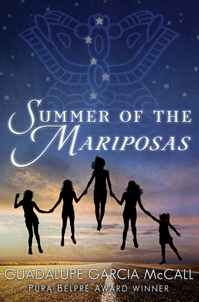
The Summer of the Mariposas, by Guadalupe Garcia McCall, (Tu Books, 2012) tells the story of 5 sisters set adrift one summer after their father has abandoned the family and their mother is always at work.  Odilia, the eldest at 16, is responsible for the supervision of the sisters, but the story gives each sister a distinct voice and personality.  One of the many things I liked about this book was how well McCall handled the personality of the sisterhood.  It’s easy to have one main character, and Odilia is that, but her personality and character can’t be separated from those of her sisters.  McCall integrates the multiple views seamlessly.   

The town itself has entered a kind of enchantment, beset by a plague of butterflies.  There are echos of One Hundred Years of Solitude, but the butterflies here are a symbol of metamorphosis for the Garza girls.

Their life takes on a macabre turn when they are at their favorite forbidden swimming hole and the body of a dead man floats into their lives.  Hurting from the loss of their father, they devise a scheme to take the body back to his home in Mexico.  Odilia is visited by La Llorna, the weeping woman, who is said to have drown her children.  She encourages Odilia to take the journey and gives her a gift to help her along the way.

The story just zooms along from there.  The real journey is one of the heart to get back to the place of family, but the physical and metaphorical journey of returning a body, finding a grandmother, and getting back home, is the adventure of the book.  McCall is a colorful and poetic writer with a keen sense of plot.  She is quite sly and adept at replacing Greek gods with Aztec and Mexican ones. 

But where Greek mythology often has a sense of fated doom, this book is shot through with hope and merriment. That is not to say the girls don’t encounter real danger, terrifying beasts and bouts of immaturity.  The girls bicker, they forget the lesson they just learned, they yearn for candy.  The twin sisters have a private bond and want to be television stars.  One of the reasons they don’t call the cops is a fear they’ll look terrible on camera — they want to go home and change clothes first.  Little bits of humor like this kept the characters real even in their most surreal circumstances. 

This book also portrays a deep respect and love for the blending of cultures, the strength of families and the tenacity of women, young and old. The girls learn the power of kindness and forgiveness, as much as they learn to trust their own strengths.  It’s marketed as a Young Adult novel, but I recommend for any age.  In fact, an 89 year old friend is reading it now.  I hope you get to, too.

McCall won the Pura Belpre Award for her first  novel, Under The Mequite, which I’ll be reading soon.  She is also a published poet and school teacher.  

Here is a link to the publishers site with a great interview with Guadalupe Garcia McCall.
http://www.leeandlow.com/books/484/pb/summer_of_the_mariposas?oos=hc&is=pb


Review: The Where, The Why, and The How

Curiouser and Curiouser:  Books That Answer and Spark Questions

Do you ever long for a no-electronic media night?  I have two books to recommend that will make such a thing both a delight and a learning experience for everyone.

I’ve always have loved science and art.  Science always seemed to be more like an art to me, but it’s probably because I approach it that way.  The world is full of wonders — whole universes live in a drop of pond water, in a dribble of saliva. Science gives me the stories of those small universes and the ones that are bigger than I could ever imagine on my own.
  

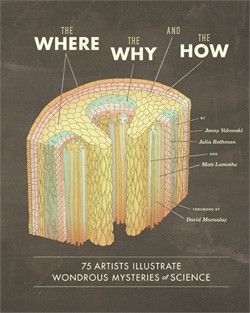
So I highly recommend The Where, The Why, and The How, 75 Artists Illustrate Wondrous Mysteries of Science, by Jenny Volvosky, Julia Rothman, and Matt Lamothe, Forward by David Macaulay, (Chronicle Books, 2012).  It provides a lot of scientific theory  and great splashes of color to illustrate what we can only speculate on. It’s promoted as “Science like you’ve never seen it before.”  The editors are partners in ALSO, a design firm based in Chicago and New York.  Julia Rothman is also author of the popular blog Book by It’s Cover. 

In the introduction, author and illustrator David Macaulay (The Way Things Work, Cathedral), talks about how we’ve become spoiled by an abundance of information.  “If you want to know anything, just Google it.”  He tells how a lively discussion about why eggs are shaped like eggs was abruptly ended by Wikipedia brought up on someone’s phone.  “The most fun, the period of wonder and funny guesses was lost as soon as the 3G network kicked in.  Fortunately, there are still mysteries that can’t be entirely explained in a few mouse clicks.  With this book, we wanted to bring back a sense of the unknown that has been lost in the age of information.  While scientists have figured out a great deal, much remains theoretical and sometimes opposing theories exist.”

Fifty scientists agreed to be a part of the project and explain theories around unanswered questions.  Then 75 of today’s “hottest” artists and illustrators were let loose to provide visual accompaniment — they were free to be as literal or imaginative as they liked. 

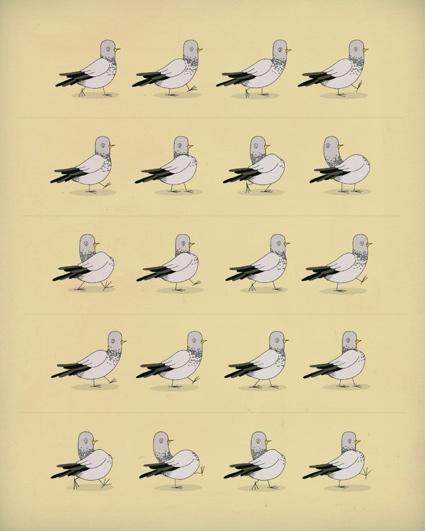
Often they seem to go off on an improvisational riff which can be both baffling and add to the general sense of wonder.  What is the origin of the moon?  What causes depression?  Why do pheremones work?   Why do humans have so much genome “junk”?   And there’s a lot of humor here.  Why do we blush?  Why do pigeons bob their heads when they walk?

The illustrations have a modern and retro feel.  “We chose a mix of well-known and up-and-coming illustrators, comic artists, fine artists and designers.”  It has a remarkable cohesion and sense of style without being too stylized.  The book is dense and has the heft and weight of a new text book and invites hours of perusal. 

You can see a video of the art of this amazing book here.
 http://vimeo.com/50786051#

While The Where, The Why and The How aims to rekindle curiosity,

Big Questions from Little People and Simple Answers from Great Minds, by Gemma Harris, (Ecco, 2012) is aimed at getting children curious as early as possible.  It’s a very entertaining and educational collection of short essays from philosophers, scientists, reporters, artists and doctors.  Harris collected questions from school children all over the world and then asked experts to answer them in a language the kids could understand.  The great minds include Mary Roach, Phillip Pullman, Sir David Attenborough and a host of other writers and scholars.  
Can animals talk?  Why can’t I tickle myself?  Are we all related?  Who invented chocolate?  Why are some people mean?  Do aliens exist?   
The editor is from Scotland, and the book originated in England, so many of the scholars are from England, Scotland, Wales, Australia and other English speaking countries. The book provides an opportunity to talk about how measurements and language differ in countries that speak “English.”
Both of these books will inspire wonder and give you a chance to think outside the electronic box.  They’re good to keep by the bed to inspire wonderful dreams.