A sequel, some links and lots of perspective


<!–[if !mso]>st1\:*{behavior:url(#ieooui) } <![endif]–>

I’ve got a little hodge podge of reviews and links for you today:
Nita and friends
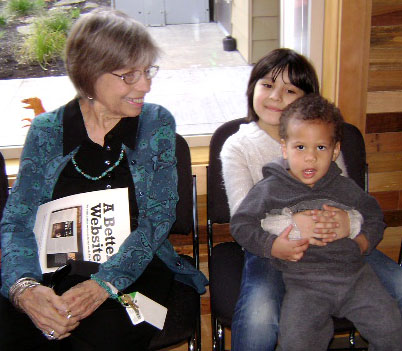
First, let me introduce my guest book reviewer for today. Juanita Laush is my 89 year old neighbor in the Bridge Meadows Community, a community in North Portland, Oregon, set up to serve the needs of families adopting 3 or more children out of the foster care system.  We are both part of the elder housing and serve as sort of surrogate grandparents and mentors for the 25 children that live here. 
Juanita is a vibrant member of our community and an inspiration to us all.  She is a poet and writer who has served with the Willamette Writers organization.  She has been a community activist and supporter of the arts all her life. 
I asked her to review this book because of her poetic nature but also because I believe literature written for young people can resonate with all ages.  One of the things we have discovered among our elders here is that the puzzles of childhood are still fresh in everyone’s minds and heart.  I think reading about children helps us revisit our young selves and gives great opportunity for growth, even as we enter our twilight years.  Both Juanita and I loved Summer of the Mariposasby Guadalupe Garcia McCall. 
I was resistant to the idea of a novel told in poetry, but found under the mesquite immediately compelling.  It is lyrical but plotted and unfolds like a great story.  The depth of feeling expressed is subtle and rooted in love of family.  Even as Lupita’s mother gets increasingly sick and the inevitable takes place, there is a place for hope and for family unity in this lovely story.
Here, then,  is Juanita’s review of under the mesquite by Guadalupe Garcia McCall. 
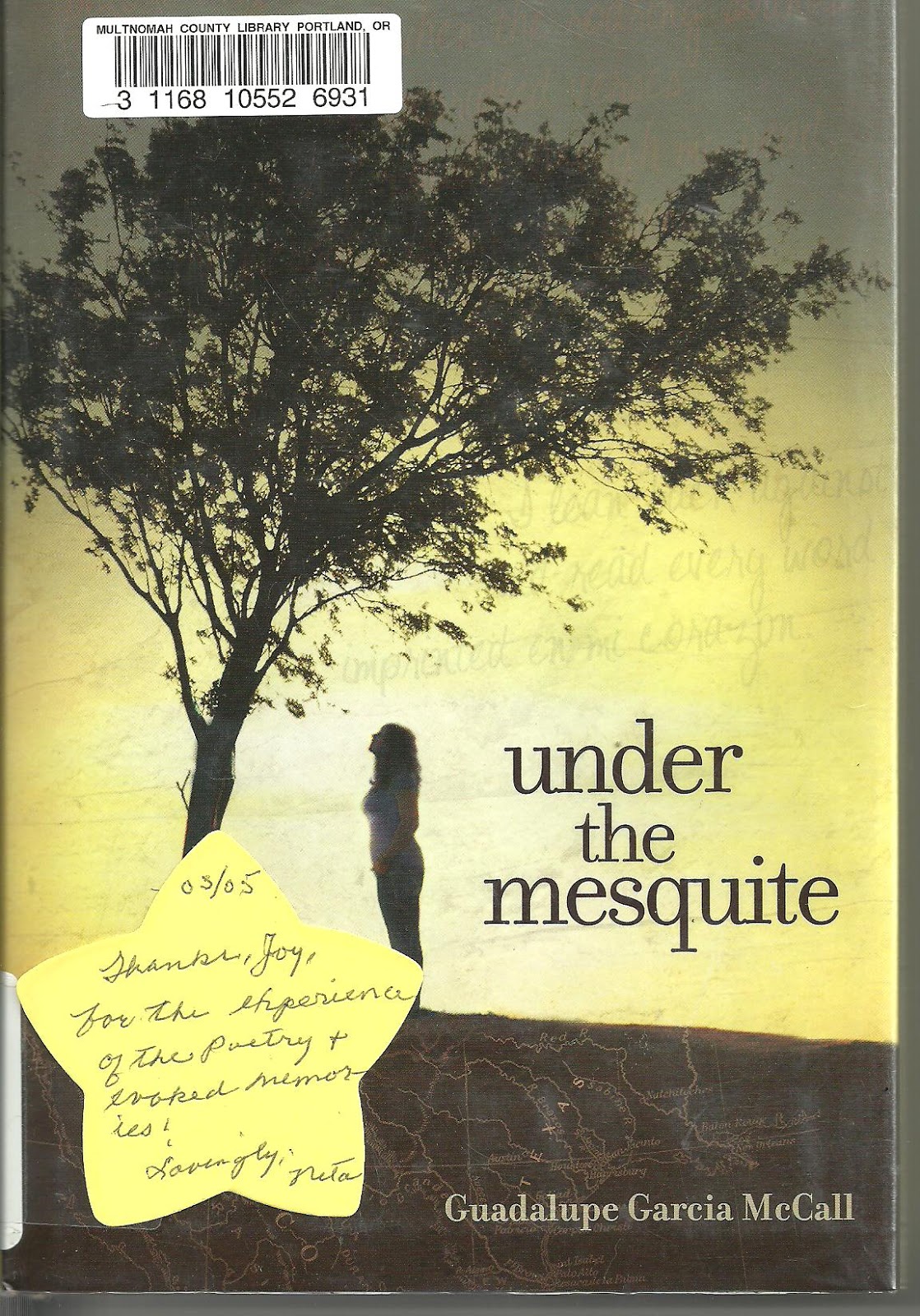
Mesquite:  a sturdy tree or shrub with sweet bean like pods, sharp thorns and extraordinarily long roots, native to the southwestern United State and northern Mexico.”
          From the beginning of Guadalupe Garcia McCalls’s book under the mesquite, (2011, Lee & Low Books) I wanted to join her.  The poetry of McCall’s writing about 15 year-old Lupita let me word by word.  Imagine, an entire novel composed in poetry!  The weight of her words flowed lightly like the laughing waters of the Rio Grande near her Texas home.
          I stopped expecting paragraphs and fell into the rhythm of her simple poetry.  Her big family with its mix of Spanish and English languages, cultures, and food recalls for me the memories of the smells of warm tortillas and simmering pinto beans.  The account of the morning murmur of conversations from the kitchen startles me with sensations of the summers I spent in Mesquite, New Mexico, which began in my 15thyear.
          There was a tall cottonwood tree a short walk from my father’s small adobe house on the outskirts of the tiny town.  While the children of his new family napped, I escaped the heat under the shade of the tree.
          Lupita’s story as eldest of seven children, tells of responsibilities heaped upon her by her mother’s illness, compelling her to put her dreams on hold.  She and the tiny twig of mesquite grow together until she finds comfort in the shade of its branches as she pours her feelings into a notebook there.  The writing reveals her curiosity, her mother’s wisdom and love.
          Lupita juggles her life between two countries and cultures on the border between northern Mexico and southern Texas.  When loneliness for their Mexican familia compels, her family visits relatives in Mexico.
          under the mesquite speaks to all ages and especially to immigrants courageous enough to seek better lives in another place.  A great book for teens and parents to read and share.
          –Juanita Laush
***
Yesterday, a friend sent me a link to the American Public Radio show On Being with Krista Tippet.  I hadn’t listened to it for a long time, so I’m really glad I have good friends looking out for me.  This last show was on a storyteller and writer I’d never heard of, Kevin Kling, and I immediately became enchanted with him and his way of telling and creating stories.  

“The Losses and Laughter We Grow Into

Kevin Kling is part funny guy, part poet and playwright, part wise man. Born with a disabled left arm, he lost the use of his right one after a motorcycle accident nearly killed him. He shares his special angle on life’s humor and its ruptures — and why we turn loss into story.”

I don’t want to sound melodramatic here, but I think this interview and listening to his stories changed the way I think about my own stories.  
I have long taught and practiced the art of “change your story, change your life.”  In retelling my own story to myself, I have come to appreciate the value of having a disability and growing up in a fractured family.  Still, I often get bogged down in my need to tell stories with light at their center, and my need to report the facts, which are more like dark matter, bleak suck-holes that silence me.
Last week I put aside a bleak story I was trying to lighten, and tried not to think about it. But then this interview came into my life and I’m once again encouraged about my own dark matter and the whole concept of not having to fix it, only to tell a story that lets me sleep at night. 
Deep thoughts are here in this interview, as well as the humor that helps us cope with what we lose and how we change, grow and resurrect ourselves.  I actually am a bit alarmed that I never heard of the guy before, but I do believe a proper mentor comes along when you can see him or her most clearly and maybe that’s why I heard of him now.  I’ve got his books on hold at the library and look forward to learning more from this fascinating and joyful man.
Let me know what you think.  Listen here:
***
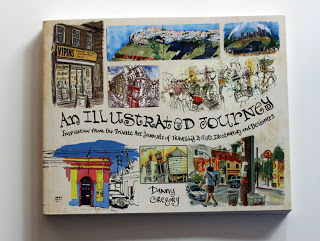
Also, I want to mention Danny Gregory’s blog again.  I reviewed his book A Kiss Before You Go some weeks ago on this blog, and talked about how his books helped me create new ways of interpreting life.  His new anthology “An Illustrated Journey: Inspiration From the Private Art Journals of Traveling Artists, Illustrators and Designers,” is a total delight and gives a lot of insight into how we can make art a part of our everyday life, even if we are only traveling through our own small neighborhoods, even if we don’t draw so well.  Of course, this book goes wonderful exotic places and we get the pleasure of seeing those places interpreted by a variety of talented artists.  From tightly rendered representations to scribbly and washy impressions, this book makes one want to put aside the camera, slow down, and really look at what we’re seeing.  His blog is featuring interviews with contributors to the book, plus posts from his own travel adventures.  Be sure to scroll through the blog and find the wealth of inspiration that he has posted.  
Then go out and draw something!  Everybody had to start somewhere and nobody ever really masters drawing. Have fun with it!  It’s your life — make your mark.
a sloppy but fun journal entry inspired by an artist in Gregory’s book an Illustrated Life,

Fish Out of Water

Fish Out of Water
    “I decided not to have any goals this week.  I could work if I wanted to, but no “assignments.”  I had tried to get stories drafted and revised.  One story, my magic fish story, got 3 criticisms from 3 different people about the same issue, so I knew I’d have to do another revision.  So I just put everything aside.
     Without my “assignments,” I felt like a fish out of water. I got depressed.  Then, I had an art session with one my Bridge Meadows kids.  We got out our notebooks, the watercolors, the gold paint and the colored pencils.  
     Then, the magic happened.  The week went heavenly after that.”
My 5 year old friend drew blobs in brown metallic watercolor.  
“What animal can we make out of this?”  I asked.
“Make it a porcupine.”
I had no idea what a porcupine really looked like, so I just started adding spikes and a smile.

That was so much fun, I decided to work on my “commission.”  My husband wanted me to redesign the logo for the organization of which he’s a founding member, The Aging Artfully Initiative.  The original looks like this:

This is my  more detailed and colorful rendition.  It’s going to go through some changes yet, but I like this first draft:

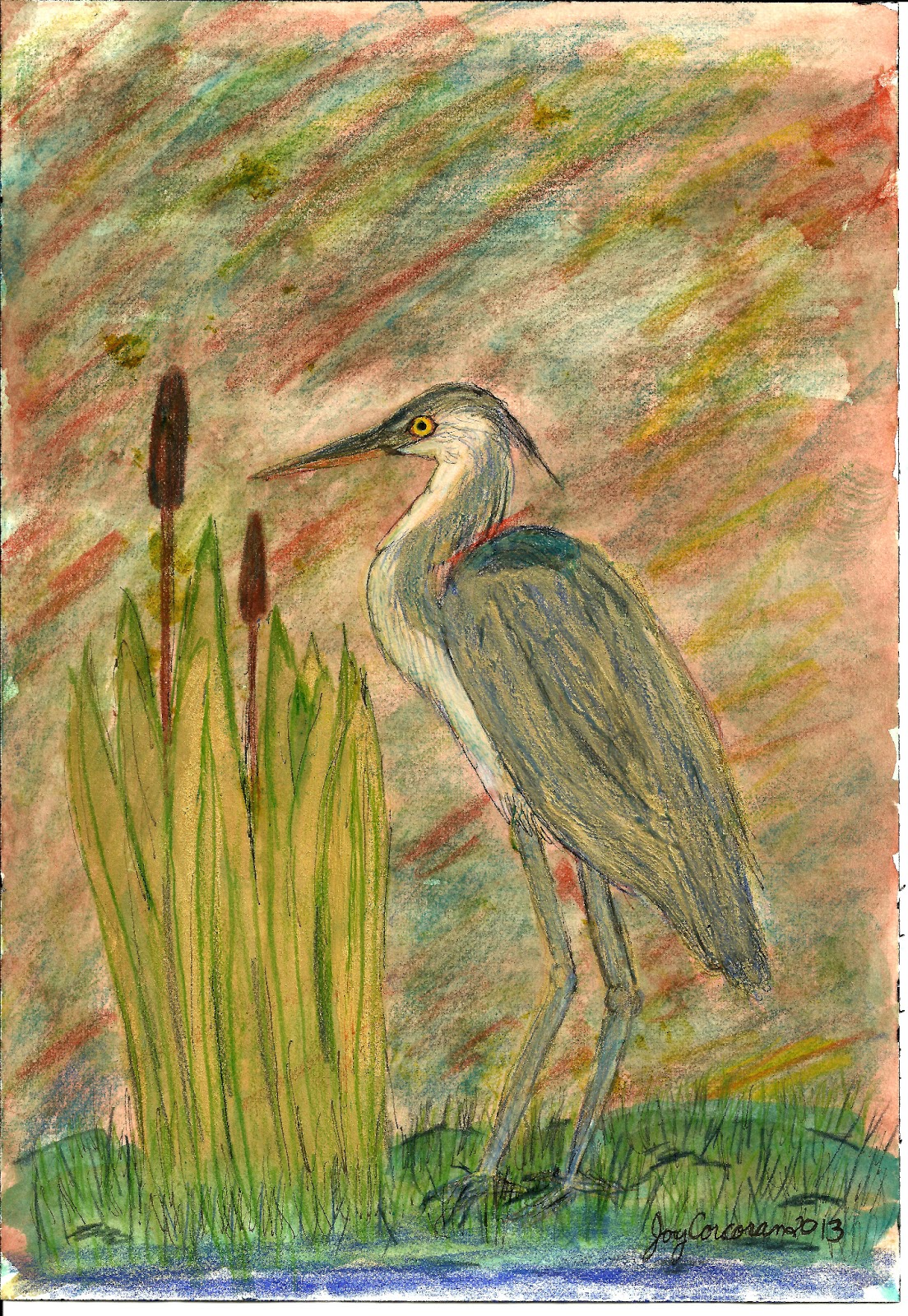
I had nice sized puddles of paint left, so I splashed them on a piece of watercolor paper.  The next day, I took my gold gouache and loosely painted the shape of reeds and a heron.  Then I started layering colored pencil, watercolor pencil and watercolor.  The gold sort of seeped up through the layers and for awhile, I thought I’d just made another of my famous messes, but I kept layering and adding detail and was surprised to find something I quite liked.

Golden Heron —  7 x 10″ mixed media

So, it was nice to let go and just enjoy playing around.  How was your week?

If you missed the Monday book review, you can find it here.  If you have a book you’d like to see reviewed on my blog, please contact me a joyzmailbox at gmail dot com.  I review everything from children’s picture books, art books to dense novels.  I love children’s literature. I particularly like independent and small presses. 

If you’re looking for painting inspiration stop by Paint Party Friday.

And if you’re at a loss and feeling forlorn, hang out with a kid for while.  You’ll be surprised how contagious a childlike spirit can be.

Head, Tails, Storks

Last week I read two very different books.  One was written last year, and the other in the 1950s.

First the contemporary one, which I found through a book review.

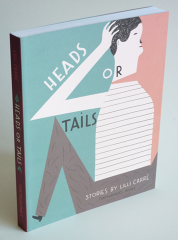
When I first picked up Heads or Tails by Lilli Carre, Fantagraphic Books, 2012, I wasn’t sure I would like it.  The strange graphic style of the cover, especially the nose and facial features, were not really a style that I liked.  But I’d heard great things about it, so I began to read and I was fascinated.  The stories are weird, dream-like and surreal, with a bit of existentialist humor.  They also reveal a remarkable compassion for characters trying to puzzle out their lives.

The cover blurb says, “…the stories contained touch on ideas of flip sides, choices and extreme ambivalence.”   In “Wishy Washy,” a judge of floral arrangements survives a car accident but loses his ability to judge and make decisions.  In “Welcome to my Kingdom” a single snazzily dressed man is increasing boxed in by the borders of his life and the page.  “The Carnival” is a ambling story that combines ideas of floods, flight, romance, family and solitude into a circular story that left me with the same feeling I get when I’ve had a particularly vivid dream.  It’s rife with meanings that I can’t quite put into words.

Which is part of the lure of this book — it’s told in ways that you can’t put into words.  The graphic elements are an integral part of the story.  It’s more than an illustrated story — it’s a dance.  There are a few sequences under the title “Short Bits” that deal with the whole dance of life — the words, the movement, what happens in reality, and what happens in our minds and hearts. In “The Thing About Madeline,” a woman finds her own double working at her customer service desk one morning.  She becomes a spy in her own life, then develops a whole new existence. In spare prose and jittery drawings, ideas of identity are deftly explored and exposed.

Then there are moments of great humor — my favorite being the last drawing The Woman With Something Stuck Between Her Teeth.

Lilli Carre won acclaim with the graphic novel The Lagoon.  Her work has appeared in The Best American Comics, 2008, and the Best American Non-Required Reading, 2010.

You can find out more about her here:
http://lillicarre.com/heads-or-tails#/t/9

Here’s a little video of how the book looks:
http://lillicarre.com/heads-or-tails#/i/10

***

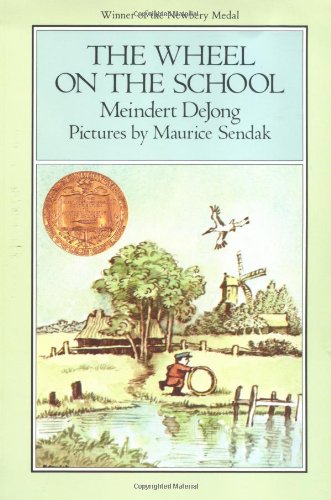
The other book I read was much more traditional.  The Wheel on the School by Meindert DeJong, Illustrated by Maurice Sendak, was published in 1954 and won the John Newberry Medal.  It’s a  novel for ages 10 and up, and is still in print.  I got mine at the library. I found it by googling “children’s book fishing village,” since I’m working on a picture book set in a fishing village.  I love the way books come to me.  It didn’t have the pictures I was looking for, but it had everything I needed in a good story.

At almost 300 pages, it is a warm, sweet book that follows a group of school children in a small Dutch village.  Lina, one of six children in the village school, wrote a paper on storks, but admitted to only knowing what her aunt from another village told her.  In that village, every Spring, people put wagon wheels on their roofs, as a foundation for a nest. “(Storks) build great big messy nests, sometimes right on your roof.  But when they build a nest on the roof of a house, they bring good luck to that house and to the whole village that that house stands in. Storks do not sing.  They make a noise like you do when you clap your hands when you feel happy and good…on your roof they are noisy.  But it is a happy noise, and I like happy noises!”

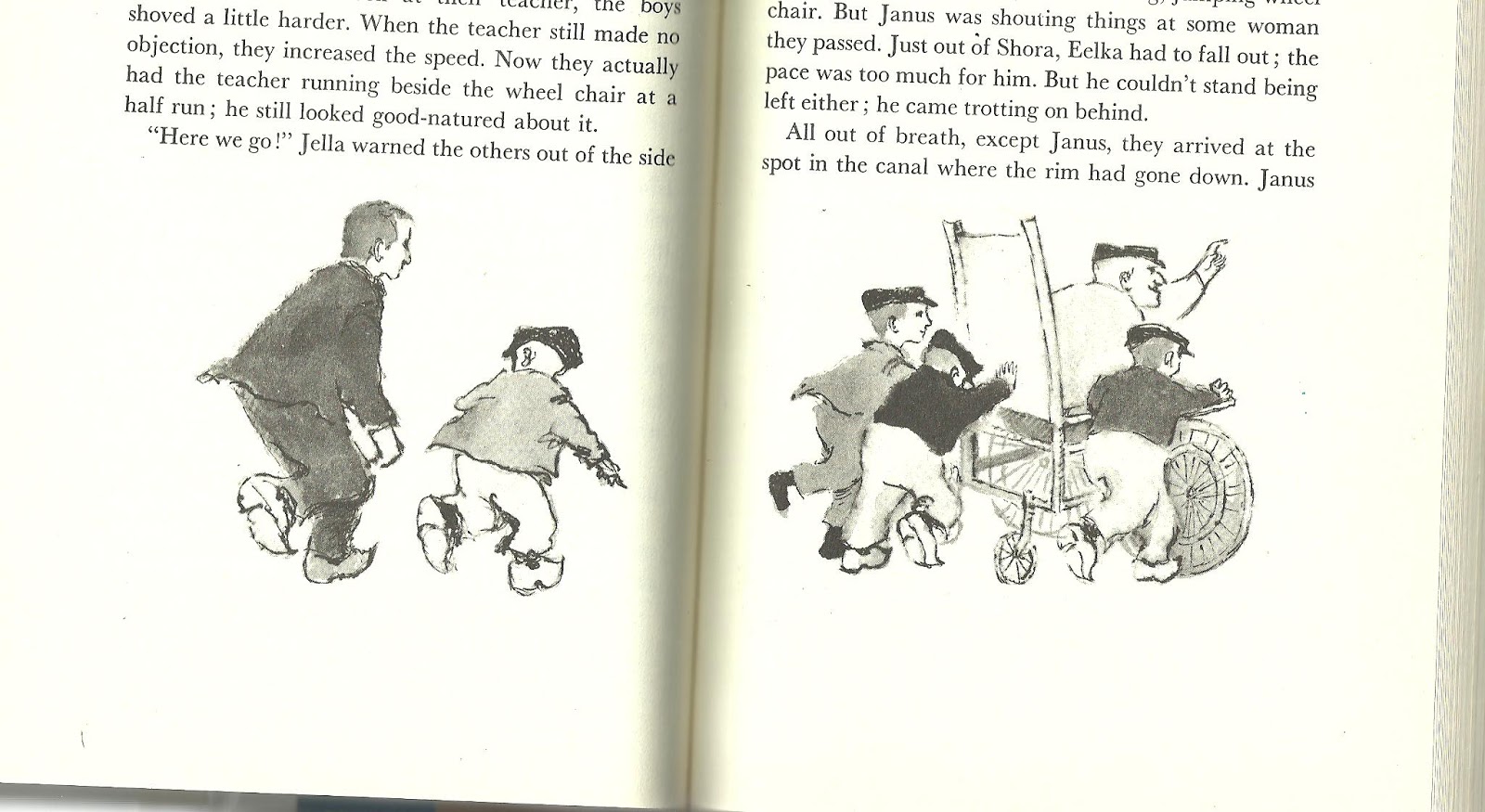
The children are instructed to try to figure out why storks no longer visit their village.  Lina finds out from an old woman that there used to be storks but the village trees had been lost in storms and no one even put a wagon wheel on their roof anymore.  What ensues is an adventure that takes each child out into the village to find a wheel to put on the school and lure a stork couple to the village.  They are told  to look “where one could be and where one couldn’t possibly be.”  In their search, they learn about their elders, their history, and their own bravery.  In a charming turn of events, they discover the meanest man in the village, who uses a wheelchair and is rumored to have had his legs bitten off by sharks,  is in fact, their best ally.  The storks begin to bring good luck even before the first ones fly overhead on their migration from Africa.

Encounters with irate farmers, terrible storms and grumpy fathers keeps the children on their toes.  Each child is developed in the course of the story and the village comes to life in the masterful storytelling of DeJong.

It was delightful to read this — it was slow paced and soothing at times, at other times an engrossing page turner.  There were moments when the children’s ears were boxed and they were paddled when I wondered if such scenes would be acceptable in a contemporary children’s novel.  There were vivid and detailed descriptions of the buildings, boats, tides, dykes and terrain — descriptive elements often left out in the fast pace of modern novels.

I loved reading it in bed with a cup of tea.  It has community and environmental themes that are very contemporary and valuable, but it has a nostalgic feel to it. The illustrations for this are very spare, rendered  in ink and wash by Maurice Sendak and add to the quaint. cozy feeling of the book.  I hope I get a chance to read it out-loud to someone someday. 

***
One more thing, I found this article on the film “Girl Rising” in this morning’s paper.  A trailer for the film is included.  It’s a documentary addressing the question “What would happen if more of the world’s 66 million uneducated girls were allowed to receive the same schooling as their male counterparts?”

I look forward to seeing it and I hope we all get a chance to help improve the lives of girls.

http://www.oregonlive.com/living/index.ssf/2013/03/girl_rising_film_championing_g.html#cmpid=9547239

I hope you get to read something wonderful soon.  Remember, books require no batteries and transport you through time and space in the most magical way.

"All The Messy Glory"

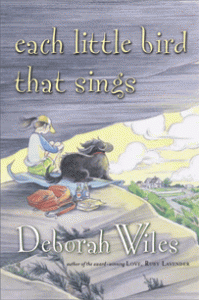
Sometimes the perfect book comes along at the perfect time.  When I was in Memphis for my mom’s funeral last week, I stayed with a dear friend who is a children’s librarian.  She urged me to read Each Little Bird that Sings, by Deborah Wiles.  It’s the story of 10 year old Comfort Snowberger, who lives with her eccentric and endearing family in a funeral home in Snapfinger, Mississippi.

The Snowbergers have a good honest relationship with death, and Comfort has attended 247 funerals.  She reports on the funerals, hoping one day to get in the local paper for her obituaries which are much more exciting than the boring things that do get published.  She feels it is her duty to keep everyone’s spirits up.  It’s her contribution to the general family attitude of  being of service. 

However, Comfort is finding it too hard to be of service to her bratty cousin Peach.  She hates him and his whiny ways.  She also finds out that her best friend, Declaration, is in the process of dumping her for cooler girls.  Declaration is being mean and  has begun to taunt her for being around dead people all the time.  Her best friend, it seems, is her dog, Dismay. 

Then Uncle Edisto dies.  Then Aunt Florence.  These elders of the family take with them the wonderful sense of security that Comfort has grown up around.  That’s 249 funerals.  Who will be number 250?  Aunt Florence promised a sign for Peach at her funeral.  What happens takes Comfort so close to the reality of death that it impacts the whole family.  It portrays the changing nature of  friendship in a delicate but realistic way.  Life altering events, in fact, alter lives. 

This book was engaging and funny and sad.  It was also a reassuring companion as I navigated my mother’s funeral.  It helped me appreciate the deeper meaning of the hymns and the sermons and the rituals we went through to honor my mother. 

When we were young, our family was torn apart by divorce, alcoholism and poverty.  We never really got proper training in how to handle funerals, weddings or any other public rituals.  I never know what to do.  My mother had the foresight and faith to arrange her own Christian funeral, and my sister, who took care of Mom, dealt with all the final details.  All I had to do was go, mourn and commune with family and friends. 

My friend who gave me the book, it turns out, went to funerals all the time with her family.  One of the reasons she loved Each Little Bird that Sings, is that it reminded her so much of her childhood experience with beautiful funerals and the camaraderie that can happen around them.  Her family would decorate and clean the graves of family members and loved ones. They took extra flowers to decorate graves for neighbors who could no longer make the trip to the cemetery. 

I never really saw myself as a person to visit graveyards, but sure enough, now I want to visit my brother, my grandmother and my mother every time I go to Memphis.  The funeral provided a closure, but it also provided a gateway.  The small plots of ground that contains my family’s bones seem like passageways now — I can’t quite make it through to them, but I know they are there, removed from what Uncle Edisto refers to as the “messy glory” of life, but not gone from my messy life.

Each Little Bird That Sings has all the charm and culture of a small Mississippi town, or any rural town.  The names and phrasings and insights and humor seem unique to the South and this book highlights all the goodness that can be a part of Southern life.  Even though Memphis is a big city, it’s on the border of Mississippi and in the Mississippi River delta.  Reading this novel took me back home in so many ways that when I got back to Portland, Oregon, the first thing I did was order my own copy.  

Here’s a link to an excerpt on NPR:
http://www.npr.org/templates/story/story.php?storyId=4699100

From her website:
 http://deborahwiles.com/site/
Deborah Wiles is the author of two picture books, ONE WIDE SKY and FREEDOM SUMMER, and four middle-grade novels:  LOVE, RUBY LAVENDER, EACH LITTLE BIRD THAT SINGS (a 2005 National Book Award Finalist), THE AURORA COUNTY ALL-STARS, and her new novel, COUNTDOWN, book one of The Sixties Trilogy for Young Readers.
Her work has received the Ezra Jack Keats New Writer Award, the PEN/Phyllis Reynolds Naylor Working Writer Fellowship, and the E.B. White Read-Aloud Award. She has taught writing workshops to thousands of children and teachers all over the country. She teaches in the MFA in Writing for Children Program at Vermont College and lives in Atlanta, where she grows the world’s most beautiful zinnias, climbs Stone Mountain, and avoids the Atlanta traffic.