How to Build a Robot

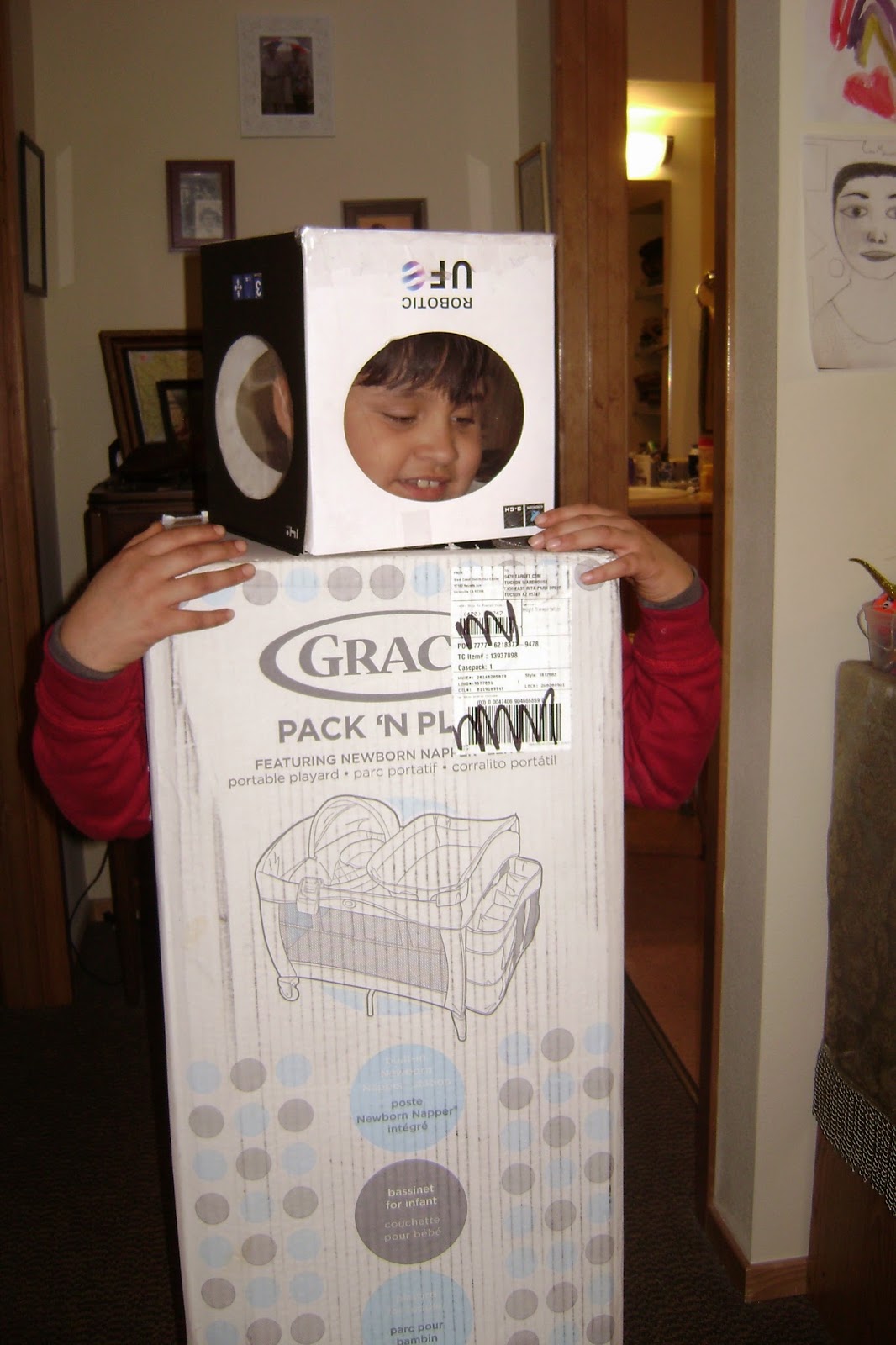
Noah Tanatchangsang is a 10 year old boy who lives in my neighborhood, Bridge Meadows. We are set up to help children being adopted out of the foster care system.  He’s one of 4 brothers who regularly come to my all ages art class in the community center.  I’ll never forget the day he came to me with the idea of building a robot.  We were drawing at a table with his rambunctious 4 and 2 year old brothers. 

Noah jumped up and said, “I forgot to bring something!”

His brothers were a little alarmed, but he said he’d be back soon.  To console themselves, the brothers wandered over to the ping pong table and tried to figure out how to play, even though both of them were shorter than the table. 
About 5 minutes later, I heard a muffled knock on the door.  I opened it to find a tall box at the door.  The box shuffled in and bumped into the ping pong table.  The boys laughed and began to beat the box with their ping pong paddles. 

“Stop, stop!” cried Noah from within the box. 

I got the boys under control while Noah wiggled out. 

“We could make a robot out of this box.  My mom was just going to throw it away.”

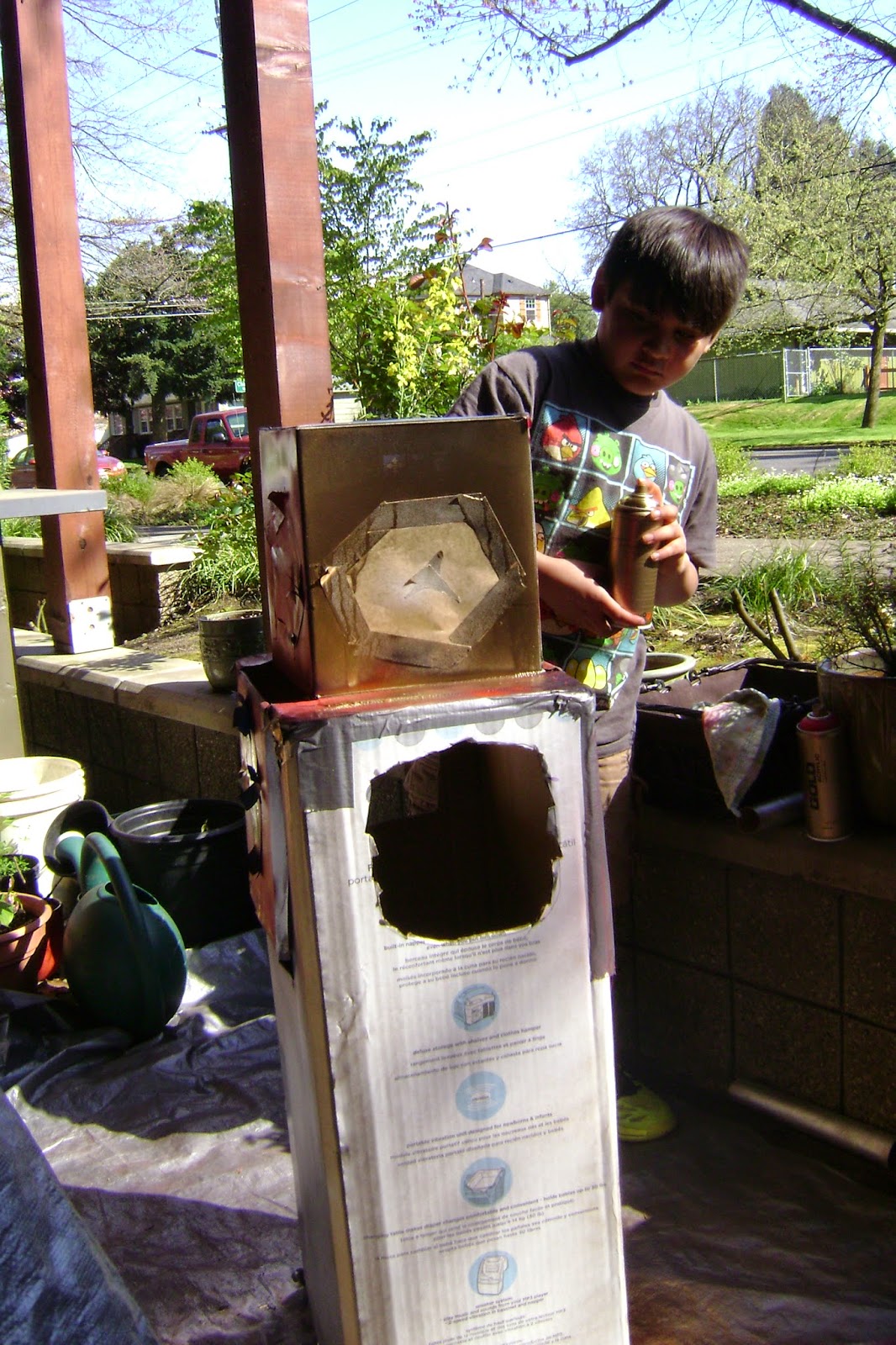
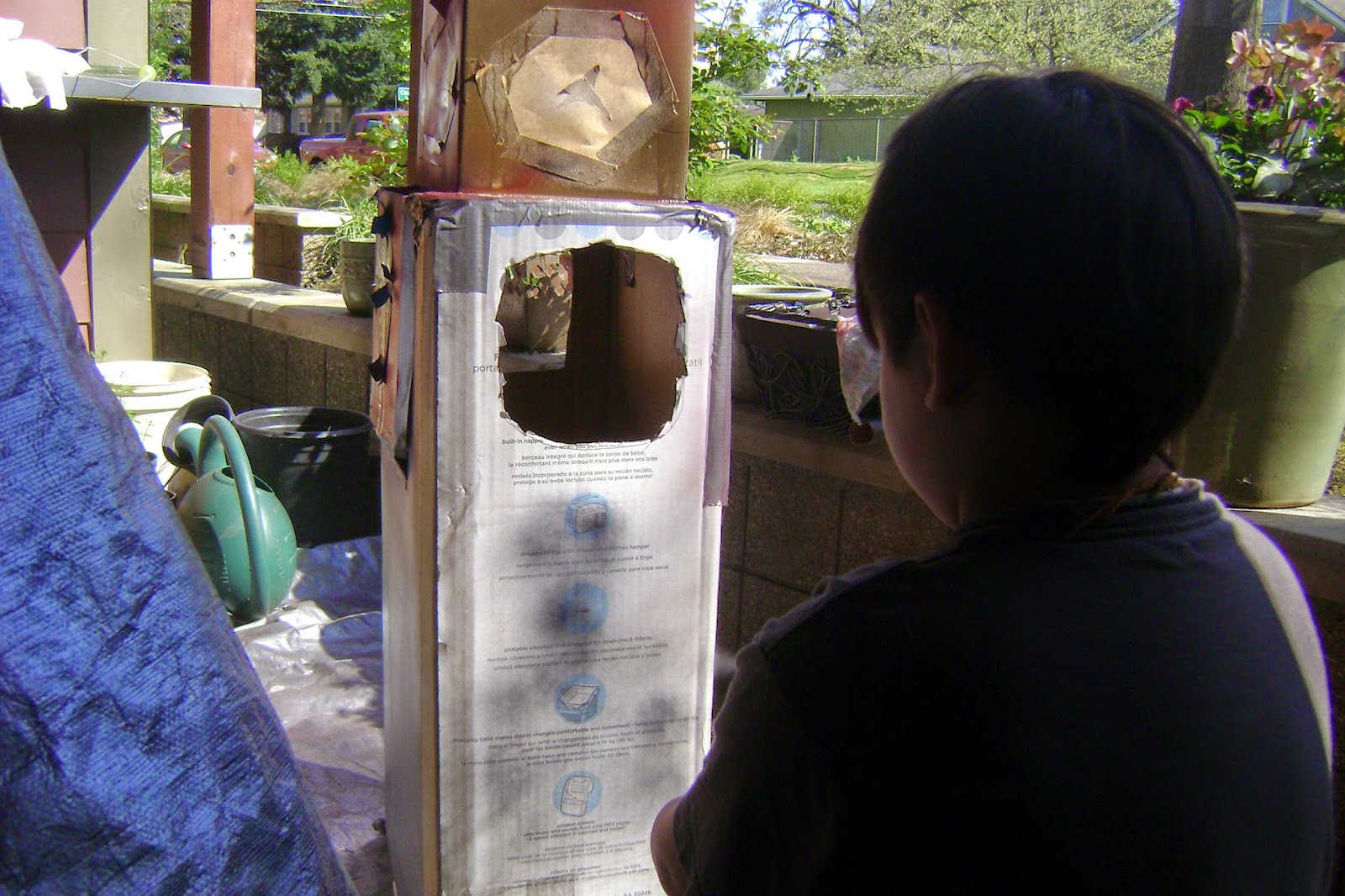
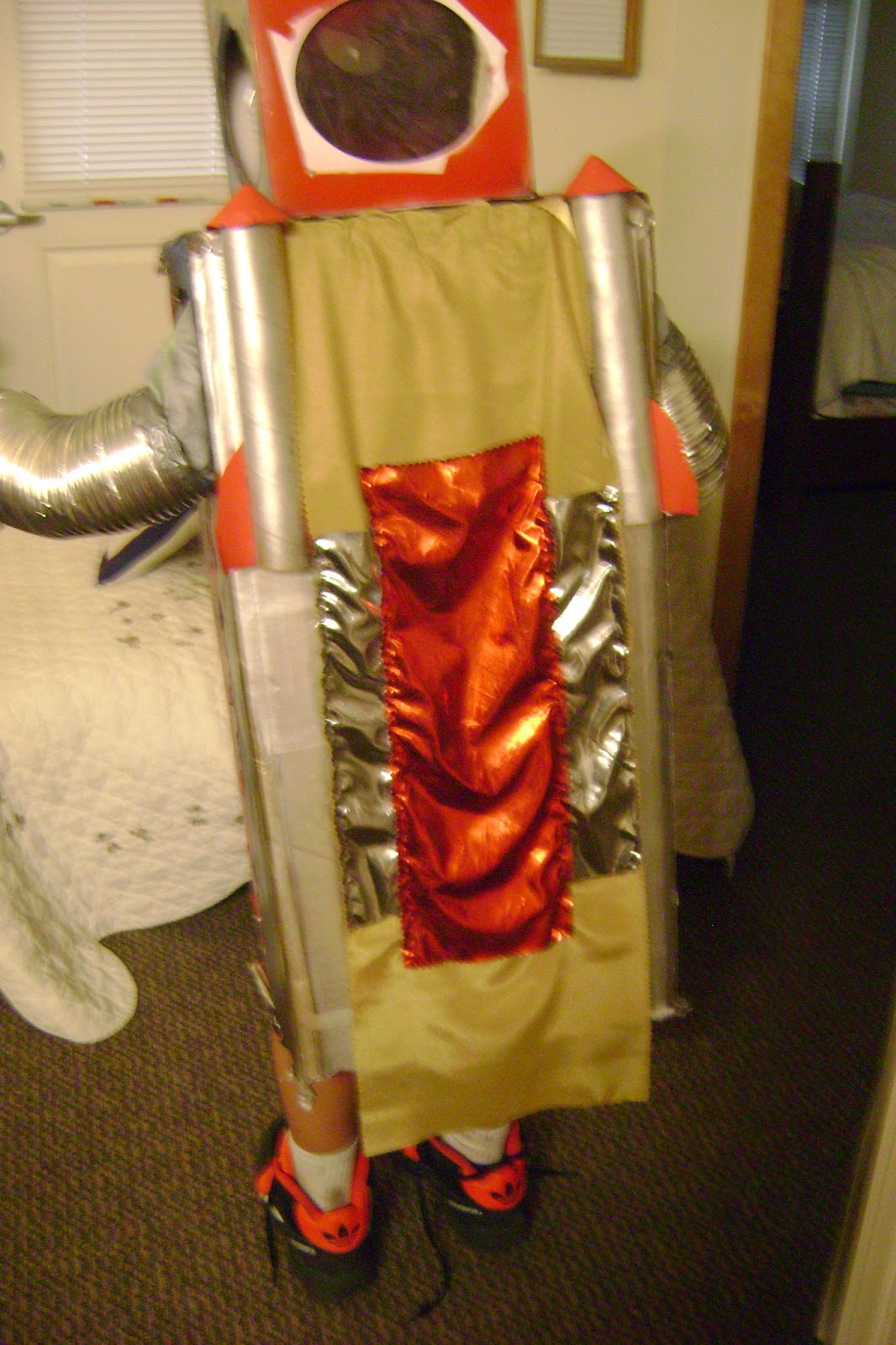
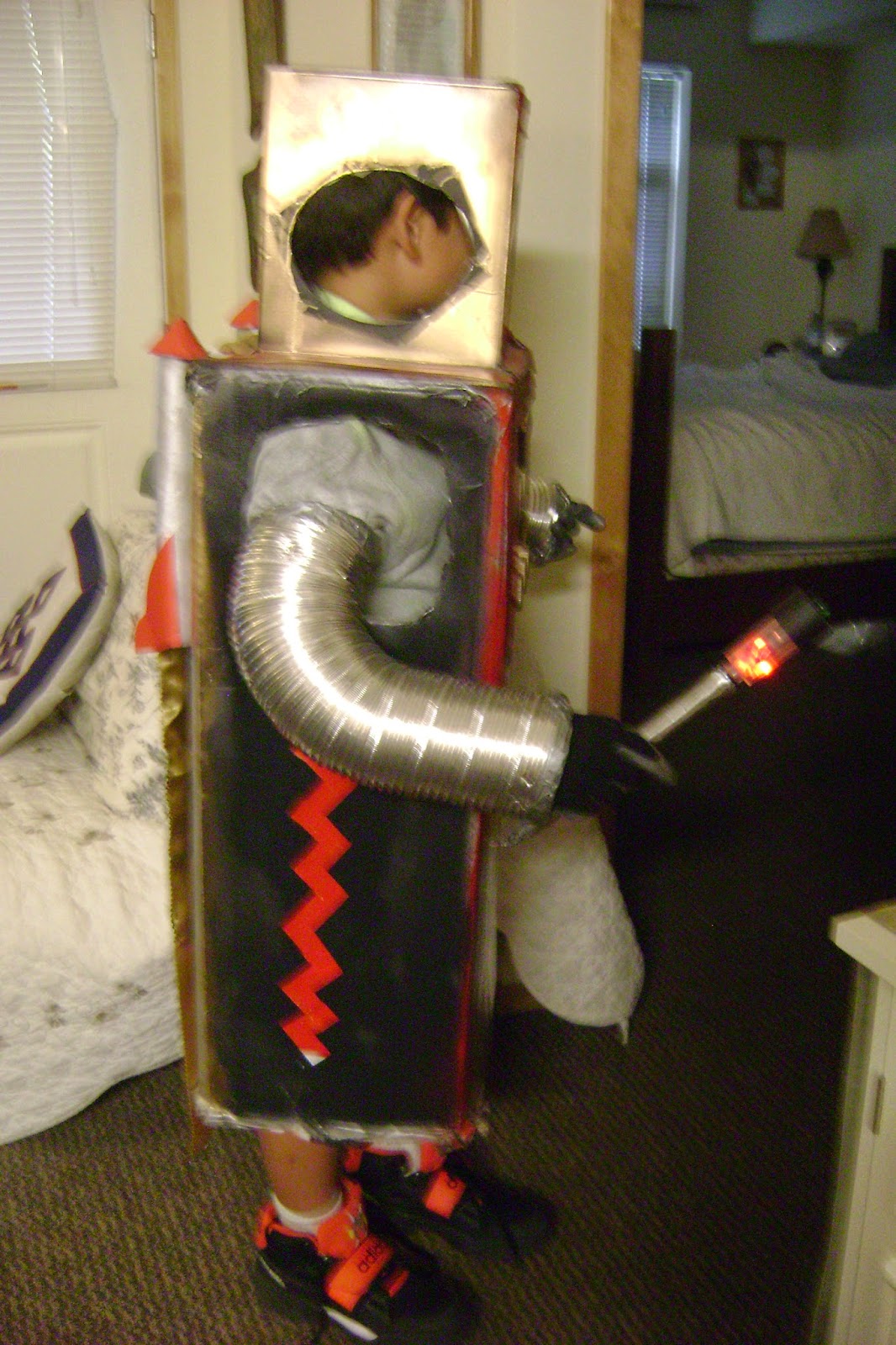
The younger boys couldn’t leave the box alone, so we decided it was best to keep it in my apartment.  That was in the spring.  For the next few months, when Noah was free from school work, after school activities, camping and traveling with his family, soccer games and home work, we built a robot. 
It was a  project that engaged his mind and fired his imagination.  A few days after he delivered the first box, he was at the door with another smaller box with clear plastic panels, perfect for the robot’s head.  Again, he said, “My mom was just going to throw it away.”


I tried to explain that we sometimes have to throw things away because there isn’t enough room to keep everything, but he’s not entirely convinced.  But it’s truly inspiring to watch a kid build things from things what would otherwise be thrown away.  It lets them see the magic of transformation in a way nothing else can.  You can read a post about how Noah first became aware that things can be fixed and transformed here.  We made a prosthetic leg for his Godzilla toy.

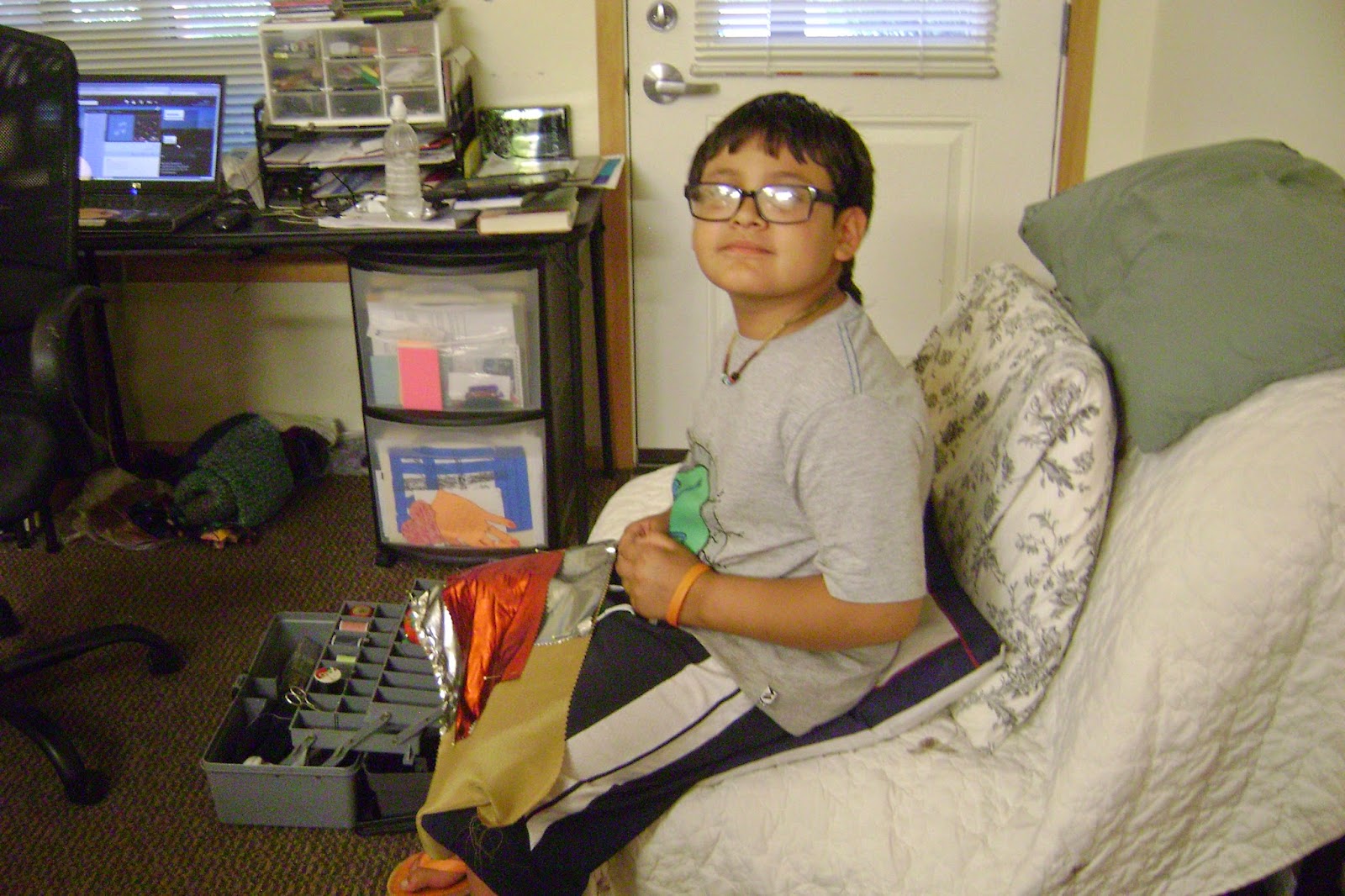
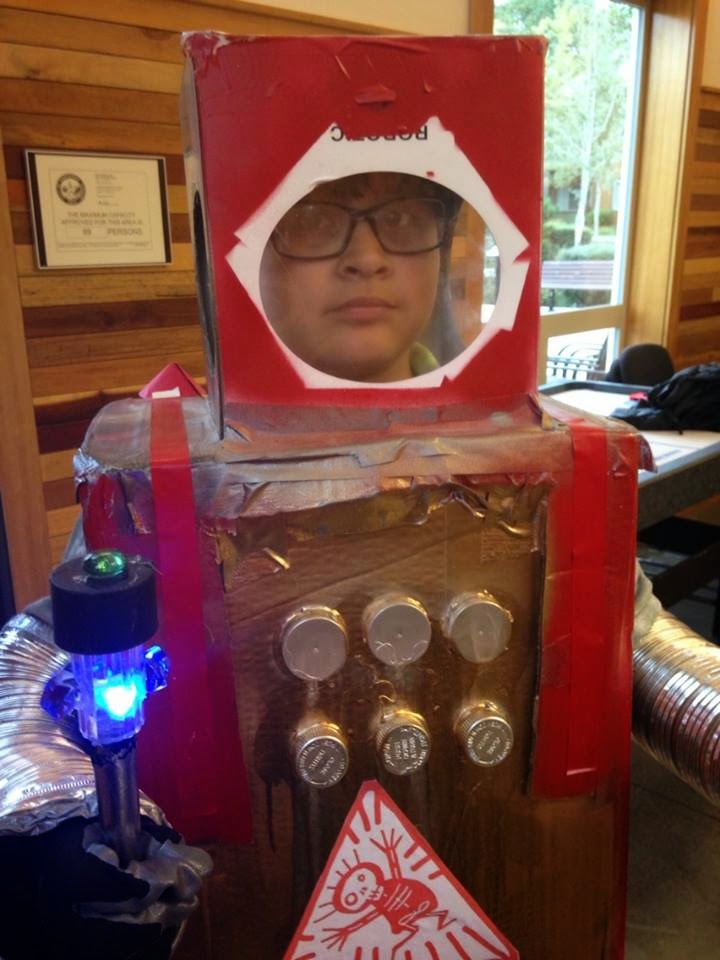
So I hope I’m inspiring an artist and not a hoarder.  I had a bag of odds and ends including pill bottle caps we could use as dials, paper towel tubes for the rockets, and fabric scraps for the cape.


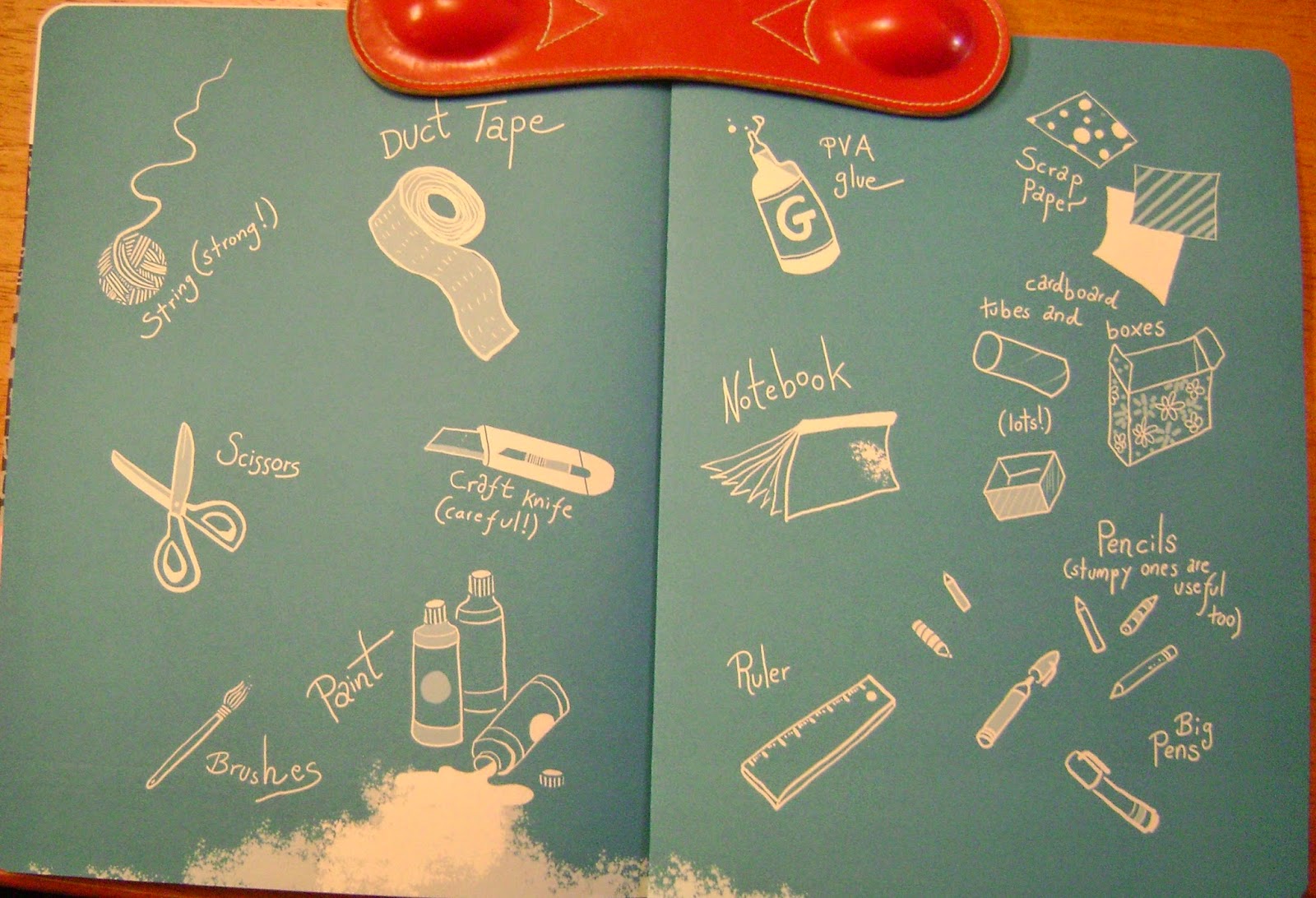
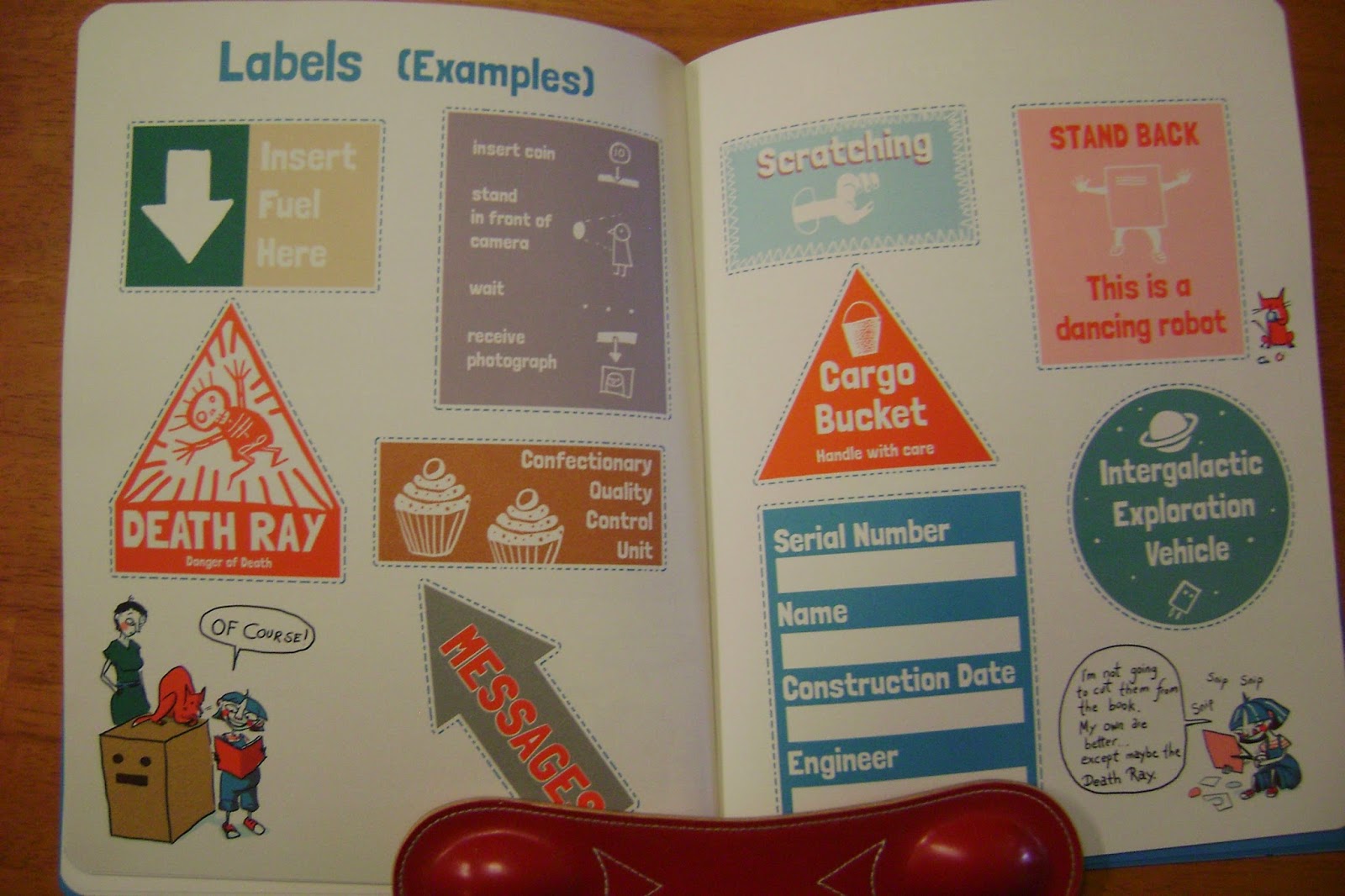
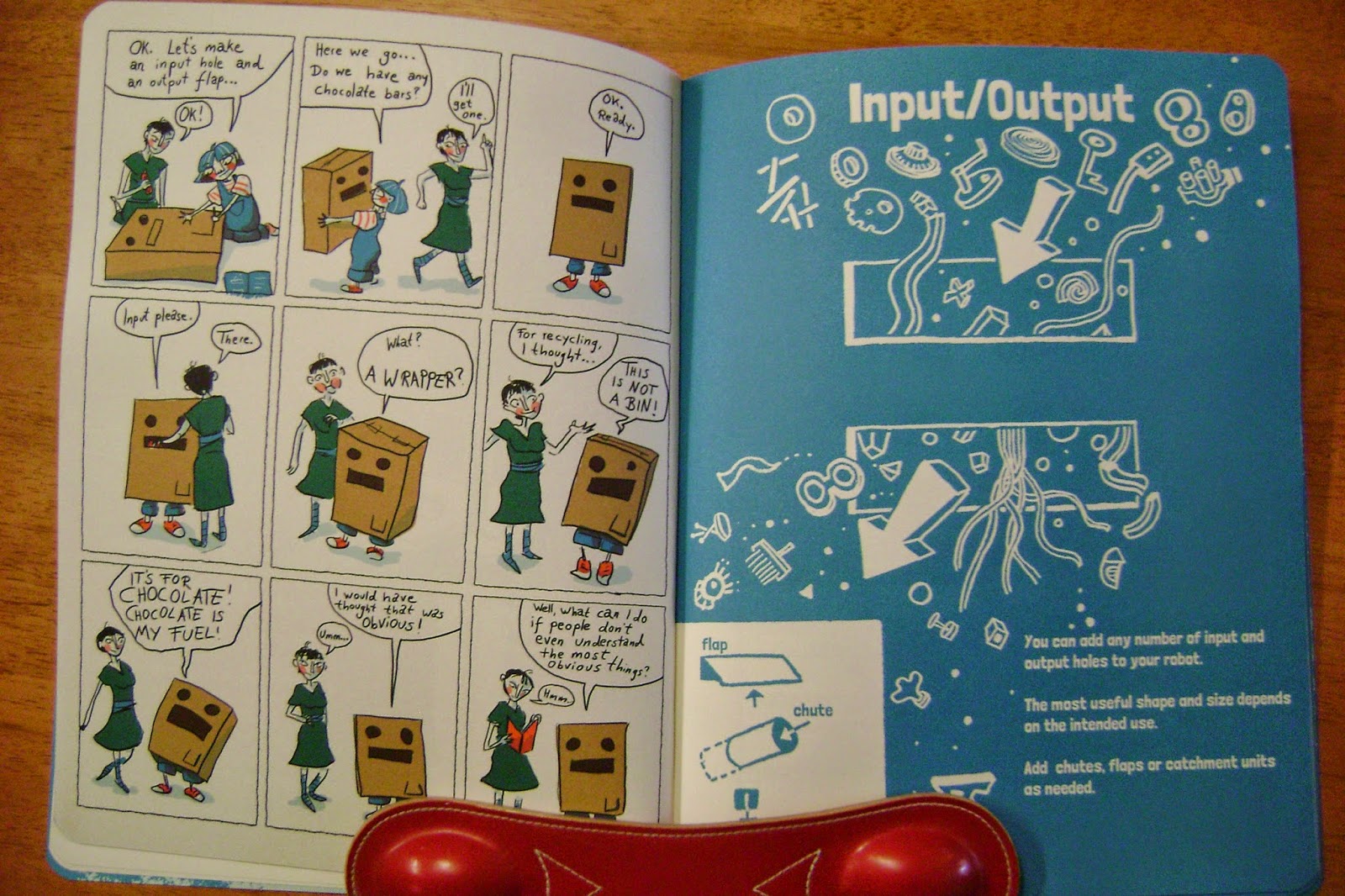
Just as we were getting close to the end of the project, I found the book, Welcome to Your Awesome Robot, by Viviane Schwarz, Flying EyeBooks, a book I wish we’d had when we started.  It’s both a story and a manual, and it’s perfect for creating a project with a kid.  I love that it features a girl.  Noah loved that it came with cut-out decals, and instructions on how to make fuel input additions and functioning dials.  


He didn’t want to cut things out of the book, although we could have.  He wanted to keep it intact for future use.  And it’s a lovely book.  It’s like a large Moleskine sketchbook with a gray paper flexible cover, and embossed print.  The illustrations are energetic and charming.  I’m so glad to have discovered Viviane Shwarz’s whimsical world.  Her website has a video of her reading her book, Is There a Dog in this Book, a fun one with foldouts and surprises.  She also has a place to post any awesome robots you make.  


Great End Papers


You watch a kid and her adult assistant build the ‘bot


We copied and enlarged the Death Ray decal and pasted it by the robot dials to warn off any enemies.

We made a magic wand with an old outdoor light and the light from another toy

We got to  make certificates, too!

While we were working on the robot, Noah became enchanted by my reading light.


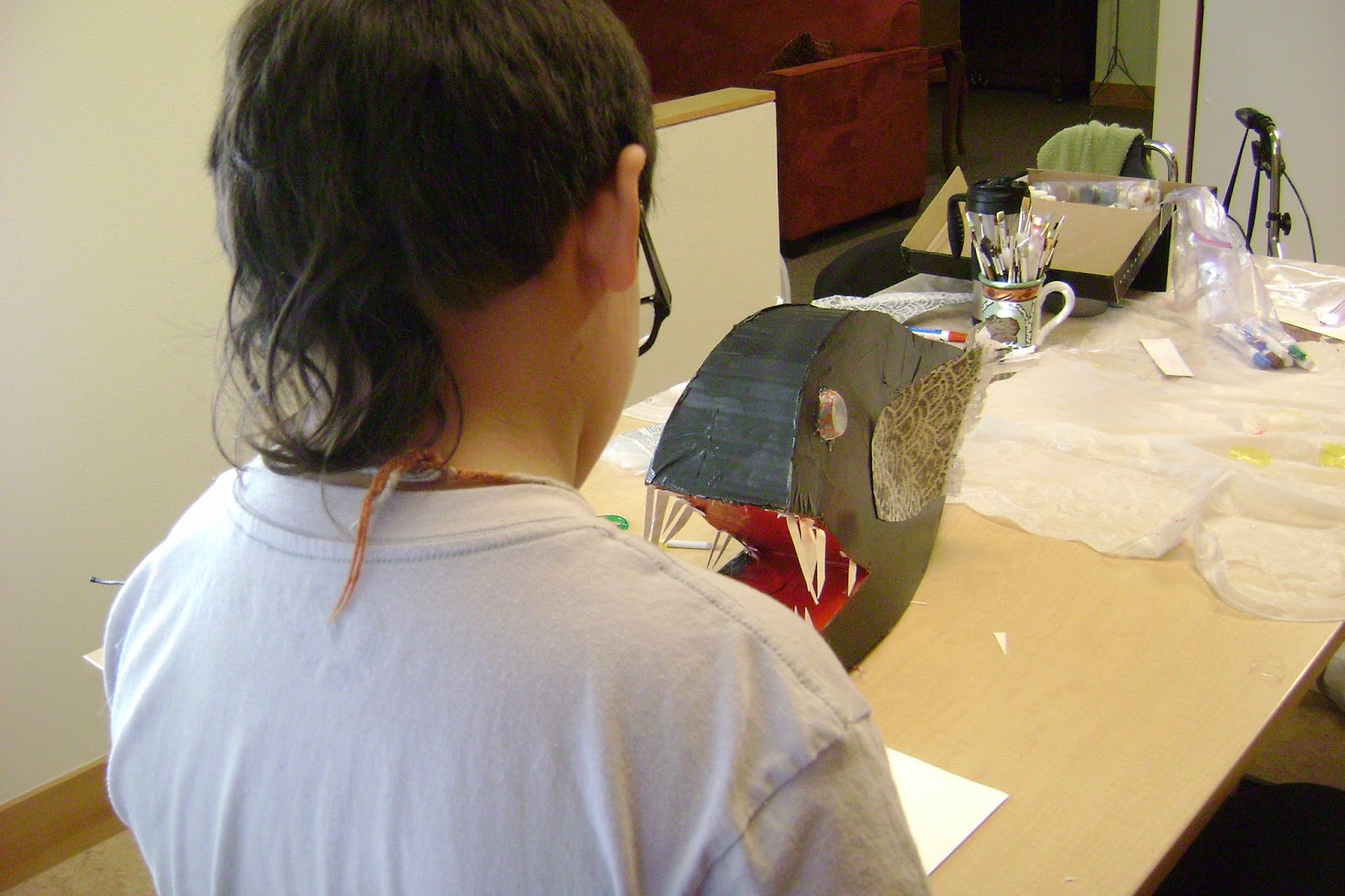
He wanted to make an angler fish with it.  I was reluctant to give it up and on a trip to the hardware store to buy robot arms (dryer vent tubes) we found another light that would work even better.  We’d learned a lot about cardboard with the robot, but with the angler fish, we learned how to bend it and shape it. 

Making Teeth

to welcome little fishies in with gently smiling jaws


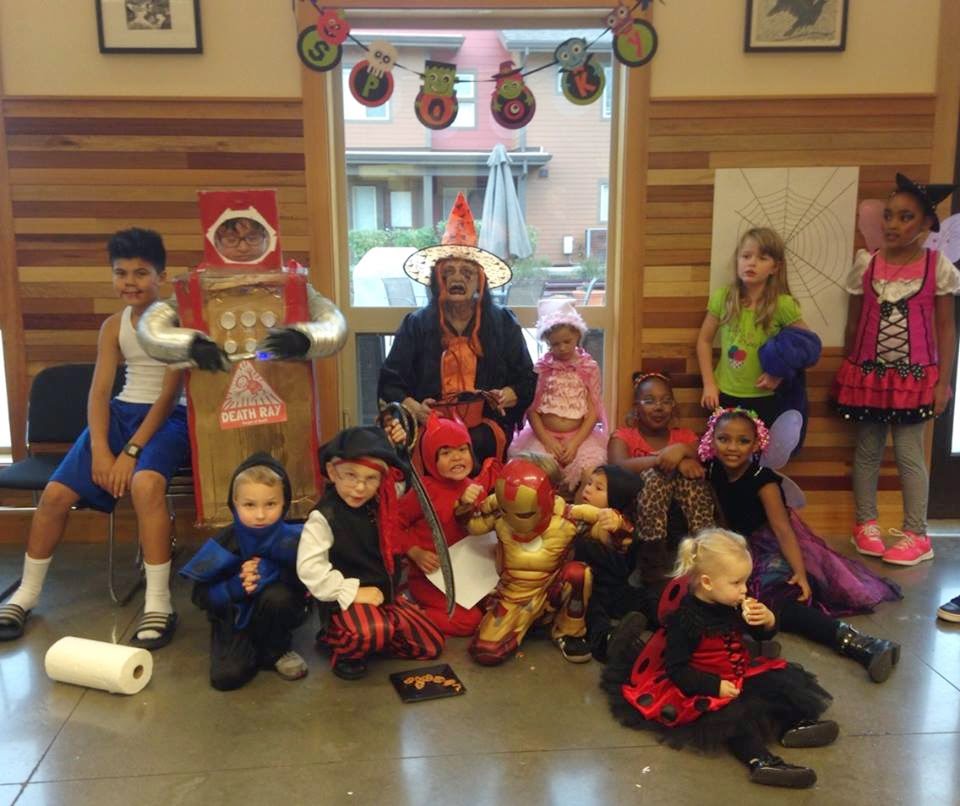
When Noah made his debut at the community Halloween party last week, we had a story about the robot going to the bottom of the sea to bring back the angler fish. 


Kids of all ages at Bridge Meadows Halloween party


Between our own projects and what we learned from the Awesome Robot book, we’re ready to teach other kids how to build their own robots.  We figure the best time will be in January. As long as the other kids keep the boxes that their Christmas presents come in, we’ll have plenty of material to work with.  Now all we have to do is convince the parents not to throw all those cool boxes away.


Reuse and recycle!


Special thanks to Flying Eye books for Welcome to Your Awesome Robot.  Check out their website, they publish lots of amazing books for kids.  Their committed to sustainable manufacturing and encouraging creativity.  They’re publishing new authors and helping children discover the joys of well made books.  

Thanks for reading my blog!


Small Fantasy, Big Dreams

The first book I read by Joanne Rocklin was The Five Lives of Our Cat Zook, which became one of my favorite middle grade novels.  It examines the power of stories, and that fine line between lies and illuminations, in the voice of one of the most charming whopper-tellers I’ve ever run across.  You can read my review of that book here. 
 
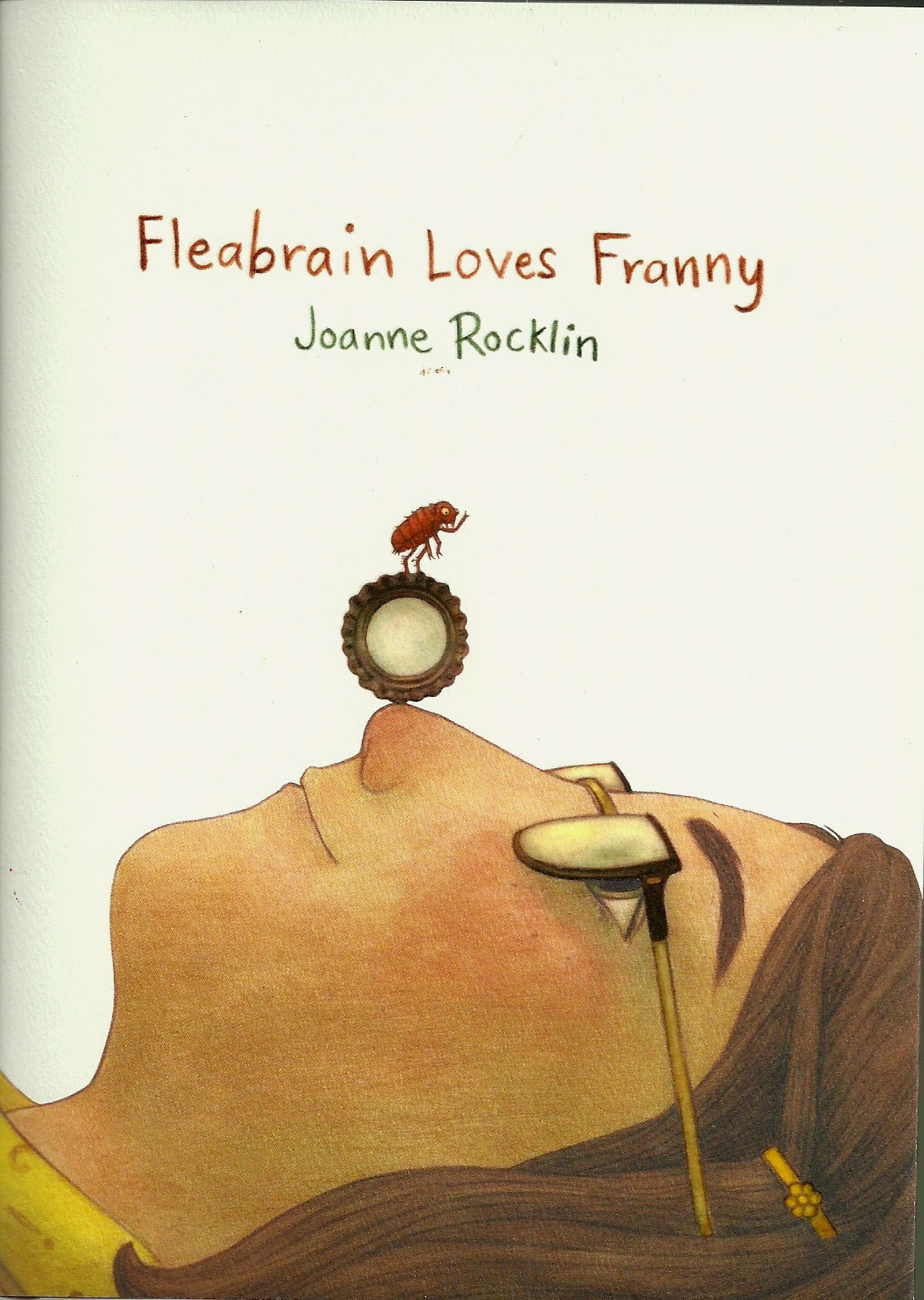
Rocklin’s new book, Fleabrain Loves Franny, is a very different novel.  It’s the story of a young girl, Franny Katzenback, who is recovering from polio.  It’s set in 1952, in a suburb of Pittsburg, where a sense of quiet optimism is surrounding the development of a vaccine.  One of the men who works with Jonas Salk at the University of Pittsburg, Professor Guttman, is Franny’s neighbor.  But for Franny, the vaccine comes too late.  Her dreams are of a cure for the neuromuscular damage that has left her unable to walk, a dream that will not be fulfilled.   
 
Confined to the upstairs of her house, she endures the treatment of a mean nurse who tells her she can walk again if only she follows her exercises, ice packs and heat treatment.  Meanwhile, Franny must adjust to life without the use of her legs.  She is only happy when she’s immersed in the book Charlotte’s Web, which also came out in 1952.  In wishing for an insect companion to cheer her and save her from feelings of helplessness and anger, she begins a fantastic relationship with a flea. 
 
Fleabrain, a pompous and erudite flea, lives on the tail of Franny’s beloved dog.  Franny is able to see him through the bottle cap of Sparky’s Finest Soda, which has a small magnifying glass imbedded in it – “so the about-to-drinker would have a magnified view of all the bubbles, like luminous marbles swimming up from the bottom of the bottle.”  
 
Fleabrain tries to be luminous, and Franny is the light of his life.  He’s multi-lingual, highly educated, super-strong, and often ridiculous.  He’s jealous of Charlotte, even though she’s a fictional spider.  In this book, all the lines between fiction, fantasy and reality are blurred.  The simplicity of the setting for Charlotte’s web and its pastoral view of childhood is not replicated here.  Fleabrain is as likely to irritate as to be helpful, but he’s a flea, after all.  And Franny seems only to be able to imagine such a creature.    
 
And this flea is a magic flea, so he leads Franny on adventures saving people from fires, visiting the Seven Wonders of the World and lighting Christmas tree stars. Franny is whisked away from the cruelties of her nurse and the even more painful interactions with her former friends. 
 
None of her neighborhood friends will get close enough to her that she could touch them and infect them.  They believe she’s contagious and wear bags of garlic around their neck to ward off her germs.  Franny has to endure their patronizing and pity. While she’s grateful for a March of Dimes Walk to help fund the search for a vaccine, she feels awkward and unhinged by it all. 
 
“Other kids were calling her name from across the street…People began to clap for her – Franny! FrannyFranny looked up and at her father and saw tears in his eyes.  She didn’t want her father to cry.  Franny understood a little better then how a poster child must feel, relieved to know that others understood the difficulty of it all.  She was grateful to the newspapers and the March of Dimes for educating the public.  But they were clapping for her as if she’d done something.   All she’d done was get polio.   
“’We miss you, Franny, ‘ called Teresa. 
But which Franny?  Franny wanted to ask.  Which Franny do you miss?  Because, actually, I’ve been here all along.  In the flesh.” 
 
As her world becomes more complex, and she gets more control in her real life, her adventures with Fleabrain diminish.  Though the interactions with Fleabrain make up a lot of the book, it feels like he’s a conduit for her to get her back to a healthy image of herself without his help, that is, without the help of fantasy.  At first, no one understand Franny but Fleabrain, but as she grows, she outgrows her need for him.  Even as Fleabrain’s prickly ways soften, she goes about fixing herself in ways that are brave and audacious but much bigger than the flea inspired fantasies she’d previously allowed herself.  
 
Joanne Rocklin is a wonderful writer and her descriptions make even the most audacious events come alive.  She’s added newspaper reports of a helper/angel that describe some of Franny and Fleabrain’s adventures, leaving the reader to ponder what is real and what is fantasy.  This is a unique portrait of a complex girl in a complex time.  You can see a book trailer about it here, and also a link to a PDF document of all the books, movies and cultural events that Fleabrain and Franny refer to. The book has a great “Author’s Note” describing the race to find a vaccine for polio.
 
These references make the book somewhat dense, and this might be better for a teenage reader or younger reader who’s quite bookish.  It made me want to re-read not only Charlotte’s Web, but Kafka’s MetamorphosisHow many books can you say that about?

By the way, for a charming post about why E.B. White chose a spider for his heroine for Charlotte’s web, read this post on Brain Pickings, and altogether engaging and insightful blog:

http://www.brainpickings.org/2013/10/15/e-b-white-on-charlottes-web/
 

Thanks for reading my blog.  I appreciate any comments and shares. 


Tara Books: Slender Art Galleries on the Book Shelf

Ever since the internet and inexpensive computers and e-readers came into existence, people have been speculating on the death of the book.  From where I sit, though, books are flourishing.  Instead of killing off the book, I think new technologies have allowed more people to produce more kinds of books and find an audience.
One of the newer presses I’m particularly grateful for is Tara Books.  I’m pretty sure I would never have even found out about them if it weren’t for modern networking through the internet.  Tara Books was started in Chennai, India, by visionary publisher Gita Wolf over 10 years ago.  Here’s an excerpt from an article by the Christian Science Monitor, July, 2014:
“Over the past 10 years, she (Gita Wolf) has collaborated with women tribal artists to create award-winning publications. In doing so, she’s helped the women step across the gulf that divides preliterate societies from the modern world of arts and letters.
”She had a young son and was dissatisfied with the available children’s books. She wanted to see bold illustrations that showed children the world of India, and she enlisted friends who were writers and designers to help create them.
“She was also active in the feminist and anti-caste movements. Five years ago she turned Tara into a worker-owned collective.”
The first book I bought from Tara was The Night Life of the Trees, by artists Durga Bai, Bhajju Shyam, and Ram Singh Urveti of the Gond tribe.  It was a pleasure to read, touch and see.  The art was exquisite line work in bright colors on black handmade paper.  The ink had a presence: it had what artist Tom Sarmo calls a “thingness.”  The narrative was poetic and told tales that blurred the borders between trees, humans, and creatures.  It was true work of art, handbound, and I could purchase it here in Portland for about $30.  Anyone anywhere could purchase it from Amazon.

It’s almost miraculous that these beautiful books by tribal people from a remote area can be bought and treasured everywhere in the world.
Not all their books are silk screened and handmade, but all of them are beautifully presented.
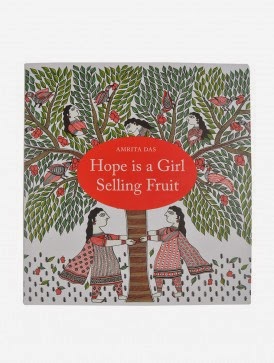
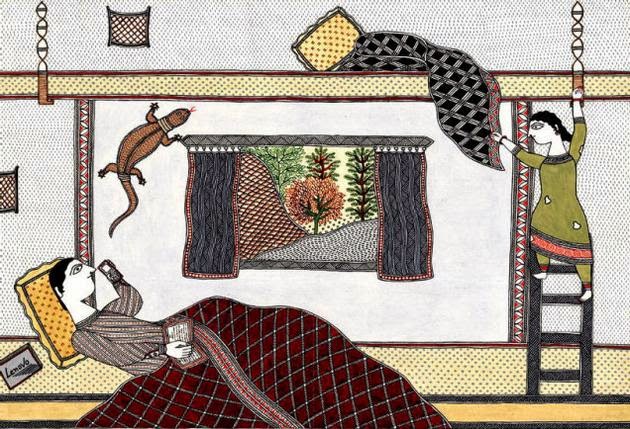
The latest book I got from them is Hope is a Girl Selling Fruit by Amrita Das.  Das has painted in the Mithila tradition of art, which originated from women living in rural Bihar.  Das builds on traditional style and creates a compelling story.  Her art illustrates her personal journey and the journey she imagines of an impoverished girl she met on a train.  The story honors the traditions of women in her culture but also questions the confines of their lives.  Even the girl who represents hope is a mixed metaphor — the art beautiful, the life it portrays hard.
“This other girl was poor too, and her clothes were torn.  She had lost a leg, but she managed to push her cart around confidently.  Two boys pointed to her and laughed, but she wasn’t bothered….  She’s her own creature, I thought, she walking around, she’s earning and supporting her family.”
I learn more about human strength and dignity in a book like this than I can ever glean from the news or documentaries.  Tara doesn’t print books about artists, the artists speak for themselves.  And it turns out their personal stories are universal, with undertones of myth and magic.
In a similar vein, Following my Paintbrush by Dulari Deva, text by Gita Wolf, is done also in colorful vibrant Mithila art.  It starts out simply:
“I am an artist, but I wasn’t always one.  This is the story of how it happened.”
 She tells how she worked in rice fields, cooked and took care of brothers and sisters, sold fish, and washed other people’s dishes.  “Time passed and I grew up, but I still did the same work.  I had never gone to school, so I was not trained to do any other job.  Sometimes I wished I could do something else.  Everyday was the same, as it had been from the time I was a small girl.”
One day, she sees a group of children playing and makes a picture in her mind.  Next she paints a fish in the mud.  Then she finds out a lady she works for is an artist.  The artist encourages Deva and she begins to create not only gorgeous art but a new identity for herself
Tara publishes all sorts of stories.  They have both men and women artists and storytellers creating books.
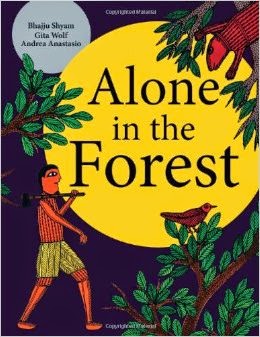
Alone in the Forest, by Bhajju Shyam, Andrea Anastasio, and Gita Wolf, is a folk tale.  Musa has to gather firewood because his mother is sick.  “I’m grown up now, I’ll get the wood!”  But it isn’t long before the sounds of the forest convince him that he is being stalked by a wild boar.  His imagination runs wild as he hides in the hollow of a tree.
 The illustrations of his imaginings and fear are enchanting, even when they’re scary.  The text is integrated into the drawings and furthers the visual delight.  The colors are muted and natural; it feels like you’re looking into a forest. The style isn’t realistic but it portrays the chaos of feeling lost.  The trees and animals are highly detailed — imagination and traditional imagery are at play here. I love that a yellow cow comes to the rescue, in its peaceful way, and brings Musa home.
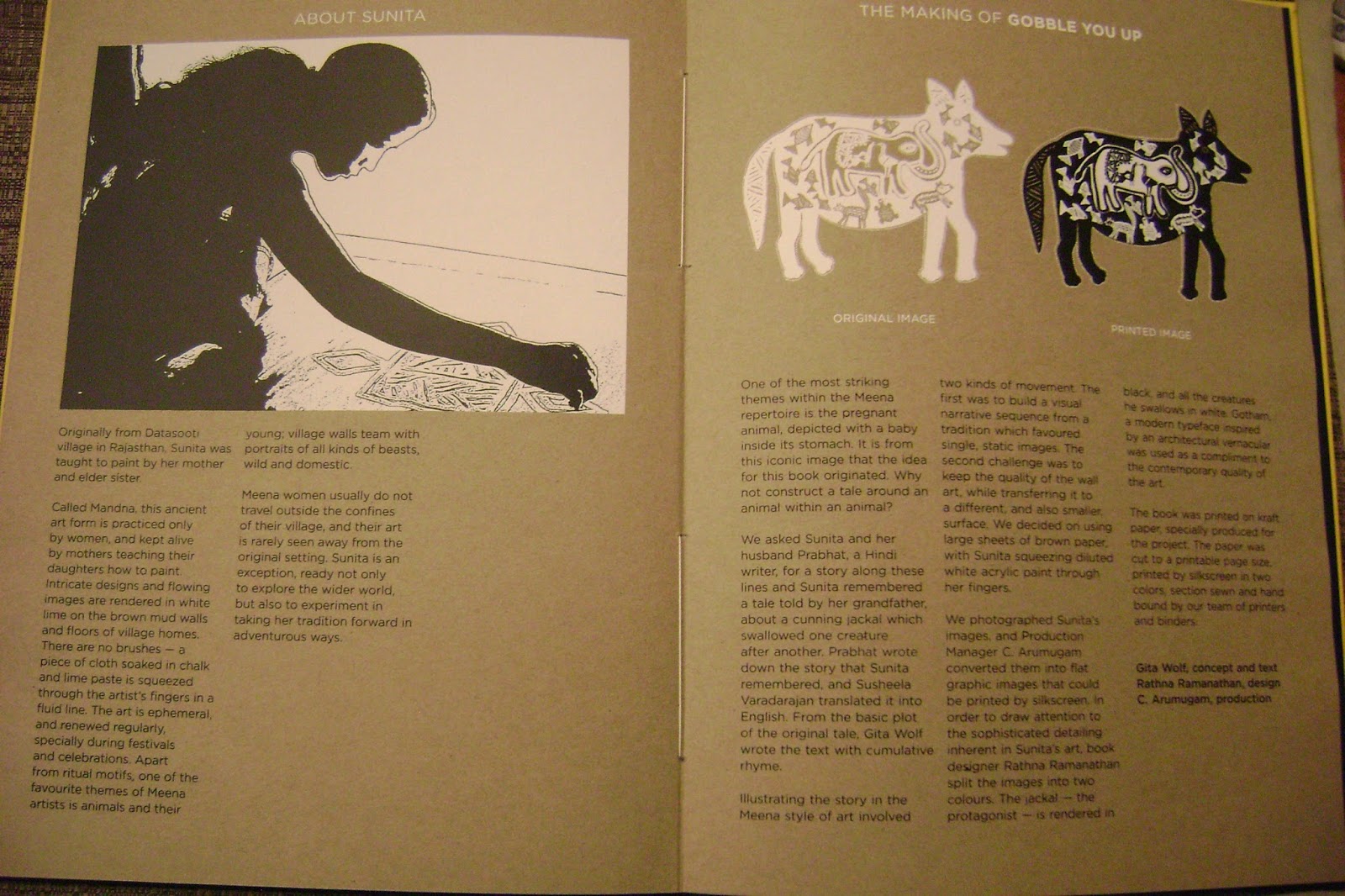
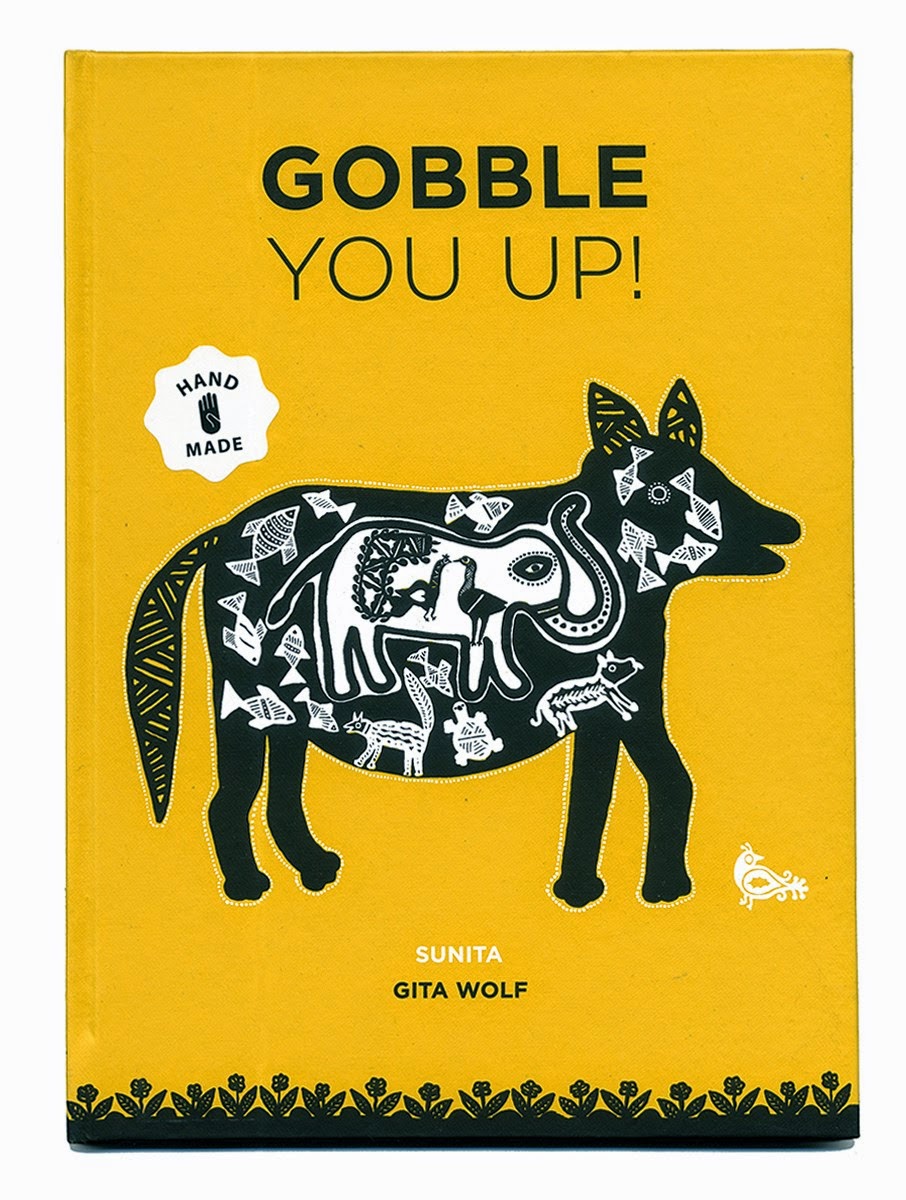
Gobble You Up,by Sunita and Gita Wolf, is another of Tara’s hand made books.  Printed on handmade brown paper with black and white drawings, it’s a captivating book in all regards.  An adaptation of an oral Rajasthani trickster tale, featuring a wily jackal who tricks and eats his friend the crane.  Then he proceeds to gobble up every animal he comes across.
Sunita is an artist from the Meena tribe in Rajasthan, who works in a traditional finger painting style called Mandna.  This book is the first time that this art form has been used to illustrate a children’s story.  To keep the feel of the art, it’s been silkscreen printed in two colors by hand on specially made kraft paper.  The drawings have a lacy, delicate feel that speaks of the transitory nature of all life.
I’ve loved introducing children here at Bridge Meadows to this book at Halloween time, when funny scary stories are in demand.  It’s a work of art they can touch.  They know a jackal can’t eat an elephant, but they also know greed can be insatiable.  It delights them to see all the animals in the bloated jackal’s belly and then see the animals come back to life. We love the off kilter rhymes and expressive texts.
And I, too, know that greed can be insatiable.  I feel insatiable about the books Tara is creating and encouraging.   I have to buy them rather than just check them out at the library.  I feel like they are little art galleries I can open and immerse myself in.  And when I’m done, I can slip them back onto the bookshelf in my small apartment, where they will wait til I need them again.  As I collect them, I’ll share what I find.
These books are available in some libraries.  The Multnomah County library has Following My Brush, Alone in the Forest, and, surprisingly, Gobble You Up!, a limited edition.  (They have #99 of 7000).  So, if you can’t afford them, check them out at the library.  Most libraries will help you get books from other libraries through their networking system.
You can learn more about Tara books here.
Here is a direct link to a video of their printing process: https://www.youtube.com/watch?v=om6i3enGZ8c
If you liked this post, feel free to share it.
Thanks for stopping by.

The Illuminated Brain


<!–[if !mso]>st1\:*{behavior:url(#ieooui) } <![endif]–>

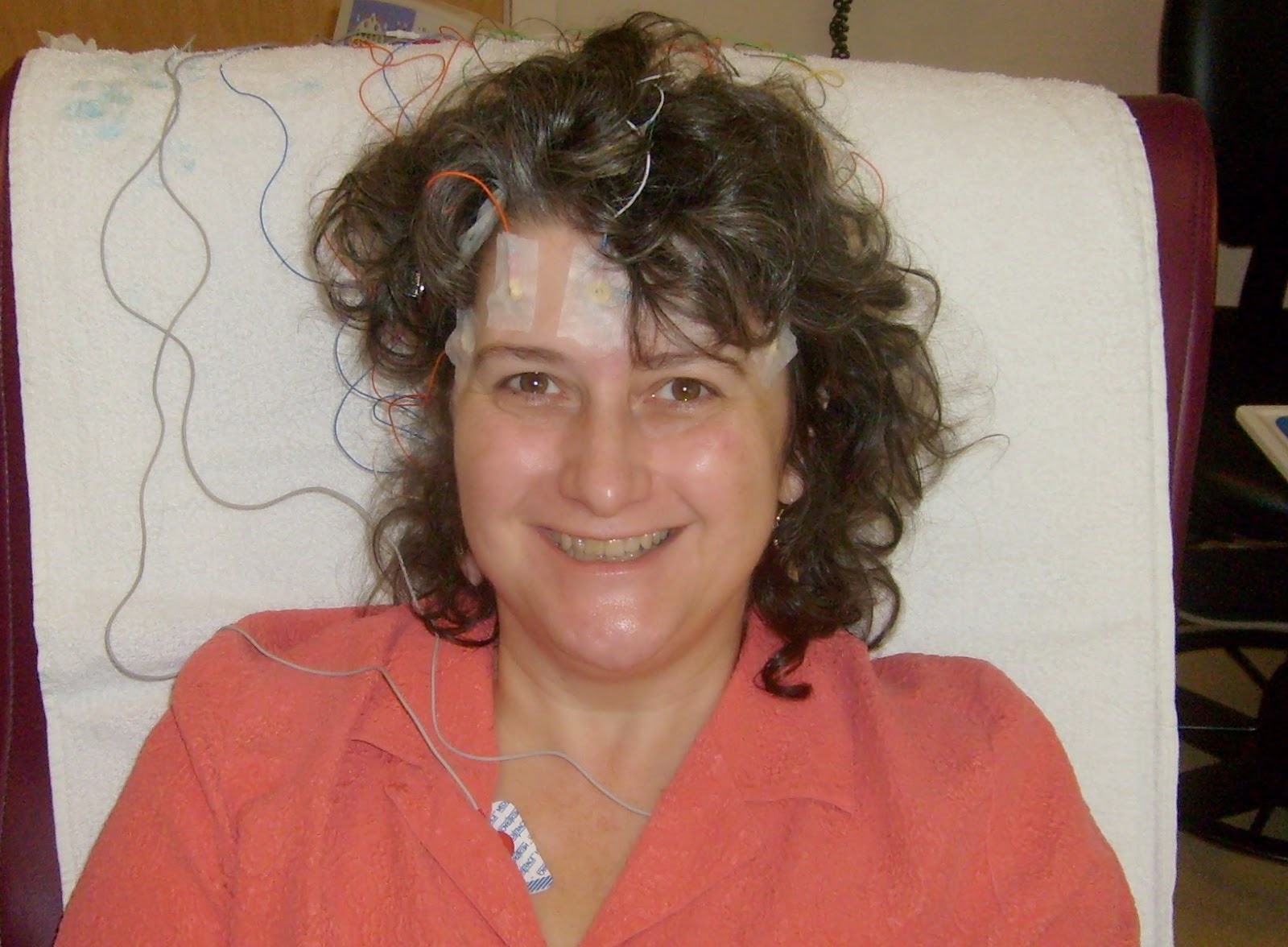
I haven’t always had a good relationship with my brain.  I developed neurological problems when I was 16, including epilepsy and muscle deterioration.  At the time, back in 1976, they didn’t have things like MRIs and my condition remained a mystery most of my life.   
My second neurologist gave me the diagnosis of “abnormal,” which I will always be proud of.  My condition is still a mystery but I now know I have a lesion in my spine, and I have a diagnosis of Transverse Myelitis.  I no longer have seizures, but I have some cognitive blips, and wrestle with fatigue, depression, and occasional mania.  For awhile, I was pretty sure my brain was trying to kill me. 
Luckily I found the books of Dr. Oliver Sacks.  His work made me feel like I would eventually understand my brain.  More importantly, he has such a profound respect for “abnormalities” and all the ways the brain overcomes damage, regenerates itself, and creates new modes of perception, that I began to think my brain and I could be friends. 
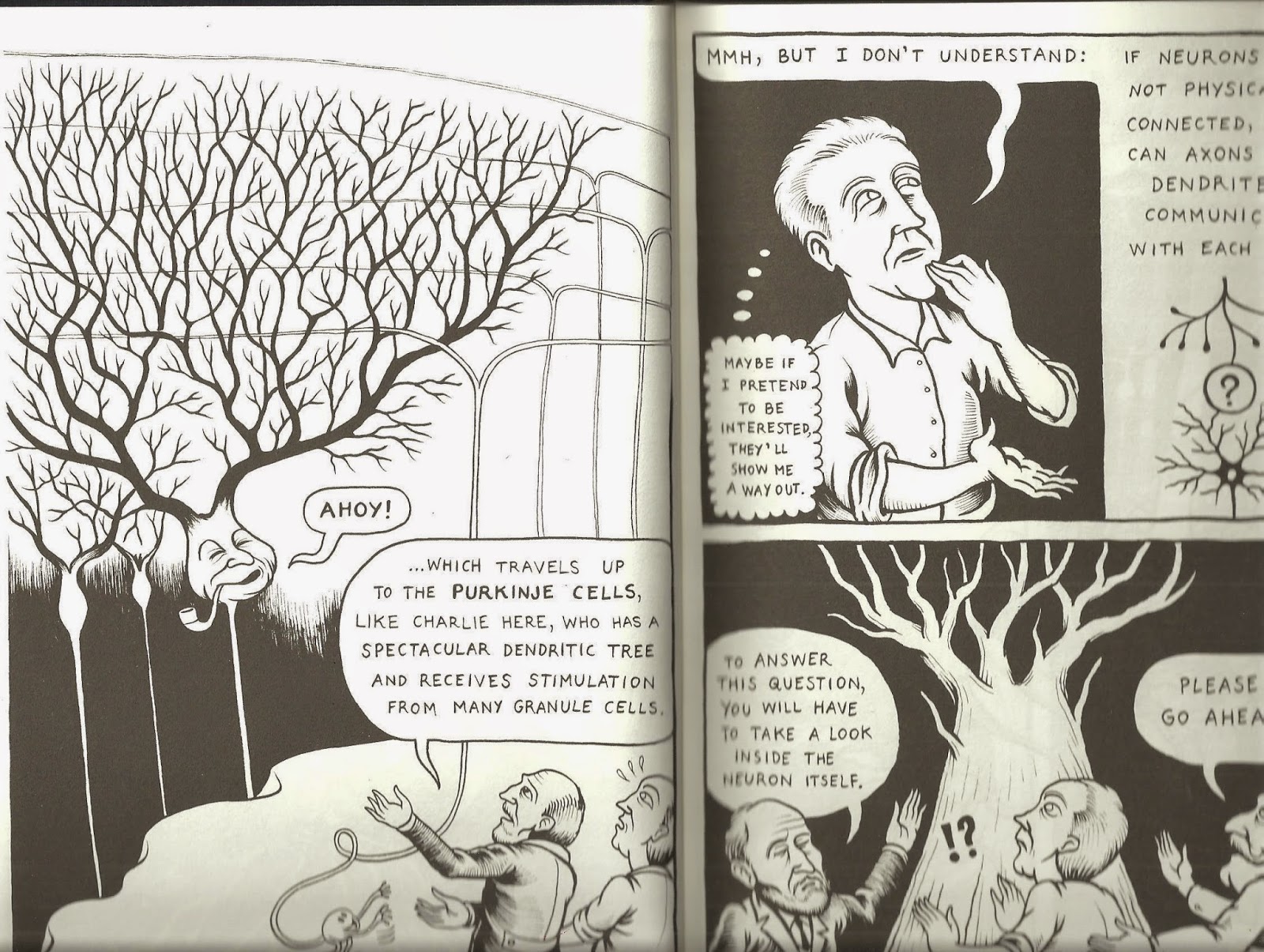
I’ve recently fallen in love with the book Neurocomic by Dr. Hana Ros and Matteo Farinella, beautifully published by Nobrow this year.  It combines all the best elements of science, art, humor, story and information.  It illuminates the brain in new and wonderful ways.
The book opens with a man who starts to flirt with a woman then finds himself sucked into her brain.  His quest is to get back out so he can continue to pursue her.  He has no idea where he is and wanders through a neuron forest until he runs into Santiago Roman y Cajal, a “Spanish neuroscientist and Nobel Laureate (1852-1934)…considered as the father of neuroscience, although he always had a great passion for drawing.” 
Thus begins our hero’s journey through neuron forests, memory caves, and castles of deception.  Along the way, he runs into pioneers of neuroscience who seem to delight in sending him into even more mysterious places.  It amused me to think of neuroscientists spending eternity studying inside a living brain.  Is that heaven for them?  The scientists are only the beginning of the zaniness.  There’s a giant squid seeking revenge for experiments on its giant axons.  There’s an aplysia snail playing banjo.  We run into Pavlov and his dog.
It’s an altogether engrossing and entertaining way to learn about the brain.  We often see science as stuffy and serious, but this book injects so much playfulness and humor into neuroscience, that it’s an irresistible way to learn.  The drawings are lively and expressive.  I love the playful way brain functions are characterized.   
Dr. Hana Ros is neuroscientist with a PhD from Oxford University.  Matteo Farinella is an illustrator specializing in graphic journalism and scientific illustration.  Farinella received a PhD in neuroscience from the University College in London.
The story format helps illuminate both what is known and how much is still not known.  It’s a mysterious world, the world of the brain, and Neurocomic celebrates that mystery as much as the science.  Ros states in a video about the book that it’s difficult to explain what’s going on in the brain without the use of metaphors.  That our brains can make metaphors is miraculous to me, and that we can understand so much more about everything in terms of story and metaphor is, I think, the most comforting thing about this book.
The other comforting thing is the book itself.  Nobrow has done a stellar job in publishing it.  It’s a delight to hold and behold.  I worry that the era of beautiful books has come to an end with ebooks, but publishers like Nobrow are putting those fears to rest.  
Nobrow started 2008 in the UK, with the aim to provide an independent platform for graphic art, illustration and art.  It’s become a leading proponent of quality in book design and a standard bearer for original creative content in print publishing.
Neurocomic’s cover and spine are embossed with gold and silver ink.  

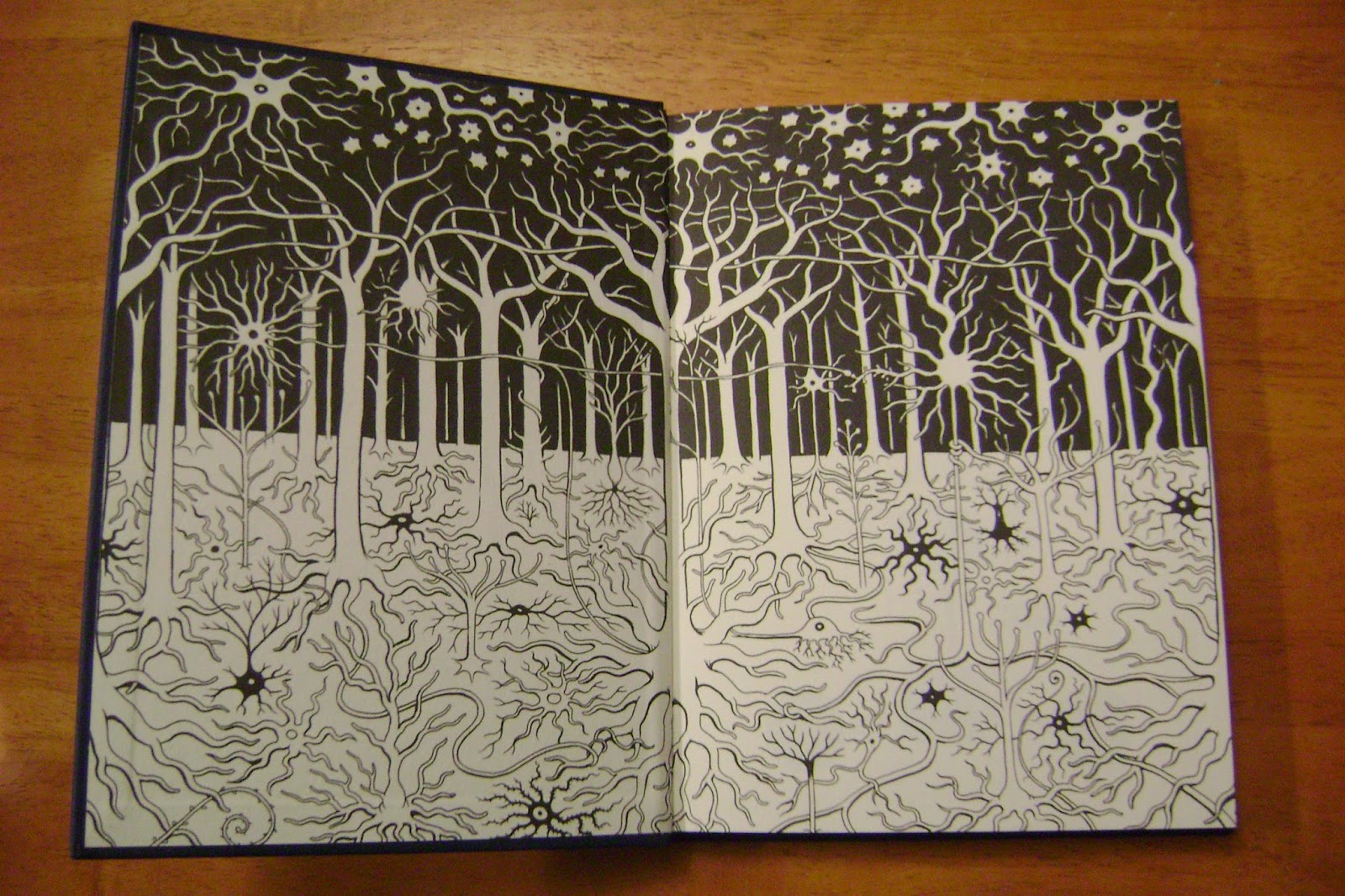
It has beautiful endpapers.
One of the problems with graphic novels is picture size.  Often the panels are so small, you lose impact.  Neurocomic has big panels and whole pages devoted to one frame.
It’s a charming way of learning a complex subject, and invites re-reading.  I think I’ll take it with me to read the next time I go to the neurologist.  
To learn more about Neurocomic, click here.  There’s a great video of the authors done by The Guardian here.
To see more amazing books by Nobrow, click here.    
If you missed my last post on the poetic astrophysics book, The Edge of the Sky by Dr. Roberto Trotta, you can read it here.
Remember, books make the best gifts.  If you liked this post, please feel free to share it.