Book Review: How to Be Sick

I wrote this in October of 2010.  I still refer to How to Be Sick on a regular basis

Toni Bernhard: “There is sickness here, but I am not sick.”

Life is suffering.  It’s not a punishment, it’s not a consequence, it’s just life.  I was fortunate to read How to Be Sick: A Buddhist-Inspired Guide for the Chronically Ill and Their Care Givers by Toni Bernhard (Wisdom Publications 2010) at a time when I was having a severe bout of insomnia that led to depression and an inability to coherently review the book or work on my websites.

My insomnia is often exacerbated by pain because of arthritis in my hip, knee and feet.  I have tried to make a place for insomnia and pain in my life and not blame myself for it.  It’s odd how we blame ourselves for the medical conditions – we always think if we had exercised more, eaten better, been a better person then we’d be experiencing great health.  I use these times now to read, look at art books, treat myself to little indulgences.  Still, it’s hard after a few nights not to despair – I know the wired insomnia energy will end with a huge bout of fatigue.

My first night with this book, I read through to Chapter 5: Who Is Sick?  She recalls a story by the Theravadan teacher Kamala Masters about her teacher who was quite old and had to endure an arduous journey with no food or water.  “She asked him if he was all right.  He replied, ‘There is heat here, but I am not hot.  There is hunger here, but I am not hungry.  There is irritation here, but I am not irritated.’”

Bernhard reports, “I recalled Kamala’s story one day as I lay in bed after becoming sick, so I silently said, ‘There is sickness here, but I am not sick.’  The statement made no sense to me.  But, inspired by the story, I persevered, repeating over and over, ‘There is sickness here, but I am not sick…There is sickness here, but I am not sick.” After a few minutes, I realized, ‘Of course! There is sickness in the body, but I am not sick.’  It was a revelation and a source of great comfort.  After a time, however, I decided to investigate more deeply.  When I did, this question arose, ‘Who is this I who isn’t sick?’”

It’s very hard to see yourself beyond what is irritating, hurting or keeping you awake.  Years ago, I heard a scientist on some documentary say, Even when you’re dying a large percentage of your body is still working fine.

I began then to try to get myself to pay attention to the parts that were working well and not give all the attention to the “squeaky wheels” of my body.

How To Be Sick is a guide to help you become familiar with that person who is not a sickness, but an individual capable of a joyful life, even though that life may have turned out vastly different than what you planned.  It’s also a guide for discovering who you are even if you’re perfectly healthy.  Bernhard was a student of Buddhism before she got sick and had already done a lot of work toward the Buddha’s teachings on “no-fixed-self.”

There is a lot fight in her to maintain her sense of self, but she’s let the illness guide her to a fuller interpretation of self, that can include sickness.  She contracted an acute viral infection on what was supposed to be a vacation to Paris in 2001.  She never recovered and is now living a largely house-centered life.  Even sitting up for long periods of time can exhaust her.  She has tried numerous treatments from the medical and alternative health communities but is still sick and may be that way for the rest of her time on Earth.

“For me…reality meant having the symptoms that accompany a severe flu, including the dazed sick feeling and low-grade headache, but without the fever, the sore throat, and the cough.  To imagine it, multiply the extreme fatigue of a flu by an order of magnitude.  Add in a heart pounding with the kind of wired, oppressive fatigue that healthy people associate with severe jet lag, making it hard to concentrate or even watch TV – let alone to nap or even sleep at night.”  She lists all the varying diagnoses she’s had that are variations on the Chronic Fatigue Syndrome “garbage pail” diagnosis.

In 1982 she received a J.D. from the School of Law at the University of California, Davis.  She joined the faculty and served for twenty-two years and also served as Dean of Students for six years.  In 1992, she began to study and practice Buddhism.  She went on yearly retreats to meditation centers and led a meditation group of her own.

This practice allowed her eventually to see herself as no-fixed-self and not some idea of a “sick person.”  She writes: “When you are chronically ill…you have to make some very hard choices.  Ironically, people may think you’re giving up, when in fact you are simply giving in to the reality of your new life.”

She quotes Byron Katie, “You can argue with the way things are.  You’ll lose, but only 100% of the time.”
Instead of continuing to argue with reality, Bernhard  spends that energy sharing what she’s learned from her teachers and her own experience about the whole concept of life and suffering.  She affirms that we can find the joy in the lives we have.  She gleans wisdom not only from Buddhism but from stories she’s found from others on coping with illness and death.  She is supremely grateful to have insurance and a loving family.

Buddhism has taught me much, as have most of the spiritual disciplines I’ve studied.  But I’ve always had a monkey mind (I call it popcorn brain), and even after studying at the Buddhist Naropa Institute in Boulder in 1978, I was never able to successfully meditate in the traditional sense.   For one thing the lotus position hurt me.   I could never empty my mind unless I was reading or writing, and later in life creating art.
So I was thrilled when I read, “My online wanderings revealed that many people, regardless of their religious affiliation, found that starting a meditation practice was the single most helpful treatment they tried.  So, Buddhist or not, many people turn to meditation when they become chronically ill.  This devoted Buddhist, however turned away from it.”  It was just too hard when coping with her symptoms.  She began to focus on the “mindfulness of the present moment.”

I was 2 years into my neurological disability when I went to Naropa, my right leg had already started to weaken and atrophy.  I was on medication for epilepsy and had a lot of headaches.  I had “drop foot,” the right foot always in the down position, and my gangly galumphing walk.  The great thing was there were some wonderful people who could meditate and tell me their stories.  I learned even as my mind swung around from tree to tree.  I was there to study poetry first and Buddhism second.  I always felt I’d missed something valuable by not being able to sit more than a few times through the group meditations.  Later I realized it was the stories that remained with me, the lessons taught, more than the actual method I used to learn and rest my mind.

The stories Bernhard tells, the lessons she gives, the exercises she stresses offer such a soothing balm.  The reading is a meditation in itself.  There is a “Broken Glass” lesson that deeply touched my heart and gave me a profound sense of compassion for myself, others and life in general.

She has been blessed with a very supportive husband and caregiver who also practices Buddhism.  The lessons in How To Be Sick can help alleviate some of the isolation and resentment caregivers feel when a loved one is taken ill.  Life is change – a lot of the suffering of life is our inability to cope with change.  This book offers good coping exercises, even if you’re not Buddhist.

I had hoped that the writing of this book gave Bernhard a sense of well being, and it did, but the actual process of it was arduous and sometimes exacerbated her symptoms.  She wrote about this process in the preface of the book and how she was sometimes unable to work on it for months.

Hard-headed in my belief that art processes heal, I asked her through an email if she felt writing the book actually helped alleviate  symptoms, since that is my experience with pain.  She wrote, “You asked if writing alleviates my symptoms. I wish I could say ‘yes’ but, unfortunately, unless I’m very disciplined and pace myself, it can make them worse (as I write about in the Preface of the book). That said, I find it so satisfying that I’m willing to feel worse sometimes in order to finish working on a piece that’s important to me. So, the act of creating is healing — to my spirit and my mind — but, unfortunately, not to my body!”

Ah yes, the spirit and mind can not necessarily influence the stubborn agenda of the body.  But a creative discipline can make living in the body a deeper, richer experience, no matter the circumstances.

Chronically Inspired Conversation

I am in the process of moving my articles from my blog Chronically Inspired to here — at least the ones that still seem relevant.  This was one of the first posts I did  back in September of 2010.  I could backdate them, but I decided just to go through the site and re-post, so for the next few weeks I may seem profoundly prolific.  I had two blogs, Chronically Inspired and Joy Corcoran Studio.  Now I have just this one and they must converge.

I sent out some information on this Chronically Inspired concept on my Facebook page and got into a very interesting dialogue with a friend. I wanted to share part of it here. She is very insightful and helps me develop my thoughts, as well as gives me a wealth of links on art work and music. I hope that readers of this blog will feel free to post comments on their challenges and the ways they have risen above them.

She wrote: “My understanding is that Portland is an advanced city in its approach to accessibility and public transportation, so I hope this will help attract an audience. Even if the return on your investment is small, please never discount that little investment. I found that lots of people look and enjoy but don’t comment….But to the site, there wasn’t enough info for me to evaluate specifically with managing chronic pain or even fatigue…outside of generalities with journaling and the like. I think those are great tools, but people have to be in a mind-set that’s open to that in the first place. Please look at this link to the laughter guru http://www.newyorker.com/reporting/2010/08/30/100830fa_fact_khatchadourian I think it’s important.”

I wrote: “I actually just got through reading that article this week-end! I love it and plan to guide people to such things in the workshop. There are active laughter yoga groups here. I just watch funny movies or read funny books. Since I just started the blog, I know there’s a dearth of real information outside the generalities of announcing the class. As I put it together, I’ll add more detail. I sometimes feel I don’t want to add too much so people will come to the class, but then I want to share everything with everyone.
“Portland is much more accessible than a lot of cities. People in the suburbs still have problems, but all the bus, trolley and trains are completely accessible. There aren’t curb cuts at every corner, but we’re working on it. A lot of the buildings are on hills and have steep stairs and are totally inaccessible both for wheelchair users and other mobility limited people. The room they do most of the art workshops in isn’t really accessible, so I insisted  got one on the lower floor.  If it’s not accessible, what’s the point?”

She: “Your best sentence? If it’s not accessible, what’s the point? I can tell you how we’ve tried to rise above limitations, but it’s from here on the East Coast and frankly, it hasn’t gone all that well, but I do have some stories. Mainly I’ve ALWAYS explored accessible outdoors trails and the like: fishing areas, etc. As you likely know, the mind erects the greatest barriers. Still, reality is that physical barriers exist aplenty too. :(“

Me: “I don’t think rising above limitations is the same thing as escaping them. We can’t. We can’t eliminate pain; we can’t regenerate lost nervous systems. It’s normal to feel trapped by both our bodies and our physical barriers. I just know that after accepting them, I have always tried to make sure I live them to the fullest. And the fact that I can’t do everything I want, or go wherever I want whenever I want, keeps me from running around using up energy on things that don’t really feed my soul. The days when I’m incapacitated by pain or fatigue, or when I can’t get to an event because I’m too exhausted and the bus won’t be available for the trip home, I make it a point to at least read something special or listen to something wonderful, and give my heart a bit of positive experience, sometimes more profound than what I missed by staying within my limits.
“I’ve also developed a ‘pain place’ — I don’t know what to call it yet because pain place doesn’t sound very pleasant. I sometimes am hurting and it’s a long time before my next pain med, usually the middle of the night, I can’t sleep. I used to just be angry and frustrated about it (still am a little bit). I’ve risen above it because I’ve stashed some soft blankets and pillows, a favorite book, a favorite CD and movie, a few toys, a sketch book/diary and a very small amount of gourmet chocolate in this one corner of my living room.
“I can only go there when I’m in major pain or severely depressed. It works very well in shifting my mood from anger to acceptance, and then I can occupy my conscious mind with things I love (letters from my kids or mom are there, too) and the pain has to take a back seat. It’s a wonderful way to deal with it that feeds the creativity bank, releases endorphins and passes the time in a more creative state that just pain and anger.
“Sorry for the long post but I’m have a “popcorn mind” day and lots of ideas are jumping around. “

She: “Joy, you’ve learned well how to handle a lot of… obstacles (sounds as though you had a lot of hard early training that you were going to be the one to soothe yourself and provide your own solutions.) To substitute immensely pleasurable and expanding activities when you can’t physically manage to “get” somewhere is smart: diversion, distraction, not giving into frustration and bitterness about life “not being fair”……AND self comfort. The “pain place” is also brilliant. I see what you mean about the name, but not sure if it matters if it doesn’t sound “pleasant.”
“I come to this discussion from vastly different places than you do. I can’t be exactly in your shoes, or in anyone else’s with a disability. My husband is the one with physical and mental disabilities, so I see it through the prism of a wife, first, and, due to the extent of his challenges, as a caregiver. My other perspective is professional: was a nurse, and later got a masters degree in Social Work (with a concentration in health, aging and disabilities.)
“So, I try to help my husband manage his advancing disabilities by being realistic about what he can do himself, respecting his desire for autonomy and independence, yet balancing that with what makes sense for him to try or not: is he going to hurt himself, and frankly, what kind of a bad spot am I going to find MYSELF in getting him out of trouble when he uses poor judgment in forging ahead when it just doesn’t make any sense. (This is extremely common.)
“Sorry, guess I’m having a bit of a “popcorn mind” myself this afternoon! (That is just the BEST phrase!)”

The conversation opened my eyes a bit more to the thoughtfulness of caregivers. Physical and mental disabilities impact the whole family. My friend exhibits some of the best aspects of being Chronically Inspired. She takes beautiful nature photographs, seeks out places she and her husband can enjoy, and is always kind and thoughtful to her friends. She has raised wonderful children and helps care for her parents. She has been hand in hand with her husband as his condition (Multiple Sclerosis) has changed both of their lives. Their world has narrowed, the things they can do are limited, there’s no getting around that. But she is rising above it in so many positive ways that it’s inspirational to me. And that’s the difference I hope to show on this website and in my workshops. Not to focus so much on the paths that aren’t accessible, but pay close attention to the path you are on and the beauty growing around you and within you.

And how, on those wonderful days when you have “popcorn mind,” to capture all the exploding tasty ideas that will nourish you when you’re too pooped to pop.

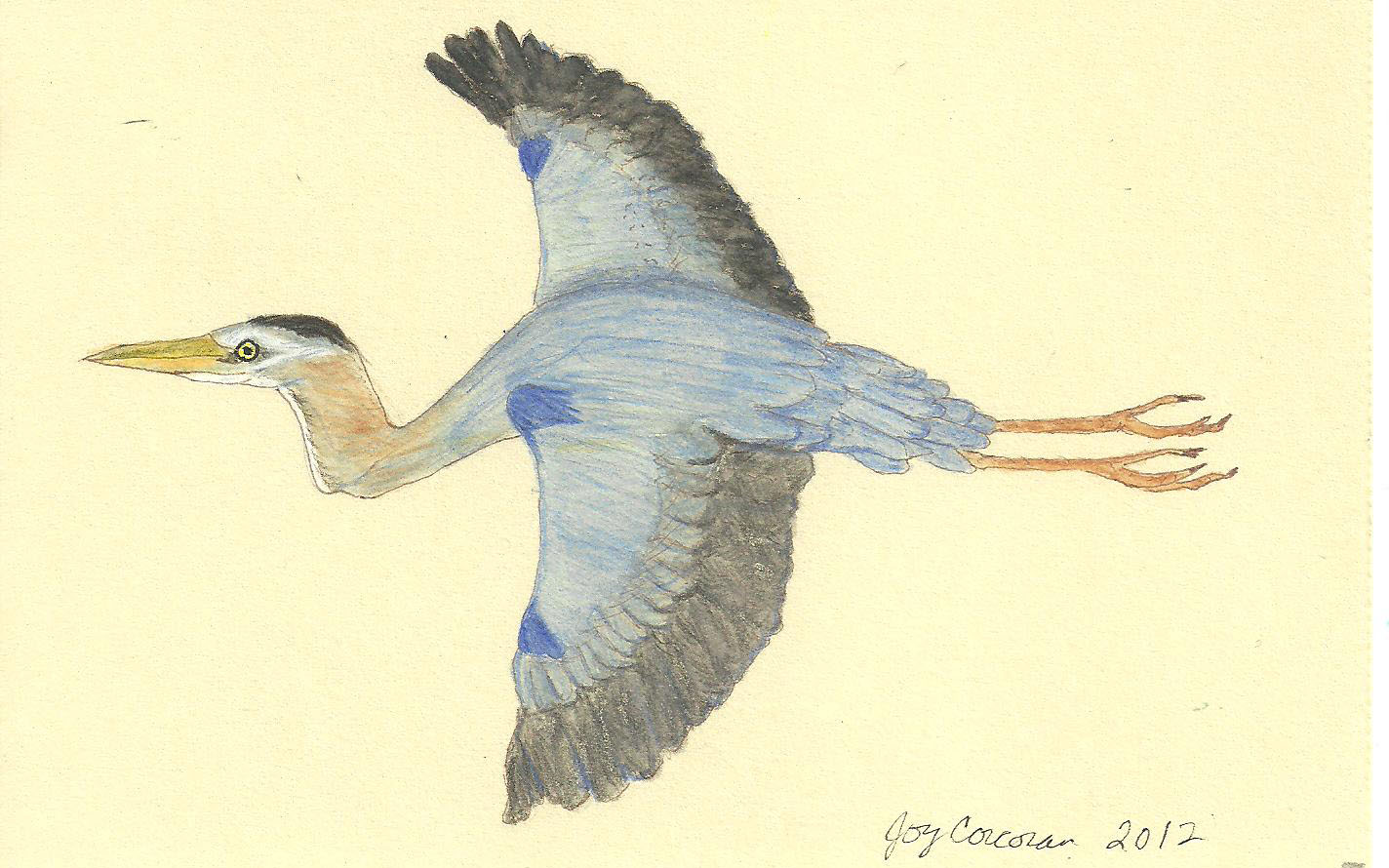
Another Heron Sketch

Great Blue Heron 

I sketched this after a friend commented how much she loved seeing the heron’s legs dangling behind them as they flew.   She watches them in Urbana, IL, and I watch them here in Portland, OR.  When my husband and I were courting a few years ago, we drove by a wetland preserve at dusk.  A great blue heron flew in front of the windshield.  We were poking along, flirting and enjoying the scenery.  Suddenly we saw beak, eye, feathers, and motion, Jim hit the brakes but it had ascended already, in one wing flap it reached the sky.  It was frightening because we almost hit it, but exhilarating because it appeared like a vision then soared into the heavens.   In the end, we felt that our relationship was blessed by a heron.  It’s a good sign that herons and other big ancient birds are still among us.  I hope we always respect and make room for their habitats.

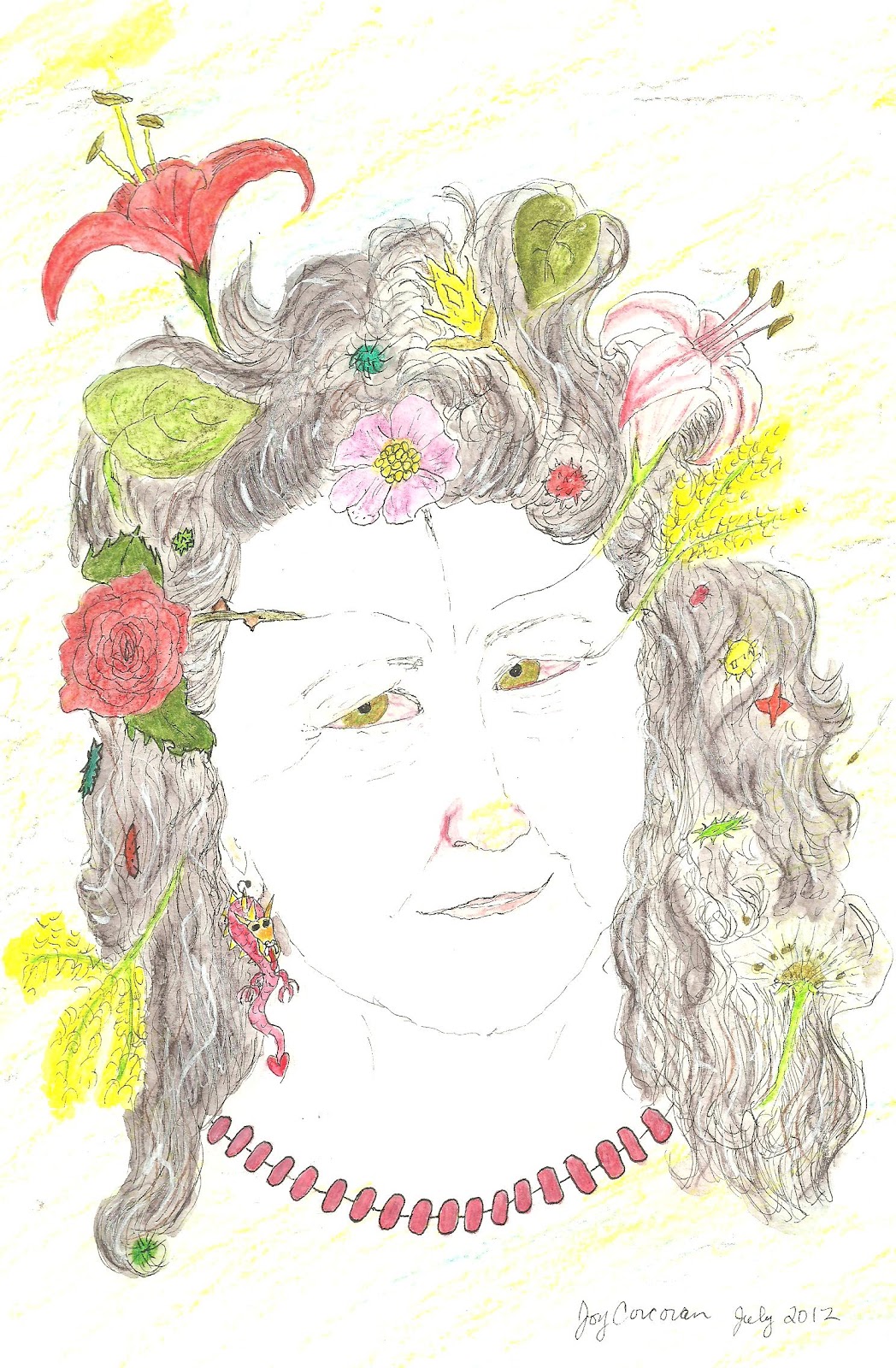
Summertime and the Livin is Sneezy

Or self-portrait with Benadryl necklace.  The scan doesn’t pick up the nice dusting of pastel pollen but you get the idea.  I meant my expression to be more resigned than severe, too, but one has to go with the lines one lays down in the sketchbook.

Mixed media on watercolor sketchbook paper.  8″x11″