Eternity in the Flowers

It’s hard to do a proper review of everything I read and love, so occasionally, I’m going to post an excerpt or picture from a book I love here on my blog. 
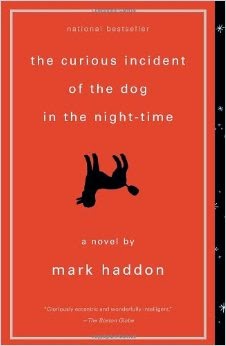
This is a meditation on death from the book The Curious Incident of the Dog in the Nighttime by Mark Haddon, which I picked up again and can’t put down.  The narrator, Christopher, has autism and was accused of killing a dog.  He is trying to puzzle out who really did it and it leads to many other puzzles that he was unaware of until he started trying to be a detective.  I like this passage, particularly now, when spring is here and all the plants are reviving and blooming and we all feel a sense of hope being resurrected from the earth:
                What actually happens when you die is that your brain stops working and your body rots, like Rabbit did when he died and we buried him in the earth at the bottom of the garden.  And all his molecules were broken down into other molecules and they went into the earth and were eaten by worms and went into the plants and if we go and dig in the same place in 10 years there will be nothing except his skeleton left.  And in 1,000 years even his skeleton will be gone.  But that’s all right because he is a part of the flowers and the apple tree and the hawthorn bush now.
                When people die they are sometimes put into coffins, which means that they don’t mix with the earth for a very long time until the wood of the coffin rots.
                But Mother was cremated.  This means she was put into a coffin and burned and ground up and turned into ash and smoke.  I do not know what happens to the ash and I couldn’t ask at the crematorium because I didn’t go to the funeral.  But the smoke goes out of the chimney and into the air and sometimes I look up into the sky and I think that there are molecules of Mother up there, or in the clouds over Africa or the Antarctic, or coming down as rain in the rain forests in Brazil, or in snow somewhere.

–Mark Haddon


Somehow We Bloom – Review of The Lost Language of Flowers

“The morning of my eviction I awoke before dawn.  My room was empty, the floor still damp and dirty in patches where the milk jugs had been.  My imminent homelessness had not been a conscious decision; yet, rising to dress on the morning I was to be turned out onto the street, I was surprised to find that I was not afraid.  Where I had expected fear, or anger, I was filled with nervous anticipation, the feeling similar to what I’d experienced as a young girl, on the eve of each new adoptive placement.  Now, as an adult, my hopes for the future were simple:  I wanted to be alone, and to be surrounded by flowers.  It seemed, finally, I might get exactly what I wanted.”  — Victoria Jones from The Language of Flowers by Vanessa Diffenbaugh
There are approximately 397,000 children in foster care in the United States.  When they turn 18, if they haven’t been adopted, they are “emancipated” and are put out of the system without a home, financial aid, or emotional support. 
The novel The Language of Flowers, by Vanessa Diffenbaugh, Ballantine Books, 2011, follows Victoria Jones, as she navigates her dismissal from the system.  She was abandoned as a baby and has lived in 32 different foster homes in her 18 years.  Her plan is to live in a San Francisco park.  Her intense desire to be alone makes living and gardening in a secluded area of the park seem more like an emancipation than homelessness.  The first thing we learn about her is that she is obsessed with flowers.
Unsurprisingly, her little Eden doesn’t turn out to be safe or even comfortable.  She’s an expert at slipping into restaurants and taking tables just as someone leaves so she can finish their leftovers.  And she’s not above filching what she can, but she’s hungry all the time.  She needs a job.  She tries for a position with a florist and soon proves herself capable and hardworking, with a tendency to show up with leaves in her hair.
The florist, Renata, is as tough in her way as Victoria and they work well together.  Renata helps Victoria find somewhat better living conditions and soon their lives are intertwined.  She connects with a mysterious vendor at the flower market and begins to have a conversation in flowers with him.  She finds out she has a gift for helping others through the flowers she chooses for them.  This gift stems from her education in the Victorian language of flowers, which she learned from the woman who almost adopted her, the closest Victoria ever got to having a mother.
The novel shifts back and forth in time, from her present struggle to survive, to when she was 10 years old and lived with the woman who promised to love her forever and adopt her, no matter what.  Elizabeth was a lonely woman estranged from her family who ran a vineyard and decided it was time to adopt a child.  Victoria was difficult and stubborn, but Elizabeth was used to difficult people and had a rough family history of her own.  She set up stern guidelines and nurtured Victoria as if she were revitalizing a neglected garden.  Elizabeth took Victoria out of school and taught her how flowers had meaning and were used to convey emotions and romantic intentions.  Honeysuckle for devotion, asters for patience, red roses for love, yellow roses for infidelity. 
We don’t find out until late in the novel what prevented the adoption, but Victoria learns early in her emancipation that the language of flowers is not consistent:
“Hours passed as I took in hundreds of pages of new information.  I sat frozen, only the pages of the books turning.  Looking up flowers one at a time, I cross-referenced everything I had memorized with the dictionaries stacked on the table. 
It wasn’t long before I knew.  Elizabeth had been as wrong about the language of flowers as she was about me.” 


This “wrongness” sets Victoria on a quest to make a definitive dictionary.  She has discovered her skill as a photographer.  She has let herself get involved with a man from her past.  She seems to be growing.  And yet she notices how different she is.  There is a core of damage in her that she believes she will never rise above.  While she helps customers use flowers to repair damaged relationships, she reflects:
“The conversations were sad, and amusing, and strangely hopeful all at the same time.  The relentlessness with which these women tried to repair their relationships was foreign to me; I didn’t understand why they didn’t simply give up.

“I knew that if it were me I would have let go:  of the man, of the child, and of the women with whom I discussed them.  But for the first time in my life, this thought did not bring me relief.  I began to notice the ways in which I kept myself isolated.  There were obvious things, such as living in a closet with six locks, and subtler ones, such as working on the opposite side of the table from Renata or standing behind the cash register when I talked to customers.  Whenever possible, I separated my body from those around me with plaster walls, solid wood tables, or heavy metal objects.
As she grows closer to the man who emerged from her past:
“My feelings for Grant, too, felt hidden, and I began to image a sphere surrounding my heart, as hard and polished as the surface of a hazelnut, impenetrable.”

Opening the sphere around one’s heart is a painful process, and not just for someone with no family who is trying to survive and make sense of world.  In this book, everyone has complex relationships with their families.  It’s compelling to see that the way people treat Victoria, the little kindnesses, make a huge difference in her life.  She does not heal easily, however.  Her inability to truly connect causes more grief and separations.  Her emotional distance remains a part of her character throughout the book, which made her seem very real. 
The intricacies of the flower business makes a nice counterpoint to Victoria’s character.  All the characters know that different flowers need different kinds of nurturing.  Victoria blows through their lives like a human air plant, unable to really understand what it means to be rooted.  Everyone can see that she’s smart, creative and capable of love, and of being loved – but she keeps locking doors or disappearing.
Since I mentor children who have been in the foster care system, I was impressed with how realistically Diffenbaugh wrote about Victoria’s life.  Her flower obsession is uniquely hers, but I know children just as smart with equally unique obsessions – these are the threads they hang on to in a world that is unstable and shifting.  Where one day they are in a group home, the next they are taken to a new family, and then, after varying times for varying reasons, they are taken back into the system.  Some become hardened and difficult, others too anxious to please.  It takes years of constancy to break through some of their shells.
Within those shells, though, there are bright souls.  I think Diffenbaugh illuminated one such soul and I’m glad the book became a best seller.
In writing The Language of Flowers, Diffenbaugh was inspired by her own experience as a foster mother and the stories she heard while teaching art and writing to young people in low-income communities.
She and Isis Dallis Keigwin founded The Camellia Network, a nationwide support organization for young people making the transition from foster care to independence.  The advance from The Language of Flowers was donated by Diffenbaugh to get it started. 
“Camellia Network harnesses the power of new technology to connect youth “aging out” of the foster care system with a community of resources, opportunities, encouragement and support. Youth have profiles on the site, giving them a place to express themselves, share their goals for the future and articulate what they need to be successful. Individuals and companies from across the country are able to collectively provide the support these young people lack by offering up doses of encouragement, career advice, professional connections, and financial support to help them navigate their way into adulthood.”

It’s an innovative way to help.  You can support a former foster child by helping them furnish their spaces (something as simple as a trash can) or help them pay for training to be a nurse, or go to community college.  Check it out here.
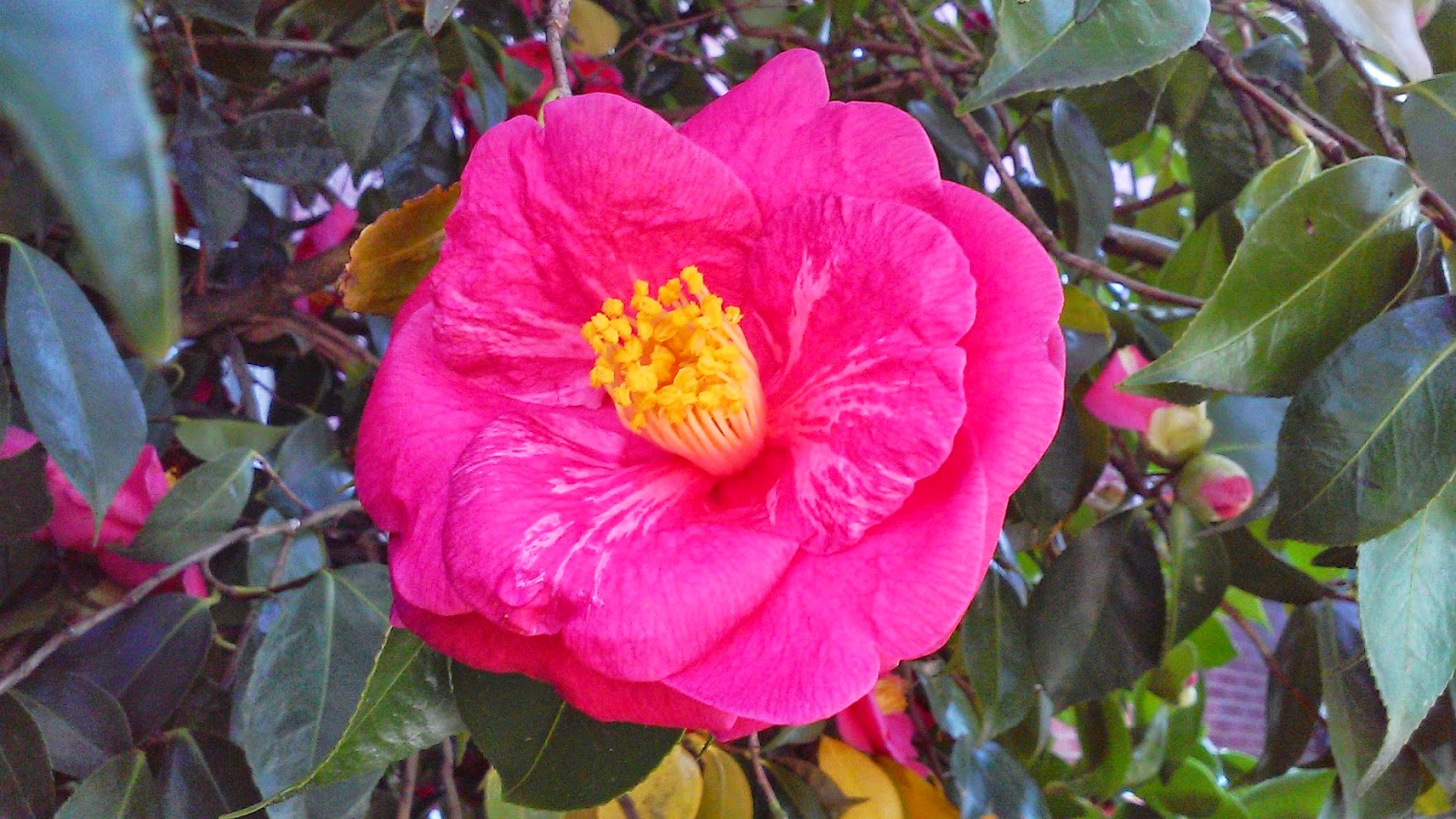
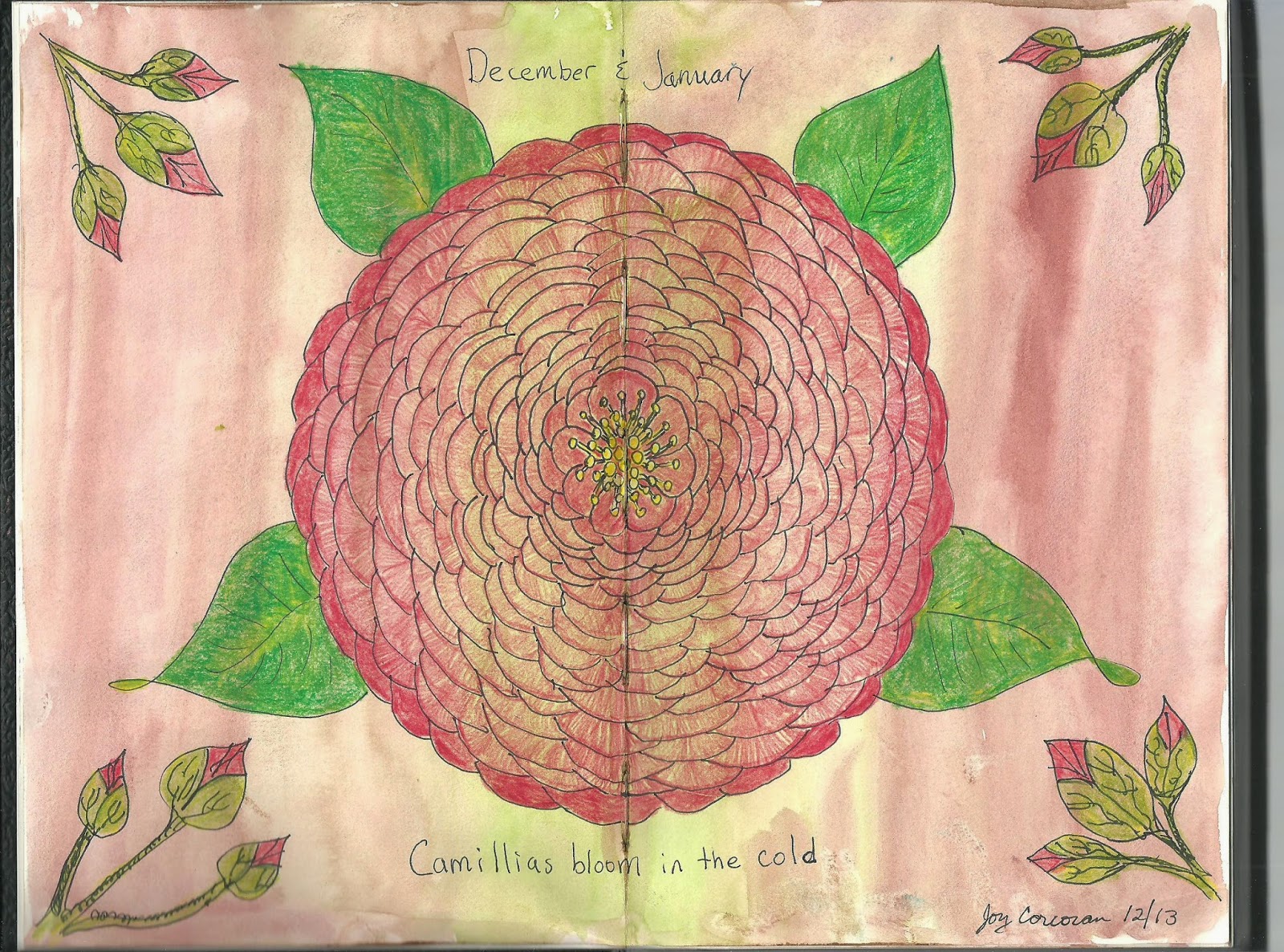
This book in no way reads like a plea to help foster youth.  It’s a compelling and beautifully written novel.  But I love that it’s a seed that started a network to help foster youth.  Camellia means my destiny is in your hands in the language of flowers.  We tend to forget that the destinies of those around us can be improved by little acts of kindness.  If we can simply learn not to pre-judge what it means to live in foster care, and what kind of person emerges from that system of support, then we can see the world around us a little more clearly.
I often mention that I live in Bridge Meadows, a community set up to support families adopting children out of the foster care system, so that they can have permanent homes.  Bridge Meadows is now in the process of building a small apartment complex for teens aging out of foster care.  It will be in the same neighborhood, and these young people will have access to the same elder network as the families who have adopted children. 
The Camellia Network and Bridge Meadows are innovative programs that can make life better for kids who are struggling to find their place in our society.  They serve as a way for us to connect, and sometimes that’s all it takes to give a complex story a happier ending.   

Shaun Tan’s Astonishing Worlds


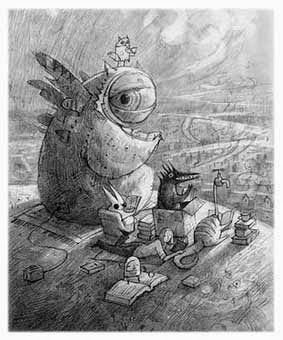
If you haven’t yet read the works of Shaun Tan, do yourself a favor and get to the nearest bookstore or library and partake of the feast of stories and images he offers. He is quite possibly my favorite writer of illustrated books.  I hesitate to call him a children’s book writer, although that’s how he’s marketed.  But like many writers pushed into that category because markets are so narrowly defined, he is a storyteller for all ages.  
I think as we age out of picture books and take on the allegedly more serious task of reading only text, we begin to lose some of our visual literacy.  We become blind to the images and wonder all around us.  Adults watch television and movies, we play video games and read on-line reports rich with photographs, but we deny ourselves the “childish” pleasure of reading picture and illustrated books.  Fortunately I never saw picture books as any different from any other visual delight.  Except for a brief time in my teens, I never gave up reading them.
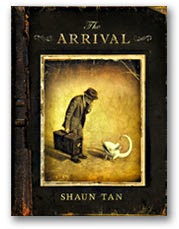
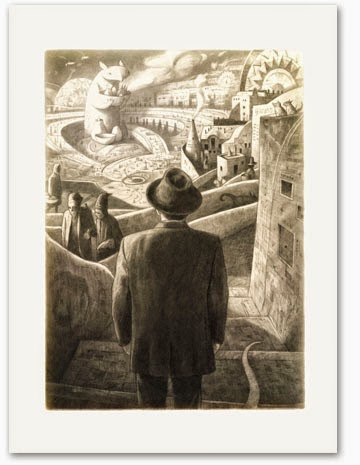
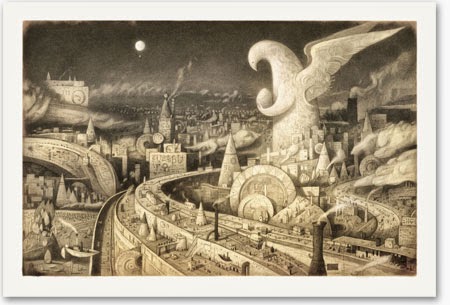
I did give up book collecting for awhile, but last year when I “read” Tan’s wordless tale of immigration, The Arrival, it re-awakened a desire to own books.  I want to see these images again and again.  They reveal new things at each reading.  The Arrival is the tale of a family immigrating from a land infested with some unnamed evil.  The father goes first and discovers a sort of utopia, filled with strange and bewildering things. 

It’s also a land filled with other immigrants and their stories unfold in deft complex graphite drawings.  It’s the best visual storytelling I’ve seen and is definitely a good read for adults.  Tan lives in Australia, where his father immigrated from Malaysia.  The Arrival, though, is about the whole experience of immigration and the thin line between chaos and order.  In a world filled with distopian stories, though, this one fills the reader with hope and a glimpse at utopia.

Then I saw the amazing film The Lost Thing, which is an animation of his story by the same name.  It won an Academy Award for Best Short Film.  (You can look it up on Youtube for a preview of it.  My attempts to embed it here failed. ) 
Next I read Tales from Outer Suburbia and it immediately became an old friend and companion.  I often reach for it in the middle of the night and let myself be transported.  The charm of Tan’s stories is that they aren’t so much an escape from this world, but a way of looking at it with new eyes.  There is boredom, depression, fear, loss, and loneliness.  His gift is his ability to refocus readers on the bits of wonder floating around outside those feelings, and the wondrous landscape in which these things come to life.
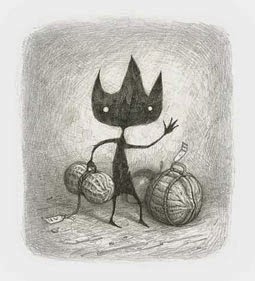
Tan’s language is spare and complex – rich with imagery and wry insight.  He has a gift for integrating the lyrical quality of dreams into waking life.  In Tales from Outer Suburbia, he tells stories of aliens, stick people and ghosts.  
Fear is muted by the delight he takes that such things exist on the periphery of our horizons.  His insights into the complexities of our desires for love, home, family and adventure are astonishing.  His stories can amuse, but they can often break your heart open to reveal hidden chambers that glitter with magic and redemption.  The illustrations and stories work seamlessly together, advancing the tales in a way words can’t. 
On his blog, Tan says, “Even the word illustration is a little misleading, because the best illustrations do not actually illustrate anything, in the sense of describing or illuminating. My own narrative images, and those of my favourite artists, are actually far more concerned with deepening the uncertainty of language, enjoying its ambiguous references, exploiting its slipperiness, and at times, confessing its inadequacy.”
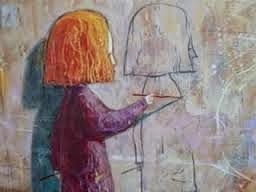
I found his book The Red Tree to be an accurate and moving portrayal of the way depression changes and skews your vision.  The economy of language and depth of the images told the tale in a way I’d never before imagined.  I was delighted by the simple way he told of how when depression passes, the whole world seems to glow with color.

 The book he illustrated for Gary Crews, Memorial, is an eloquent look at how war affects generations and the natural world as well.  It shows how man’s desire for progress often destroys what is best about life, in this case a beloved tree that 3 generations of veterans have felt was an homage to their service, and their home life. 

It’s a poetic and beautiful book that is unfortunately out of print in the United States.  It’s at the Multnomah County Library, though.

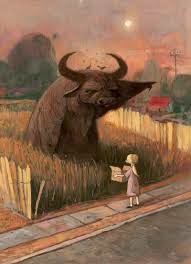
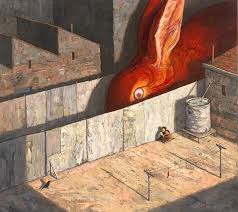
In his most recent book, Rules of Summer, Tan exploits the slipperiness of language and images with charm and grace.  An older brother has given his young brother certain rules of caution about how to proceed through the vastness of summer.  Full-page paintings have one-sentence rules, such as “Never leave a red sock on the clothesline.” The painting shows the two boys hiding behind a fence while a giant red rabbit glares at a single sock drying on the line. 

The rules conjure up their own reason for being.  Each sparse rule becomes a catalyst for a visual journey.  The Rules, for me, are a direct passage back to childhood, when the world wasn’t entirely understandable or safe, but anything could happen.  It restores a sense of the largeness of life, of our imaginations, of our hearts.

Tan is very generous with his images and time on the internet.  There are interviews with him on Youtube and he has a website, and a blog where he posts paintings he’s working on.  Go explore his world.  You’ll emerge from it with treasures that will enrich you forever.

Thanks for reading my blog.

A New Season of Blogging

It doesn’t seem like it’s been since July since I last posted here.  Two things kept me away from blogging.  I was in the lull of summer.  The heat just does me in.  It was particularly warm here in Portland, Oregon, and the heat held until yesterday.  Today a soft rain is falling, it’s 69 degrees and I feel a renewed sense of energy.

The other thing was a bit of post-ARTum depression. Do you ever get that?  You finish a big project, you’re happy with it, and you’re glad it’s done. Then you sink into malaise and can’t focus on anything.  I finished writing the 12 Lessons for Greatness and had a great list of things I wanted to do.  What I wound up doing, though, is reading like crazy.  It’s such a good way to cure that feeling of being drained.  I need to plan for that period of malaise and restoration after each project.  There’s no need to rush into another project without properly resting and refilling your creative spirit.

Although I’ve written the material for the 12 Lessons for Greatness, it’s inspired a new interest in helping parents find resources for teaching their kids values.  The word “values” has been politicized so much in the past decades, and yet we yearn for intelligent creative ways to teach our children lessons that will help them as they grow and work.  Fortunately, the YuhuHugs company is committed to making it easier to find playful ways for children to learn.  I’ll be posting news concerning that effort soon.

For the blog, I will continue to post my own experiences with my community, Bridge Meadows, where I work with kids who have been adopted out of the foster care system. 

I’ll also post stories and illustrations as I create them. I’ll share links to cool websites I find.

I had stopped reviewing books for a while because I had too much going on.  I keep reading great things, though, and will be re-starting book reviews.  I’ll lean towards reviews of children’s books — from picture books to young adults.  I also have a fondness for books from independent presses. I love illustrated books of all kinds.  I’ll be reviewing old books, too — even out of print books if I find a particularly lovely gem.   If you have a book you’d like to see reviewed on my blog, please let me know.  Almost all of the books I review will end up in the Bridge Meadows community library, so it will be appreciated by many.

You can read some of my previous book reviews here.

For now, it’s a rainy afternoon, and I must get on with my reading.  I’ll write again soon.