Earlier this year I served for a month on a grand jury. A grand jury hears cases presented by city prosecutors to see if there’s really enough evidence to go forward with prosecution. I heard close to 100 cases in 30 days. Most of them were traffic violations, but we got some pretty hard violent crime cases, too. And even the traffic violations were associated with addictions.
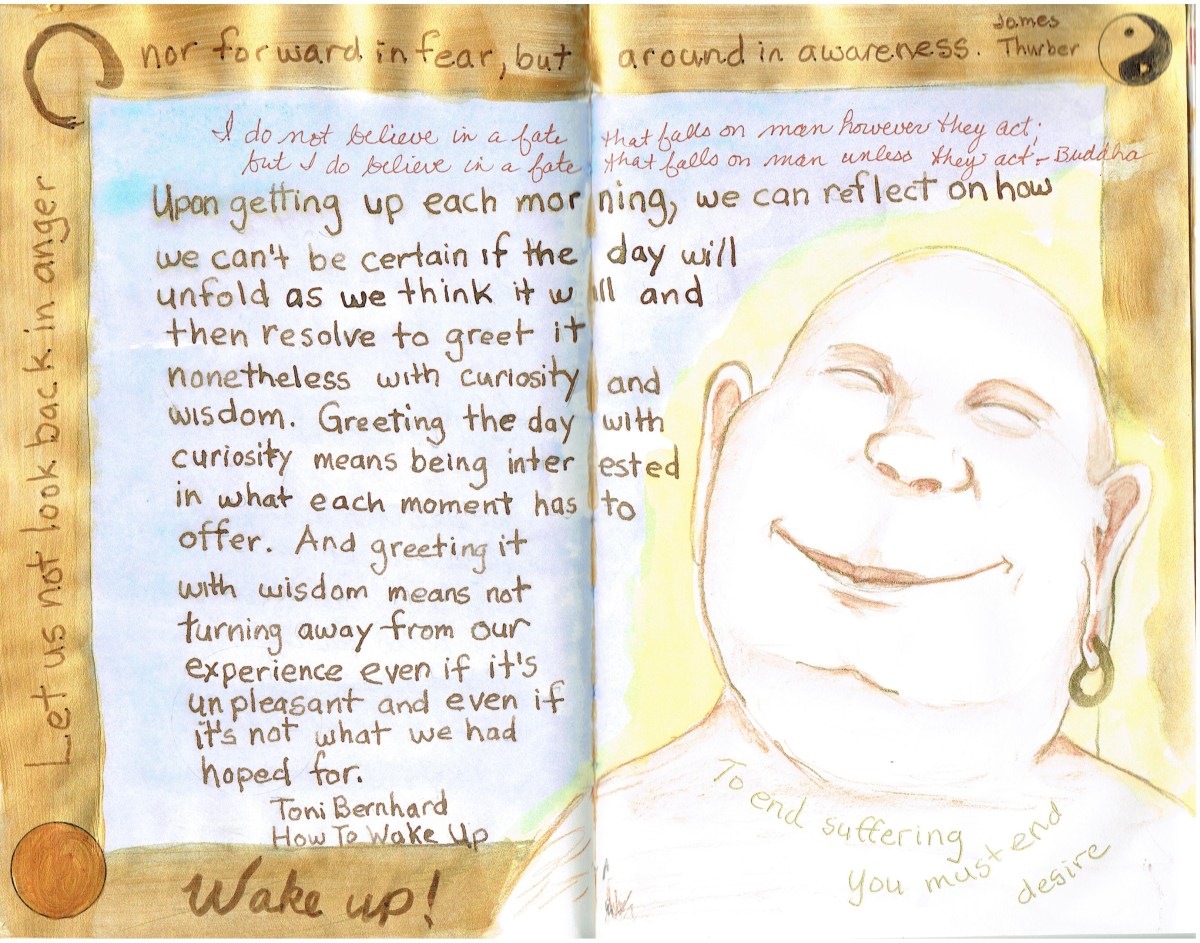
 One of the hardest things about serving on a jury is the mandate to not talk about the cases to anyone. Because I keep a journal and make art, I had a way of processing the sadness I felt over the human condition. At the time, I was reading Toni Bernhard’s book How to Wake Up: A Buddhist-Inspired Guide to Navigating Joy and Sorrow. After reading a particularly insightful passage, I made this entry into my journal, adding other bits of wisdom that helped keep me afloat:
Bernhard began writing about chronic illness after she fell ill on a trip to Paris in 2001. She was initially diagnosed with an acute viral infection. Only she never got better. So for approximately 15 years now, she’s had flu like symptoms, chronic fatigue/Myalgic Encephomyalitis, and is in bed for much of her life. Before she got sick, she was a law professor at the University of California at Davis, and served as dean of students for 6 years.
She’d been practicing Buddhist since the early 1990s.
How to Wake Up was Bernhard’s second book. Her first, How to be Sick, A 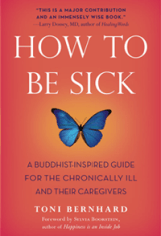 Buddhist Inspired Guide for the Chronically Ill and Their Caregivers, was published in 2010 and became one of my go-to books for helping me deal with a chronic illness that I’ve had since I was 16.
When I reviewed that book on my blog, I had the opportunity to email her and ask her if she felt that writing the book helped alleviate symptoms of her illness, since that is my experience with chronic pain: She wrote:
“I wish I could say ‘yes’ but, unfortunately, unless I’m very disciplined and pace myself, it can make them worse…. That said, I find it so satisfying that I’m willing to feel worse sometimes in order to finish working on a piece that’s important to me. So, the act of creating is healing — to my spirit and my mind — but, unfortunately, not to my body!”
So, I was delighted that she remained disciplined and has now come out with a third book, How to Live Well with Chronic Pain and Illness: A Mindful Guide.
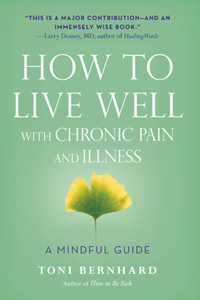
In the introduction, Making Peace with Life Upside Down, she writes:
“Many people think it’s somehow their fault when they become chronically ill. They see it as a personal failing on their part. We live in a culture that reinforces this view by bombarding us with messages about how, if we’d just eat this food or engage in that exercise, we need never worry about our health. For many years, I thought that the skillful response to my illness was to mount a militant battle against it. All I got for my effort was intense mental suffering – on top of the physical suffering I was already experiencing.
“The pivotal moment for me came when I realized that, although I couldn’t force my body to get better, I could heal my mind. From that moment, I began the process of learning (to reference the title of my first book) “how to be sick,” by which I mean how to develop the skills for living purposefully despite the limitations imposed by chronic illness….
“I vividly remember the first moment when I accepted my life as it is – chronic illness included. I felt a huge burden lift. For the first time since I became sick, the conviction that I absolutely need to recover my health in order to ever be happy again was absent.
“In the space created by that absence, I began writing about chronic illness.”
How to Live Well with Chronic Pain and Illness came at a great time for me, since I’m undergoing another major health transition. Even with acceptance and mindfulness, I fall into deep despair at times. I question everything I’ve ever done, from not exercising enough (even though when I started weakening I was riding my bike 10 miles a day), to not eating my spinach when I was kid. Part of the despair comes from not having many real models for accepting the loss of my health.
Bernhard’s writings helps untangle all the feelings that surround chronic pain and illness. In a chapter on letting go, she lists things not to do, including:
“Do not get hooked into believing you always have to ‘think positively.’
“This is known in the counseling profession as the ‘tyranny of positive thinking.’ Are we never supposed to get frustrated or disheartened about out medical conditions? That would be holding ourselves to an impossible standard. People in excellent health get frustrated and disheartened at times about their lives, so of course, those of us who are chronically ill do too. Our ‘unpositive thinking’ moods can be particularly intense, because they’re often triggered by stressful thoughts and emotions that arise because of our health problems.
“I have days when I’m just plain weary of being sick. I’ve come to think of this ‘unpositive thinking’ as a natural response to the relentlessness of chronic illness. I don’t try to force myself into thinking positively at a moment like this. I wait the feeling out, know that, like all feelings, it’s impermanent. Some people even tell us that positive thinking can cure disease. Although the mind and the body are interconnected, I do not believe that visualizing that we’re 100 percent healthy can cure chronic illness – although I’ve received dozens of emails trying to convince me otherwise.”
Sitting with and waiting out dark moods is an important and difficult skill to learn. Our bodies are fragile and they will eventually break down completely. There are countless things that can go wrong with anyone at any time. And even if you’re already struggling with a chronic illness, you will have other things go wrong, too. It’s hard not to resent that or wish for a better situation or feel that we’ve been singled out for unfair treatment.
How to Live Well offers support for those kinds of thoughts. There is sorrow in life and we must honor and accept it. But there are lots of ways of living more fully within the constraints of our situations. When we accept the life we have, we open up to its opportunities. There aren’t easy answers or promises of cures in this book, only guidance to live mindfully. And guidance for treating yourself compassionately:
“… there’s that out-of-touch-with-reality expectation that you should be able to control what goes on in your mind. Instead of getting impatient (that is, angry or upset) about unwelcome thoughts and emotions, you can work on holding them more lightly – sometimes even with a wry smile as you reflect on your mind’s seemingly nonstop unruliness. Doing this is a compassionate response to what arises in your mind.”
My husband picked up this book, and about halfway through reading it, we began a great dialog on his feelings about being a caregiver, and how my illness impacts his life. He ordered a copy for his sister, who, like many, is dealing with aging issues and feeling isolated.
How to Live Well provides gentle reminders to be compassionate to yourself and also to be aware of the measure of peace that resides within you, the space to create yourself and move forward with the life you have.
I highly recommend all of Toni Bernhard’s books. Her “voice” is soothing and friendly, but not condescending. Whether or not you’re a Buddhist (I’m not), the wisdom in these books is universal to anyone. You can also read her blog, hosted by Psychology Today, Turning Straw Into Gold: Life Through a Buddhist Lens.
If you’d like to read my review of How to Be Sick, you can read it here.
Thanks for reading my blog and may you live your days to their fullest.




 Who knew I’d be around in this strange and wondrous future? It’s not quite what the Jetson’s predicted, but there’s a lot of technological and medical advances that I never could have imagined in the 1960s, when I was watching that cartoon.












 joy murray art~stories~life