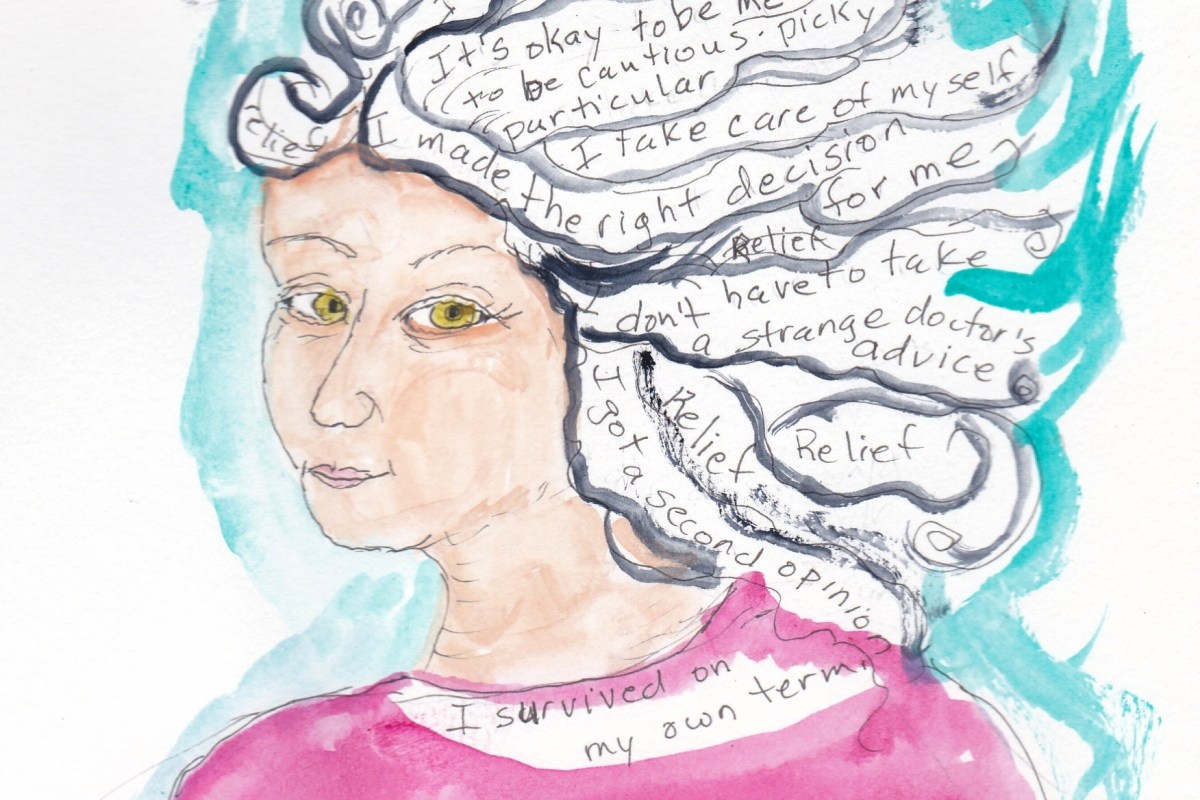
Steroid Paranoid

I had a pinched sciatica nerve for about a month.  It’s caused severe pain every day for that long.  I have moderate pain most of the time from osteo-arthritis in my hip, knee, ankle and toes.  This is caused by my limp from my neurological problem, transverse myelitis, which started when I was 16.  My right leg is atrophied and weak.  I walk by leaning over a bit, and kind of throwing my right leg forward.  Still, I walked a lot and even rode a bike until my mid 30s.   Since then I’ve had to use a cane, then a walker, and now I’ve added a wheelchair to my collection of assistive devices.  I’ve accepted these challenges with relative grace, though I also have bouts of terrible depression and feel defeated.

The pinched nerve caused pain all down my right leg.  I couldn’t find a position that was comfortable except flat on my back.  My doctor  was out of town.   I went to a minor emergency clinic and they gave me an anti-inflammatory shot, which helped for a few days, and gave me a referral to an orthopedic clinic.  That was on a Friday.  The following Monday, a friend drove me miles and miles to the clinic.  There was a 3 hour wait once we got there

The doctor took x-rays of my hip.  When he came back with the film, he was concerned about the curvature of my spine.  I gave him my information sheet that told of my neurological history, and my latest MRIs.  He glanced at my information then suggested a course of steroids.

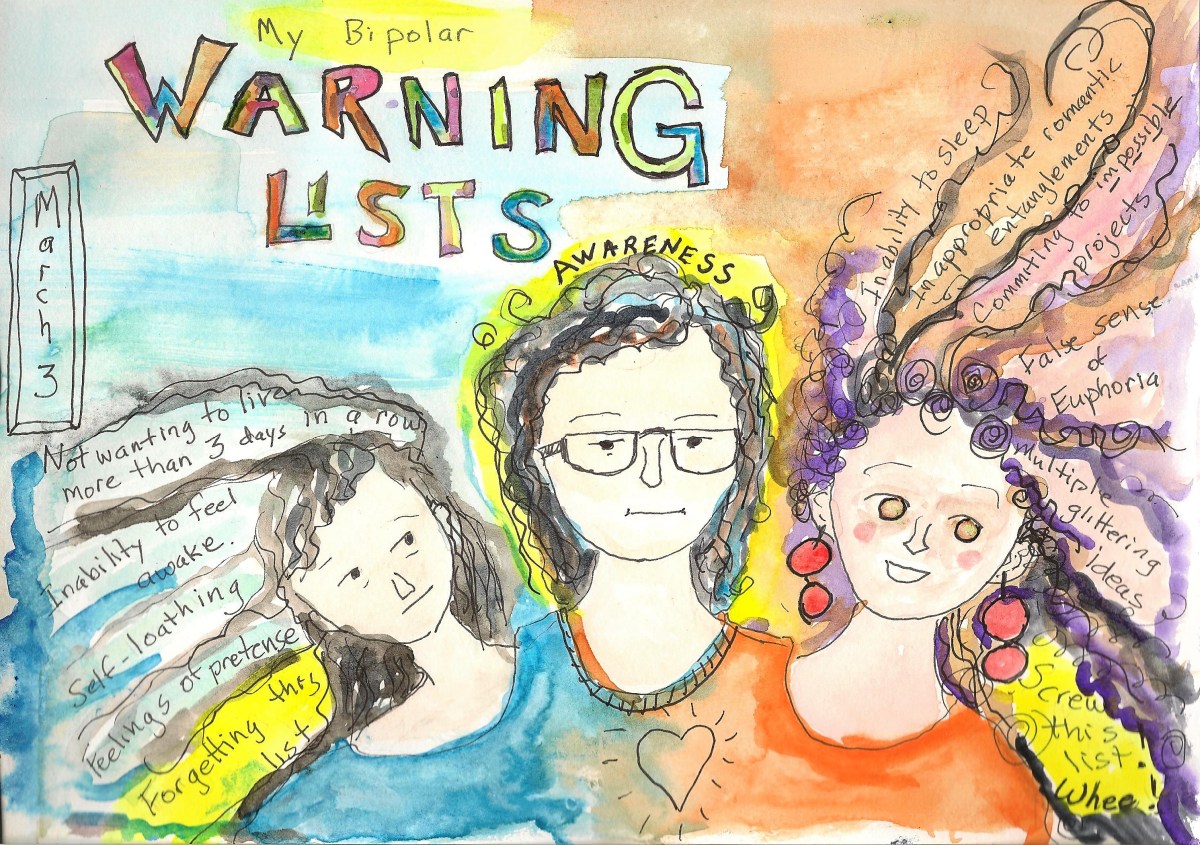
“I’m concerned about taking steroids.  I have a bi-polar disorder and I’m afraid I’ll have a bad reaction.”

He looked slightly put out.  “So are you like Robin Williams or do you just have mood swings?”

My brain froze and my guard went up.

It’s very hard to admit I have a mental disorder.  It’s hard for anyone.  I think the doctor may have been asking if I was suicidal, but I thought he was asking if I was talented like him, or as wild as him, or — I don’t know what.  I don’t think I have it as bad as Robin Williams did, but like so many with bi-polar and mood disorders, I do have a little voice inside me that whispers I’d be better off dead.  I’m afraid if I get manic on steroids, I might not be able to ignore it.  I’m between psychiatrists right now and am self-managing, so I don’t really have a good team to consult or keep an eye on me.  But I couldn’t say any of that.

“I self-manage now, so I guess it’s not severe but…”

“We can put you a short course of steroids to get the inflammation down and then we can figure out what the next step.”

“Can’t you give me an anti-inflammatory shot?”

“That’s not going to do much…” and after that all I heard was blah, blah, blah.  I was standing on one leg and leaning against the examination table.  My mind started going in circles.  I wanted out of there.  My fear of being a “bad” patient, not following doctor’s orders, and my feeling of insecurity about admitting my mental disorder had erupted.  I kept a calm face, said I’d take the steroids, told the nurse I’d call in three days and then I got the hell out of there.
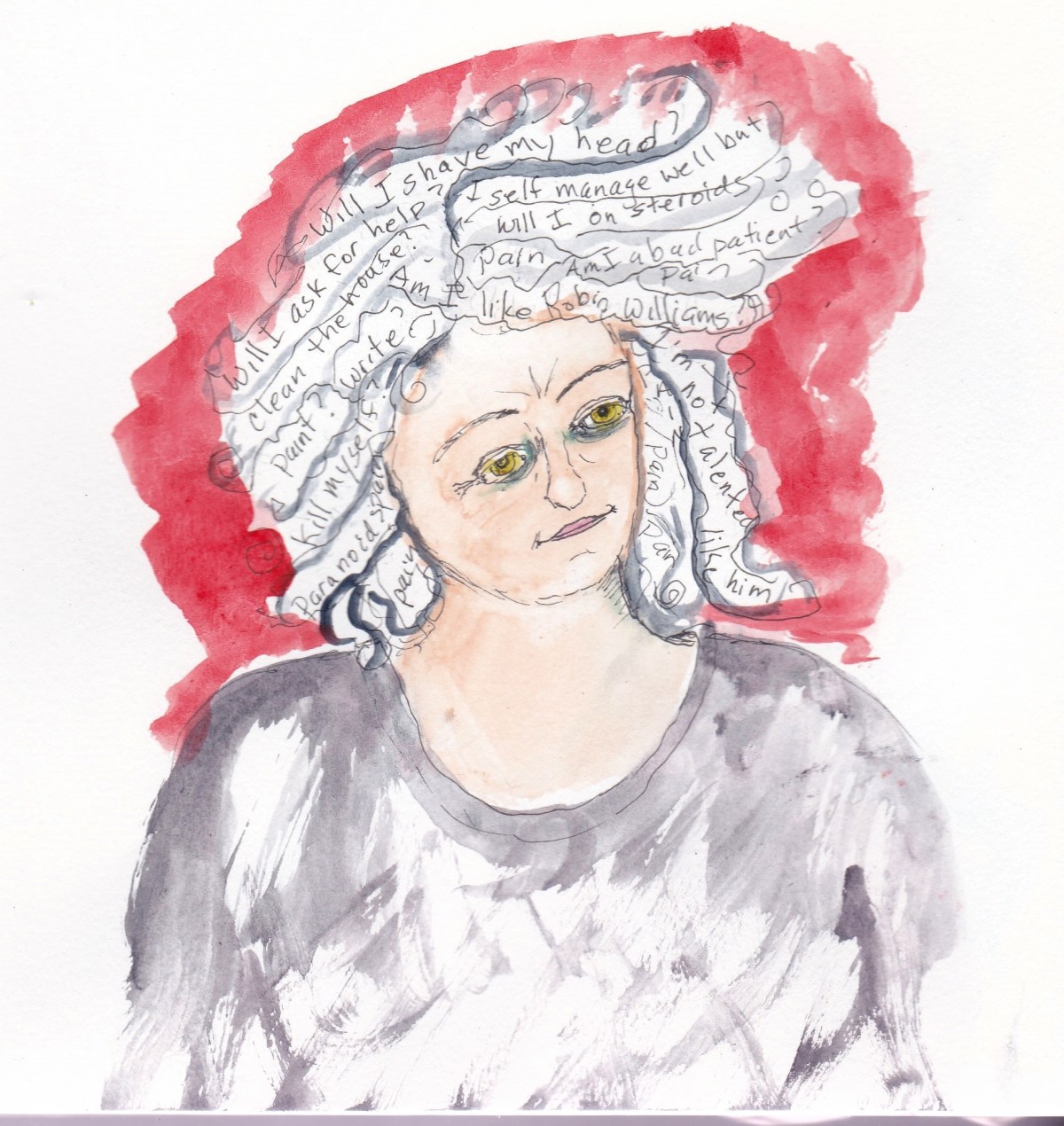
steroid

I didn’t take the steroids.  I was already fighting a compulsion to chop all my hair off.   I’d been in bed so much, that every time I looked in the mirror, it felt I was wearing a rat’s nest.  But cutting my hair off is a compulsion that flares up from time to time, and usually I resist until I can get to a salon and have it properly dealt with.  (Actually, a good way for me to fight that compulsion is to start an art project involving scissors.)  I could see me on steroids shaving my head bald, then deciding I’d ruined my life, and then…. I was gripped with fear, and felt stupid, too, for being so fearful.

I called my pharmacy to cancel the prescription, but the clinic hadn’t called it in, so that seemed like a sign that I’d made the right decision.


I spent a lot of time in bed, sometimes in tears because it hurt so badly, and isn’t my life challenging enough as it is?  Must I go through this, too?  I thought about the people who think I’m an inspiration.  If they could see me now, bitching and crying and whining like a little weasel weenie.

But my doctor was back in town after a few days.  He’s a great doctor.  I heard him in the next room talking and laughing with an elderly woman.  Then he came in my room.  I was stretching out my leg, leaning on the examination table, in obvious pain.  He gave me a hug.  I told him the steroid story, and he shook his head.  “You shouldn’t have to put up with that.”  He increased my pain meds, changed my anti-inflammatory meds, gave me an anti-inflammatory shot, and called my neurologist to get my appointment with him changed to an earlier date.  He gave me stretches to do that helped.

So thanks to him, I was able to work on my paintings a few hours a day, and have the art show I planned.  Then a few days ago, I woke up and the sciatic pain was gone.   And due to the different anti-inflammatory meds, my normal pain is at a very low level.

I was so glad I waited it out.

steroid 2

It wasn’t the first time I’d refused steroids.  When I was younger, and they hadn’t figured out exactly what was wrong with me and there were no MRI, I seemed to have the symptoms of multiple sclerosis.  One neurologist I was seeing had been very nice to me, but when I refused steroids, he told me he wouldn’t see me anymore.  “There’s nothing I can do for you.”

I know many people who’ve been helped by steroids.  And I might take them in the future.  If I lose strength in my upper body, if I lose my sight, I’ll try them if that’s the best option.  I’ve talked to psychiatrists about it and they agree that steroids are risky for people with mental health problems.  I would need to be monitored.  Another fear then pops up.  Will I have the good sense to ask someone to monitor me?

After this little drama, though,  I’m more confident that I will.  I’m also more confident that I’ll worry more about my own health, my unique situation, and less about following the doctor’s orders.

lantern plant


~~~

If you’d like to support my art and writing, please consider becoming a patron on Patreon:

https://www.patreon.com/user?u=8001665

You can get prints and cards of my work on Redbubble:

https://www.redbubble.com/people/JoyMurray/shop?asc=u
 

Unraveling

Thanks to my patrons on Patreon and those who bought my art at my art show, it looks like I’ll be able to keep my home internet service.  Thanks so very much to all of you.

I haven’t been as productive as I’d like because I have a pinched sciatic nerve that’s left me in intense pain.   My doctor was out of town, so I had to go to a minor medical clinic then an orthopedic clinic.  Neither were very helpful. (I’ll write about that in a future post.)  I’ve spent a lot of my time flat on my back or propped up on pillows with my leg straight.  It’s the only way I can get even close to comfort.

I was afraid I’d have to cancel my show, but when my doctor returned, he gave me an anti-inflammatory shot, a prescription for anti-inflammatories, and increased my pain medication.  It hasn’t eliminated the pain but it gives me a few hours a day when I can get out of bed and do some creative work.  It gave me enough relief to have the show.  I didn’t get as many paintings finished as I’d like, but I had enough.  My son Timothy Allen showed his work, too.

I’ve always taken comfort and found pain relief in drawing and painting.  But for this bout of pain, I couldn’t do it.   I can’t sit down comfortably.  I can’t stand for long.  I’ve been able to accept my physical limitations in the past.  Using a wheelchair and a walker isn’t the worst fate in the world.  But without even that option, it was hard, hard.  If this was going to last forever, I’d ask my son to make me some sort of art station I could use in the bed.

I got a bed desk, so I could write, use my laptop, and prop my books up. (I’m getting a phenomenal amount of reading done.  Also watching movies til my brains ooze out my ears.)

But the bed isn’t very big, I can’t easily get up and fetch water or clean brushes.  Besides, I was in pain and depressed.  But for the hour or so I could get up, I worked on a piece exploring my feelings about having a long term disability.

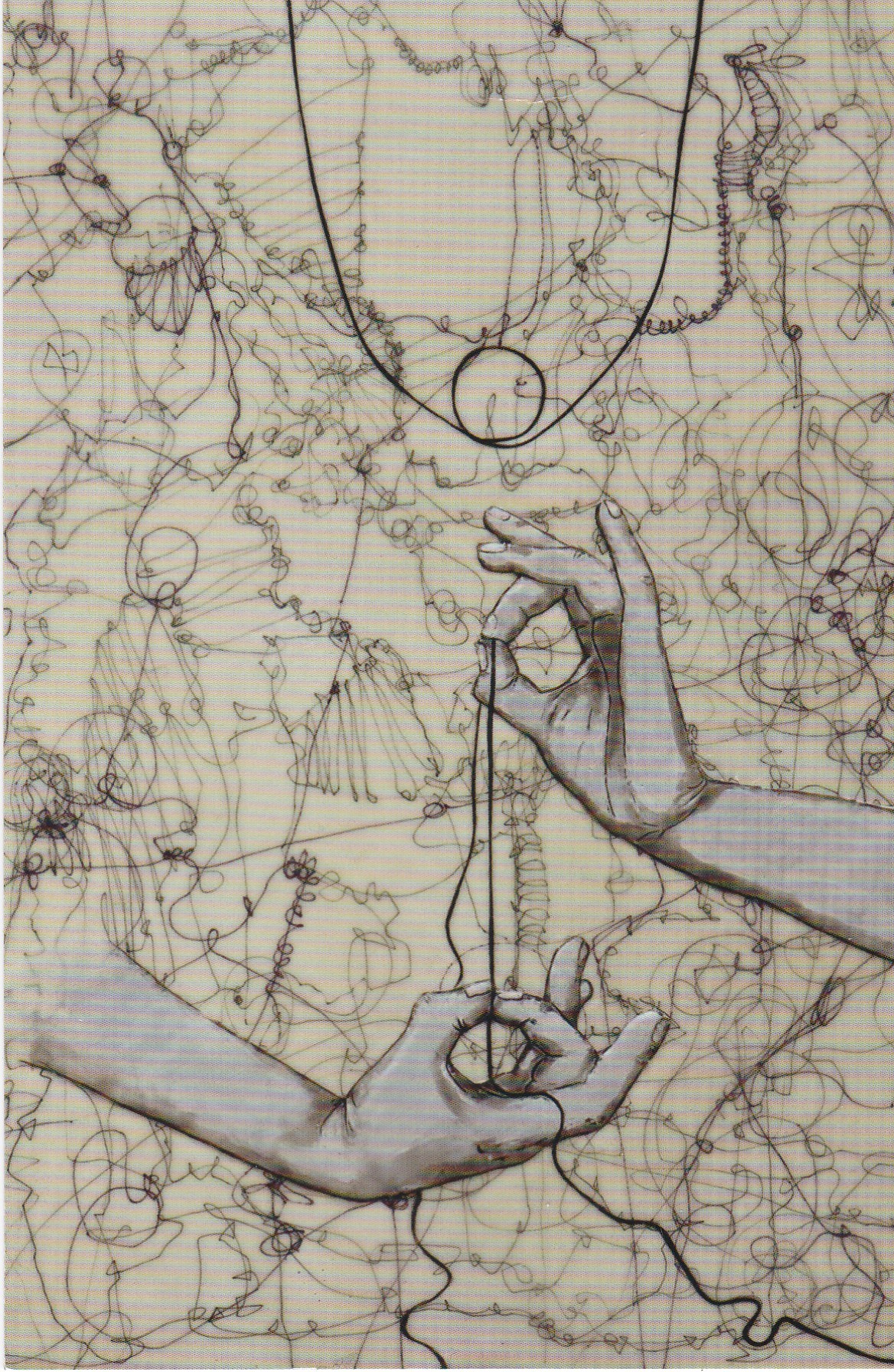
I love drawing and painting hands.  A few years ago, I saw this piece by Portland artist Andrea Benson.  She creates amazing and insightful art using encaustic paint and layering techniques.   I got a postcard of this piece and it has been on my inspiration wall for a few years now.

IMG_20171115_0002
String Theory: The Moment, 2008, Andrea Benson


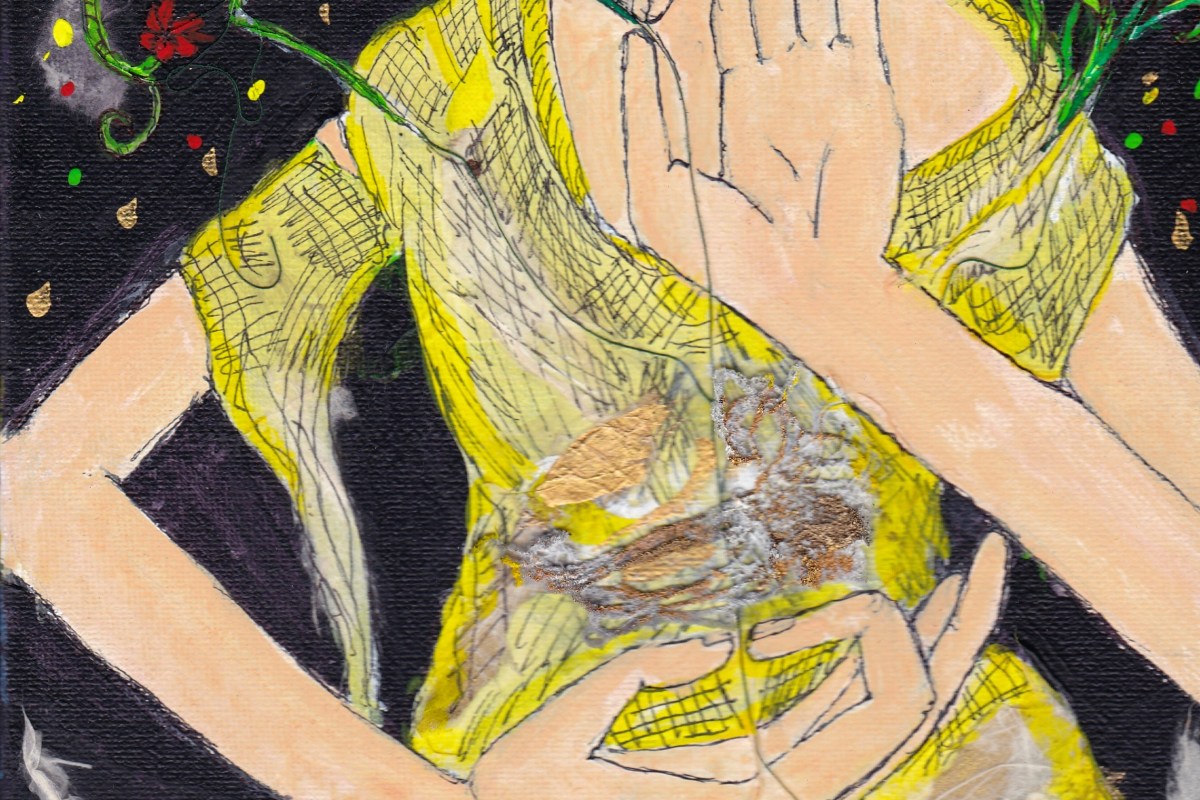
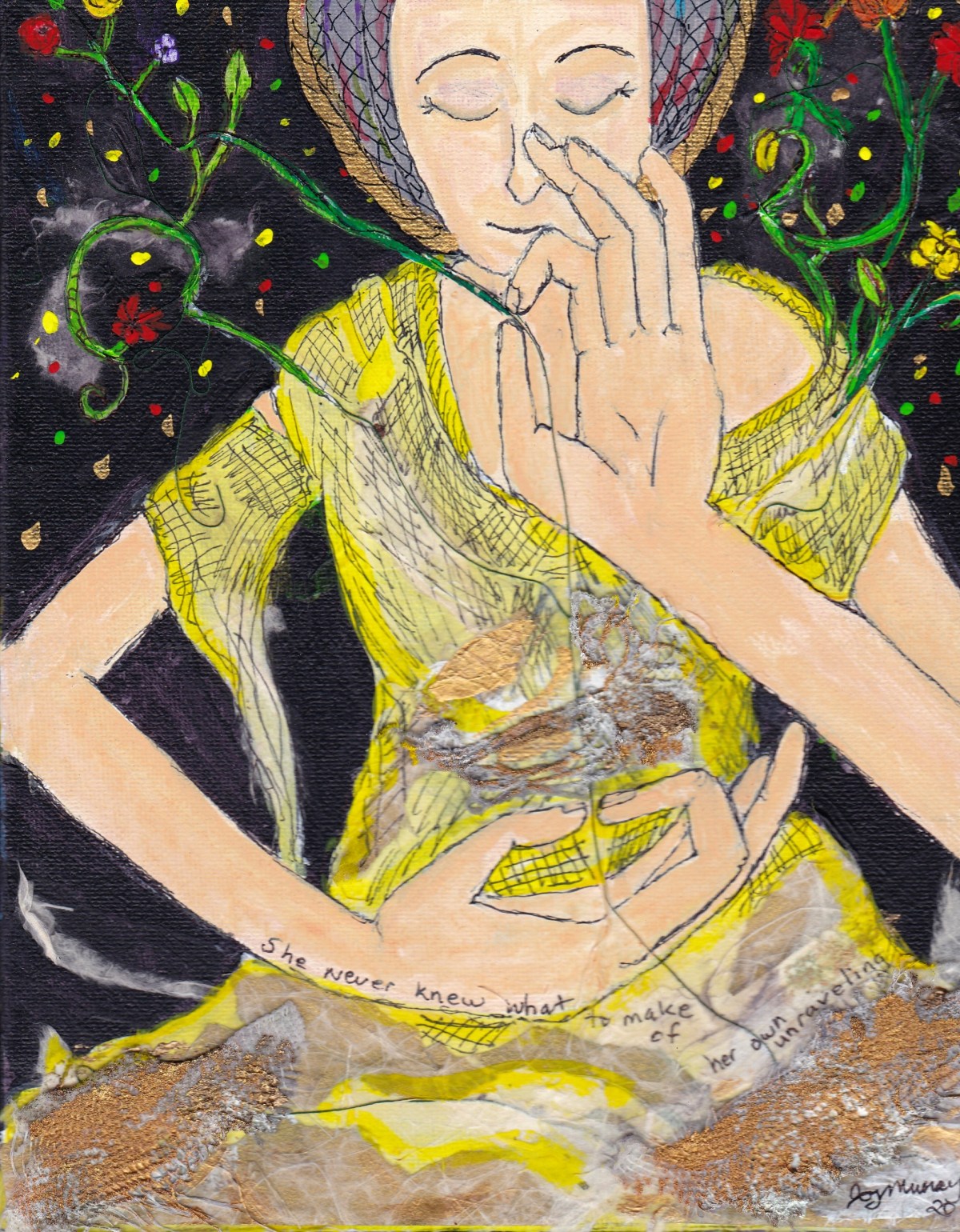
I used the pose of the hands, though mine are less detailed.  I created a figure trying to understand herself.  It’s such a bitter thing to feel my own body is fighting me, is unraveling and there’s not a lot I can do about it.  Yet in the few hours I was able to work on this, I felt serenity.  I don’t have control over much of this life, and I’m doing the best I can with what I’ve got.

She never knew
She Never Knew What to Make of Her Own Unraveling, Acrylic and collage, 8×10″

Art saves me over and over.  It doesn’t cure me though.  In this work I found a way to calm myself, to add a little hope and color to my unraveling.  I hope to make a bigger piece on this same theme when I get better.  This painting I’ll keep for myself.  An homage to the frailty of my body and the hope that when I’m released from the physical world, my elements will return to the earth and blossom.

~~~

If you’d like to support my art and writing, please consider becoming a patron on Patreon:

https://www.patreon.com/user?u=8001665

You can get prints and cards of my work on Redbubble:

https://www.redbubble.com/people/JoyMurray/shop?asc=u
 

Self Portraits and Insecurity

I took part in  #metoo, a campaign on facebook to speak out if you’d ever been sexually harassed, abused, or assaulted.  I searched around in the photos of my drawings and paintings for an appropriate self-portrait that spoke to my troublesome and strange history.

20160112_134148

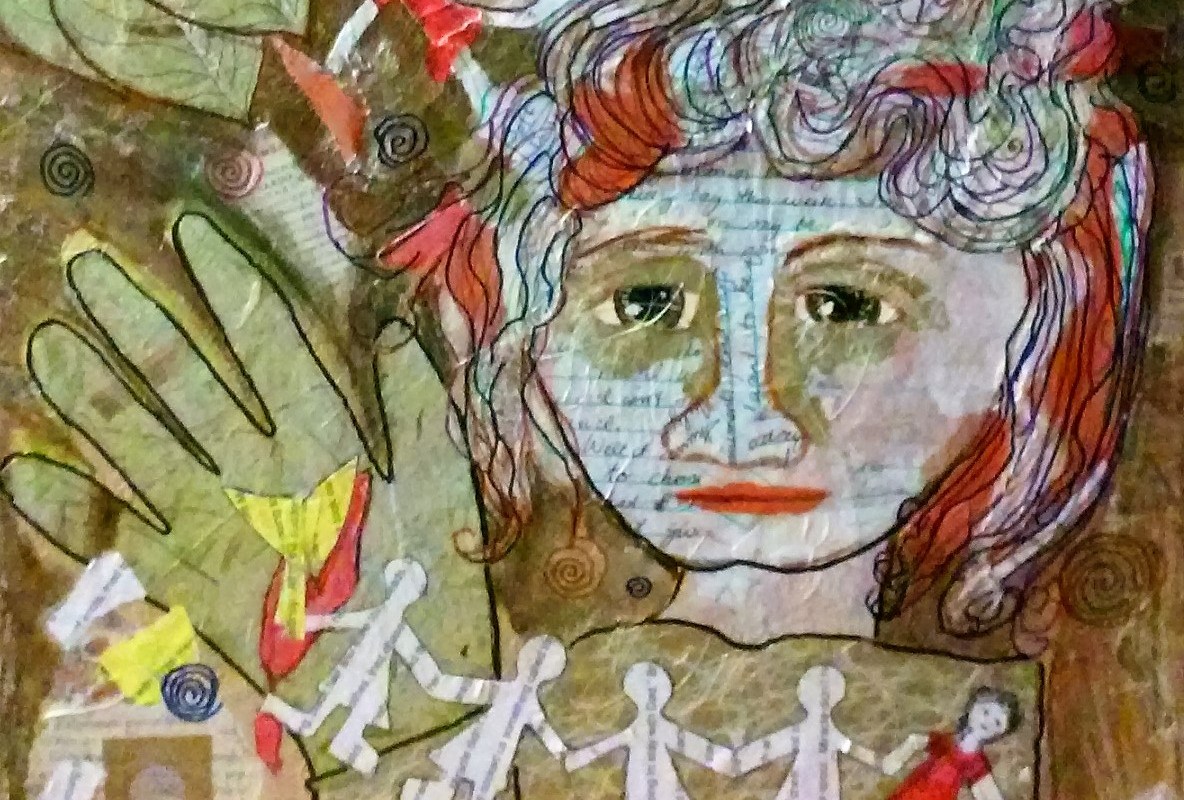
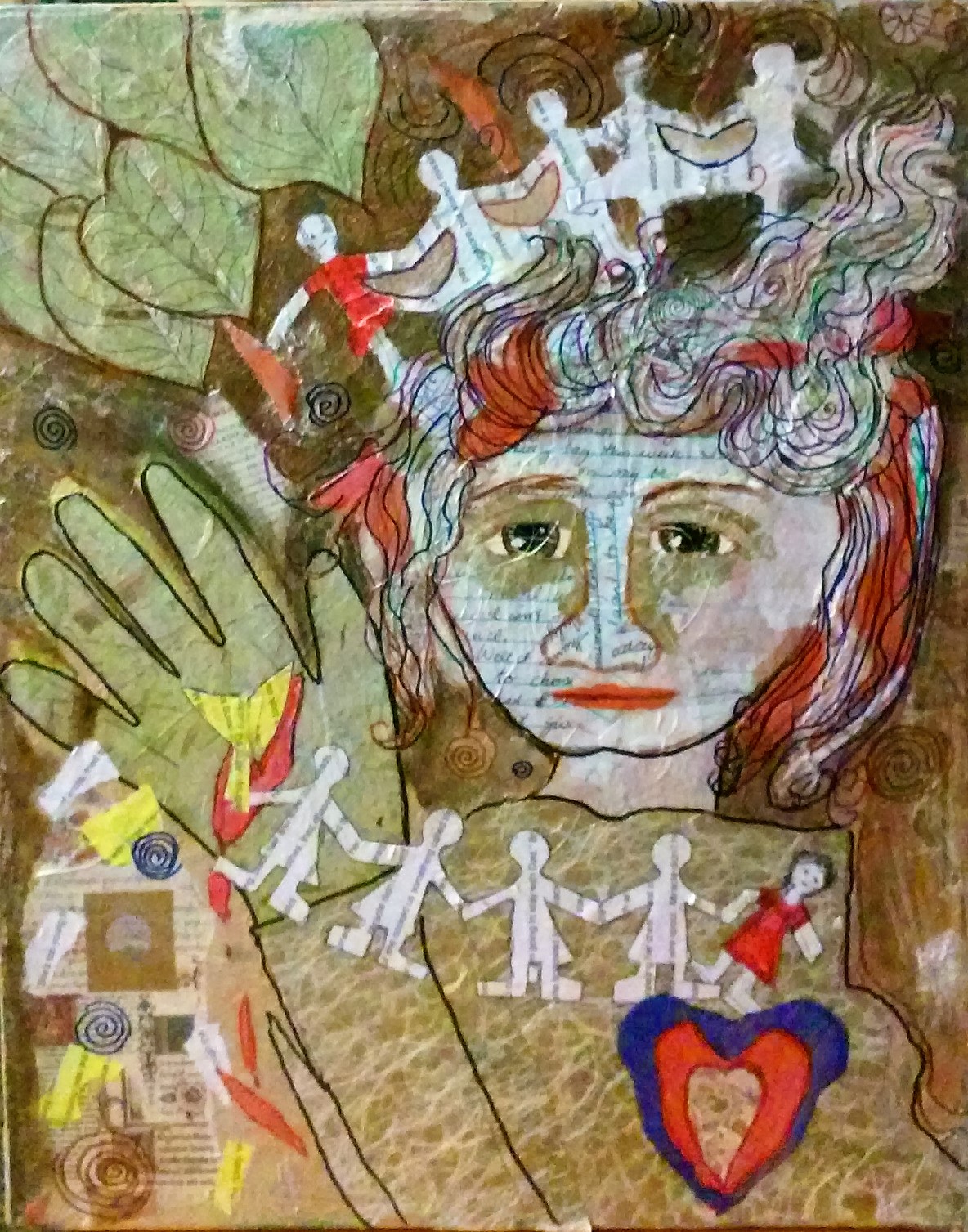
I made this collage in 2016.  It’s made from handmade paper and paper torn from my journals.  I’d been in a writing workshop on remembering and re-framing the stories of our families, or our history.  I tried to speak, in a round-about way, to the abuse in my family, and the struggles of dealing with a body that doesn’t work properly — the many ways I’m broken but still held together by words and images and the support of friends.  How I can be a content person, but still hold onto painful knowledge.  How I can be melancholy but playful.

One of the many side effects of growing up in a family where there was sexual abuse is silence.  You don’t tell.  You don’t know how to tell.  And no one wants to hear it, much less believe it.  When you break free from the constraints of that family, you still keep quiet about it.  When other’s are sharing their family stories, telling of adventure and love, of misunderstanding and reconciliation, you keep quiet.  If you tell, a silence will settle over the room, shock, sometimes deep sympathy, but the whole mood of the conversation changes and it feels like you’ve sucked all the happiness out of the room.

008

(I notice I slipped into a passive voice for this last paragraph.  I think maybe I should change it to collective voice “we,” but really I can only speak for myself.)

I’ve learned to speak for myself by writing fiction and drawing pictures.  My art practices aren’t directly about sexual abuse  because I don’t want to dwell in it.  If I dwell in it, I don’t dwell in the rest of this rich and robust world.  I’m grateful I’m not naive.  I’m grateful I can recognize, sometimes, the behaviors of a child who is battling what I went through.  I tell stories.  I make narrative art.  I try to honor the courage it takes to survive and not let others steal your happiness. I encourage others to do so


But I don’t always know what I’m doing.

When I made that collage, at first I liked it a lot.  But as it stared out of my wall, I began to think I got it all wrong.  It was naive and cluttered and too personal.  What was I thinking?  I tried adding a new layer to it, but only made it worse.  I moved it under the bed thinking I’d reuse the canvas one day.

But when I moved to Memphis last spring, I threw it away.

So I was surprised to find that I thought it was a good image for #metoo, and others identified with it.  I remember now that when I first posted it on facebook last year, when I still liked it, it got a better response than I expected.  It speaks to others.  It tells a tale that needed telling, even if it’s interpreted by others in different ways than I intended.

I only have a small digital image of it now, but it’s enough to make card sized prints of it.

I’m going to put a postcard of it on the wall of my studio to remind me not to toss things out.  I judge my work harshly and hate all of it at first.  That’s why I like working in a journal.  I can hide what I’m doing from myself.  It’s a kind of bi-polar process, create, show it to everyone, then look back in horror.

025

I have coined a term for the period of time when I hate my work — post-artum depression.

I try to give myself at least a month before I trash something.  But it isn’t always a safe guard.  And I get existential and feel that nothing really matters anyway, it’s all just clutter.  Is this a side-effect of toxic family or depression or just something unique to me?

005

But when I look around me, when I look through my art files, when I see the long trail of stories in many forms I’m leaving behind me, I feel good that I’ve mostly overcome the silence and shame imposed on me as a child.  It will always be a struggle to speak, but I will.   I can.  I do.

I will.

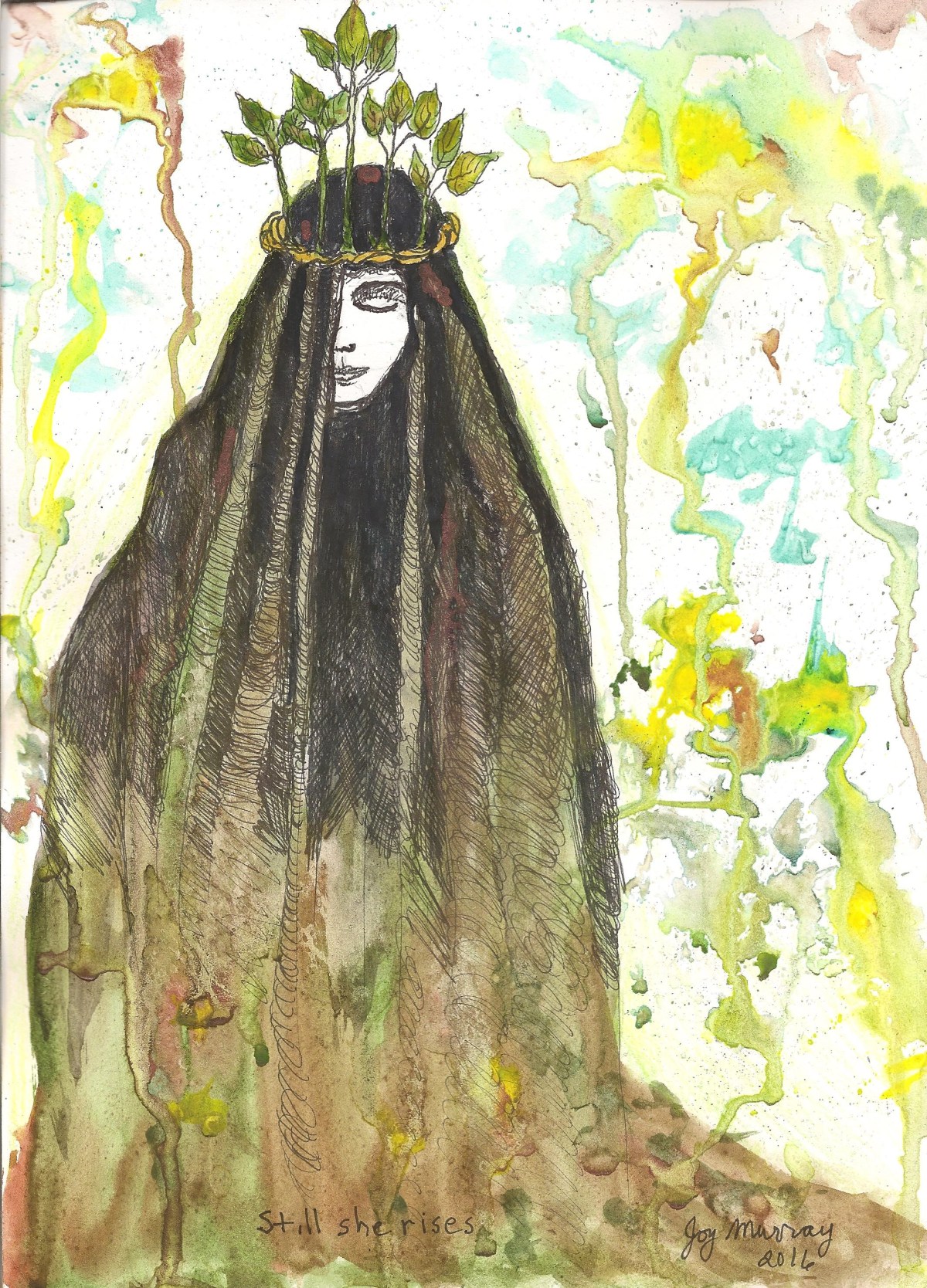
still she rises

Any comments and shares are greatly appreciated.

If you’d like to support my art and writing, please consider becoming a patron on Patreon:

https://www.patreon.com/user?u=8001665

You can get prints and cards of my work on Redbubble:

https://www.redbubble.com/people/JoyMurray/shop?asc=u


How Life Passed Through Me

How do I know when an idea is a good one?  How do I know if I’m communicating a coherent image?  How do I know when a painting or story is finished?

I have a bad habit of revising stories to death and not knowing when to quit when I’m painting.  I get in a frame of mind where I feel like I have to correct and correct all my mistakes.  I feel like I can never quite get it right, can’t represent the shining idea in my head, but only futz around until I give up.

Is that my process?  I do eventually create things, and they do eventually stand on their own.  With all their flaws, I send them out into the world.

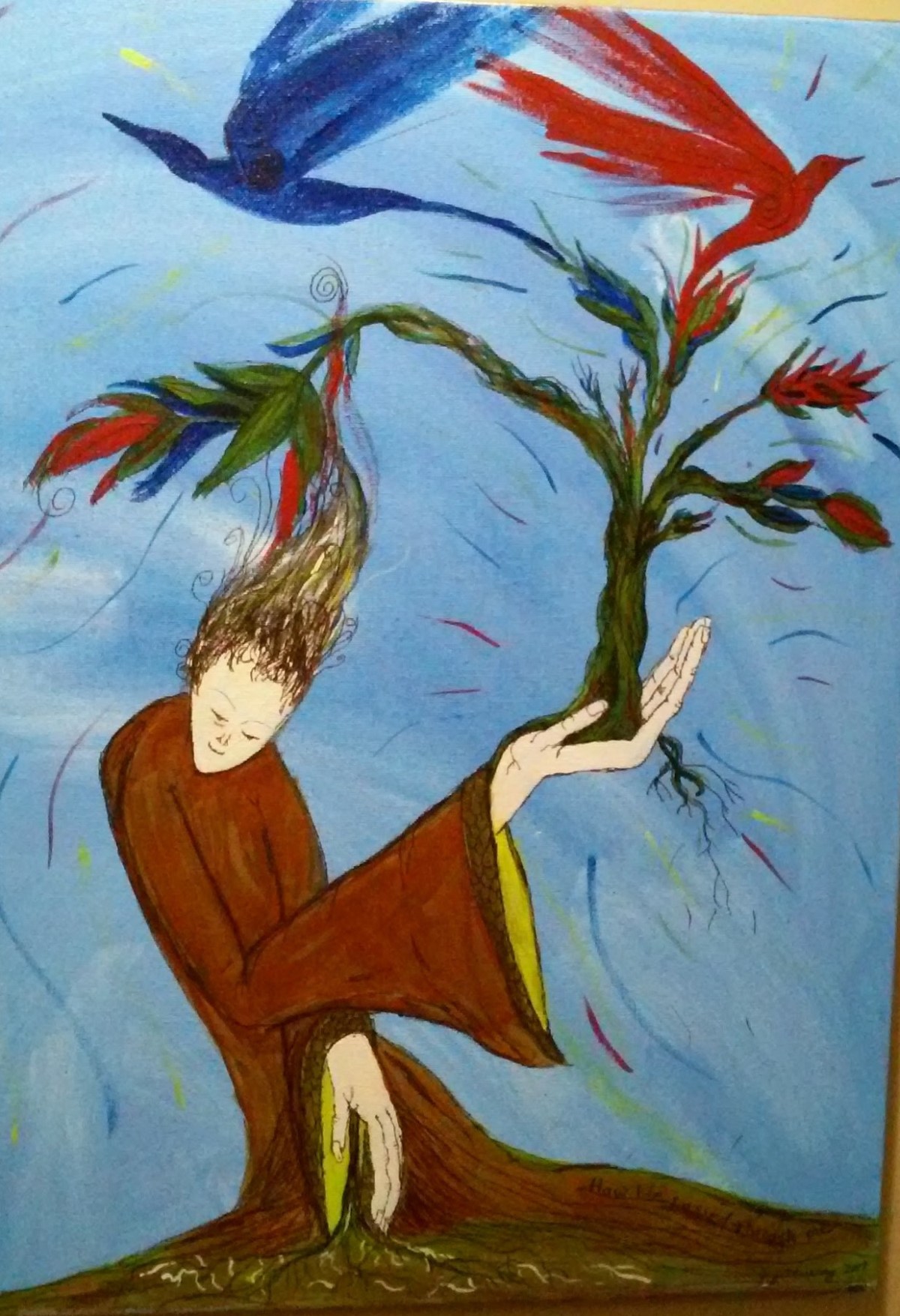
This painting started as an idea that occurred to me when I took a life story class.  I realized I am not just myself.  I am made up of all the family, good and bad, that came before me.  I am also not the end of the story.  I am in my children and they are my bit of immortality, a continuation of story that didn’t start with me and will never end.  And even if I hadn’t had children, I am in the life of everyone I know and love.  They are in me.  My best parts will be remembered and carried forward.  We are all upcycled elements that will continue to grow up and out and into infinity.

I drew this little piece in my journal:

IMG_20171007_0001_NEW

I then did a more detailed drawing using watercolor pencils and thinking about color and life.

IMG_20170815_0001_NEW

As I drew this self-portrait, I thought a lot about my disability, my broken body.  How do I represent it as a metaphor, not realistically, but how it feels.  The immobility and how it feels that I can’t move about in the way other people do.  I feel rooted and immobile.  But in that rooted place, I have lived such a full life.  Life has moved through me in rich and rewarding ways.  I decided to do a big painting on canvas.

20170909_204817

I hung it up in my studio/bedroom.  I saw it before I went to sleep and when I woke up.  Something didn’t seem right.  I wasn’t happy with the downward hand, and the lack of definition of the plant moving into that hand and out the other.  And the glow I feel wasn’t there.  And my crookedness wasn’t visible enough.

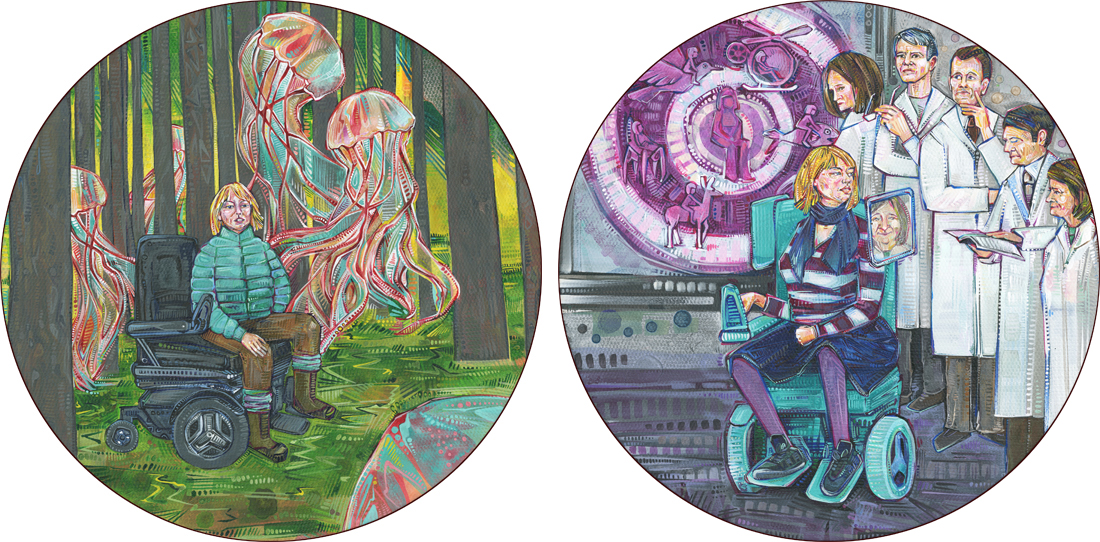
I’ve been watching a lot of videos by Gwenn Seemel, a wonderful artist that I love, who is very generous with her process and shows her many revisions.  She layers and adds color and lets her paintings flow, glow and grow.

Get Well Soon by Gwenn Seemel
Caitlin: Get Well Soon and Don’t Look at Me that Way from Empathetic Magic by Gwenn Seemel

So I decided to let my painting grow, too.  I layered over it, changed the position of the lower hand, added to the humped back of my tree figure, then added the aura, the glow I feel as I think of how life passed through me.

I hung the revised painting in my studio/bedroom.  I saw it before I went to sleep and when I woke up.  And it didn’t bother me anymore.  It said what it needed to say.

20171006_171741

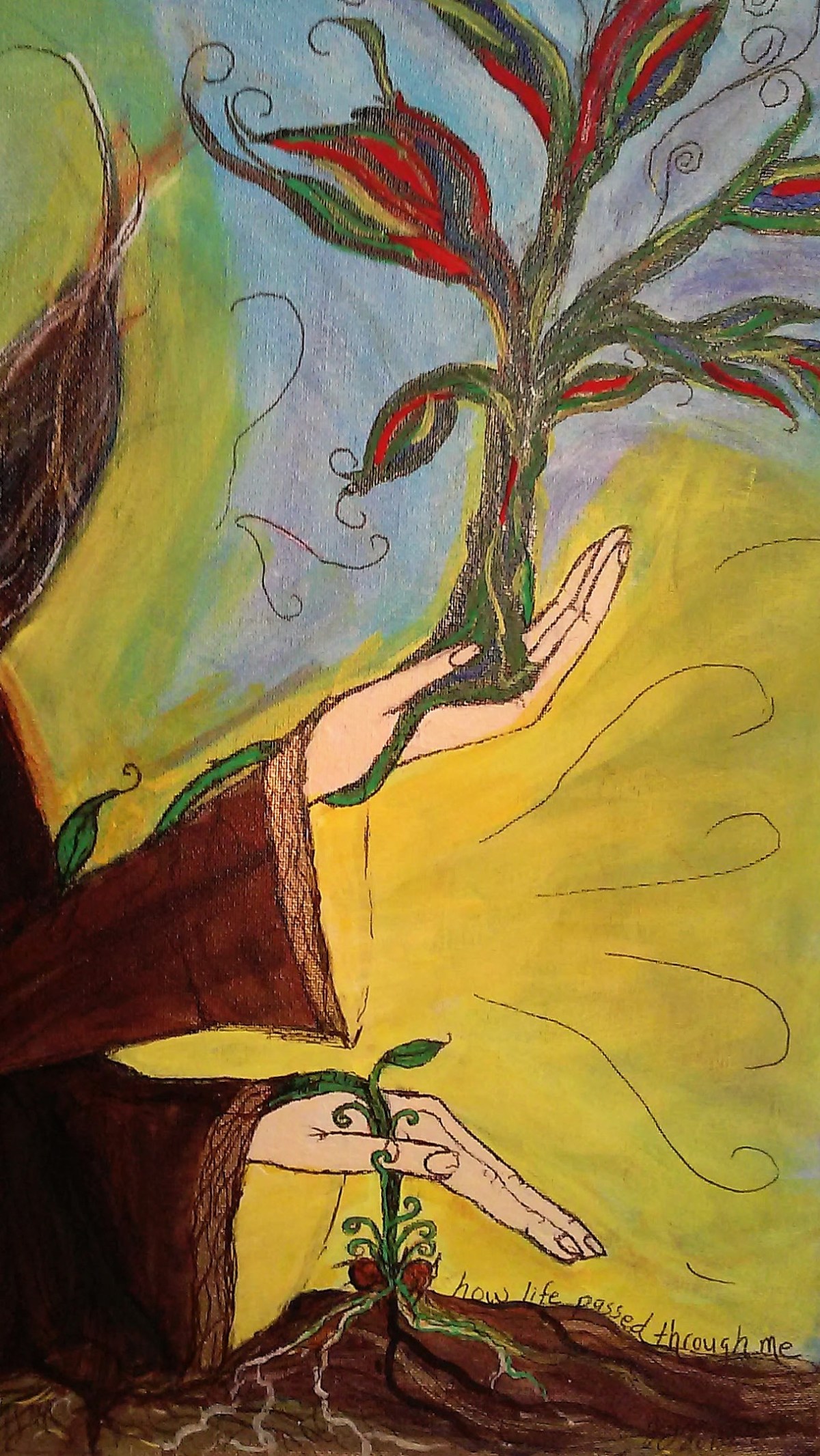
I deepened colors.  I made the title more visible.  I added iridescent paint, that shows up as a sort of grainy white in these photos.

20171006_171814
detail
20171006_171804
detail
20171006_171754
detail

This painting may be only a personal statement that no one else relates to. but I’m glad I moved forward with it.  When I see it on the wall, I feel less alone, that in spite of or maybe because of my disability, there is vitality in me that it’s taken me a life time to recognize.  I finished the early painting on my 57th birthday, and the revision a month later.

Now when I look at it, I wonder about ways to revise the image of bodies that have been twisted and reshaped by life.  How to capture the vitality and beauty and light of survival.  For all it’s flaws, it’s a catalyst for future ideas.  Isn’t that where new ideas come from — the old mistakes give birth to the new ideas?

It’s a good thing to meditate on as a I wander my way through the next year.