Head, Tails, Storks

Last week I read two very different books.  One was written last year, and the other in the 1950s.

First the contemporary one, which I found through a book review.
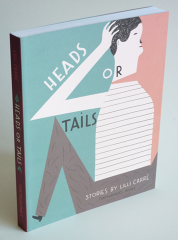
When I first picked up Heads or Tails by Lilli Carre, Fantagraphic Books, 2012, I wasn’t sure I would like it.  The strange graphic style of the cover, especially the nose and facial features, were not really a style that I liked.  But I’d heard great things about it, so I began to read and I was fascinated.  The stories are weird, dream-like and surreal, with a bit of existentialist humor.  They also reveal a remarkable compassion for characters trying to puzzle out their lives.

The cover blurb says, “…the stories contained touch on ideas of flip sides, choices and extreme ambivalence.”   In “Wishy Washy,” a judge of floral arrangements survives a car accident but loses his ability to judge and make decisions.  In “Welcome to my Kingdom” a single snazzily dressed man is increasing boxed in by the borders of his life and the page.  “The Carnival” is a ambling story that combines ideas of floods, flight, romance, family and solitude into a circular story that left me with the same feeling I get when I’ve had a particularly vivid dream.  It’s rife with meanings that I can’t quite put into words.

Which is part of the lure of this book — it’s told in ways that you can’t put into words.  The graphic elements are an integral part of the story.  It’s more than an illustrated story — it’s a dance.  There are a few sequences under the title “Short Bits” that deal with the whole dance of life — the words, the movement, what happens in reality, and what happens in our minds and hearts. In “The Thing About Madeline,” a woman finds her own double working at her customer service desk one morning.  She becomes a spy in her own life, then develops a whole new existence. In spare prose and jittery drawings, ideas of identity are deftly explored and exposed.

Then there are moments of great humor — my favorite being the last drawing The Woman With Something Stuck Between Her Teeth.

Lilli Carre won acclaim with the graphic novel The Lagoon.  Her work has appeared in The Best American Comics, 2008, and the Best American Non-Required Reading, 2010.

You can find out more about her here:
http://lillicarre.com/heads-or-tails#/t/9

Here’s a little video of how the book looks:
http://lillicarre.com/heads-or-tails#/i/10

***
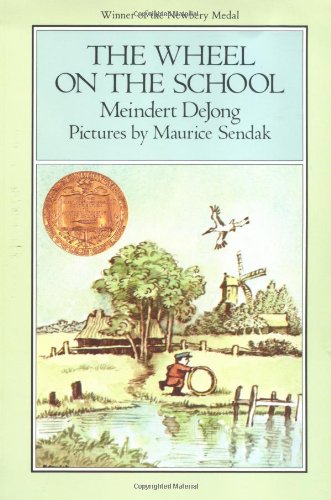
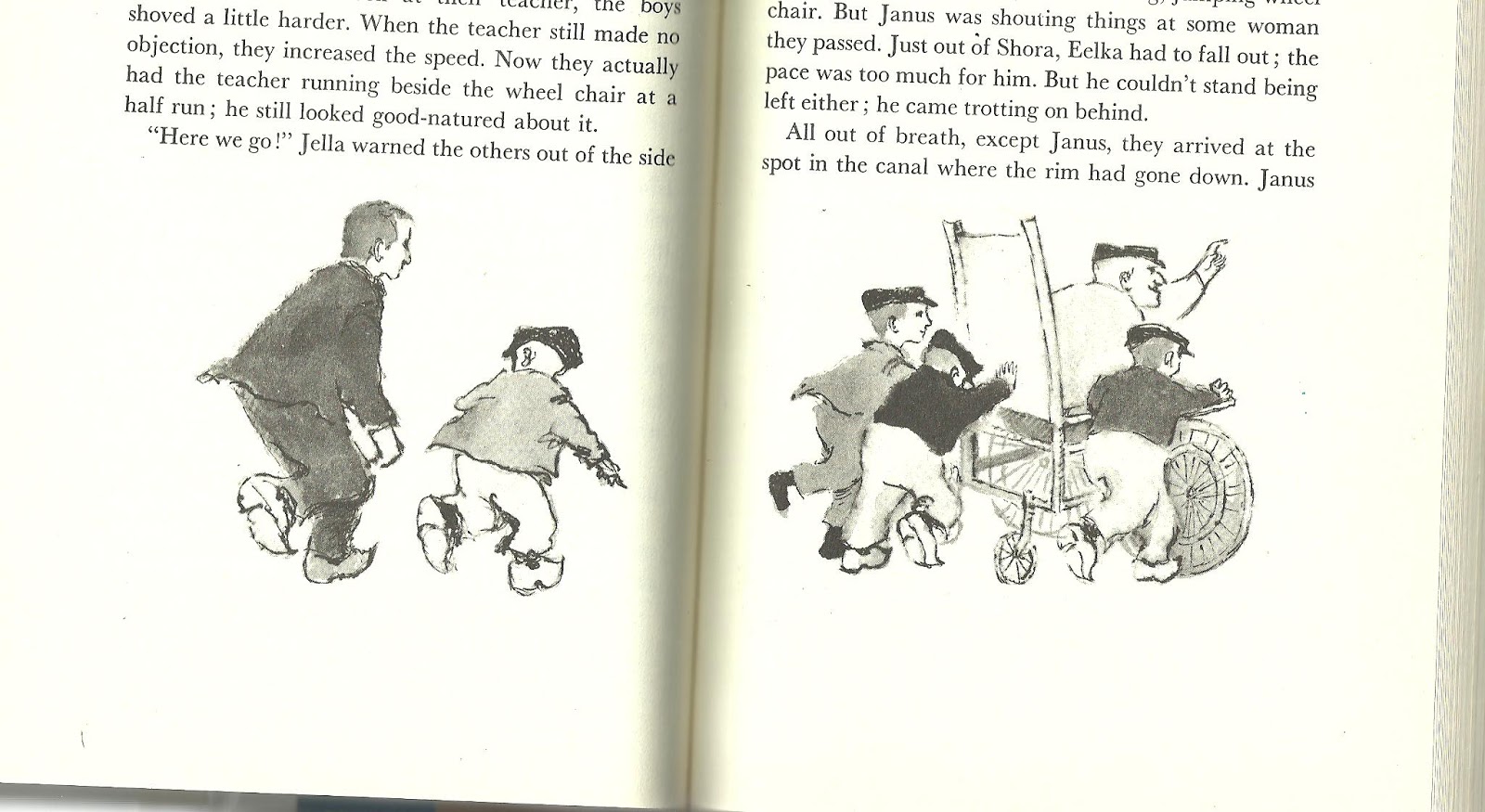
The other book I read was much more traditional.  The Wheel on the School by Meindert DeJong, Illustrated by Maurice Sendak, was published in 1954 and won the John Newberry Medal.  It’s a  novel for ages 10 and up, and is still in print.  I got mine at the library. I found it by googling “children’s book fishing village,” since I’m working on a picture book set in a fishing village.  I love the way books come to me.  It didn’t have the pictures I was looking for, but it had everything I needed in a good story.

At almost 300 pages, it is a warm, sweet book that follows a group of school children in a small Dutch village.  Lina, one of six children in the village school, wrote a paper on storks, but admitted to only knowing what her aunt from another village told her.  In that village, every Spring, people put wagon wheels on their roofs, as a foundation for a nest. “(Storks) build great big messy nests, sometimes right on your roof.  But when they build a nest on the roof of a house, they bring good luck to that house and to the whole village that that house stands in. Storks do not sing.  They make a noise like you do when you clap your hands when you feel happy and good…on your roof they are noisy.  But it is a happy noise, and I like happy noises!”

The children are instructed to try to figure out why storks no longer visit their village.  Lina finds out from an old woman that there used to be storks but the village trees had been lost in storms and no one even put a wagon wheel on their roof anymore.  What ensues is an adventure that takes each child out into the village to find a wheel to put on the school and lure a stork couple to the village.  They are told  to look “where one could be and where one couldn’t possibly be.”  In their search, they learn about their elders, their history, and their own bravery.  In a charming turn of events, they discover the meanest man in the village, who uses a wheelchair and is rumored to have had his legs bitten off by sharks,  is in fact, their best ally.  The storks begin to bring good luck even before the first ones fly overhead on their migration from Africa.

Encounters with irate farmers, terrible storms and grumpy fathers keeps the children on their toes.  Each child is developed in the course of the story and the village comes to life in the masterful storytelling of DeJong.

It was delightful to read this — it was slow paced and soothing at times, at other times an engrossing page turner.  There were moments when the children’s ears were boxed and they were paddled when I wondered if such scenes would be acceptable in a contemporary children’s novel.  There were vivid and detailed descriptions of the buildings, boats, tides, dykes and terrain — descriptive elements often left out in the fast pace of modern novels.

I loved reading it in bed with a cup of tea.  It has community and environmental themes that are very contemporary and valuable, but it has a nostalgic feel to it. The illustrations for this are very spare, rendered  in ink and wash by Maurice Sendak and add to the quaint. cozy feeling of the book.  I hope I get a chance to read it out-loud to someone someday. 
***
One more thing, I found this article on the film “Girl Rising” in this morning’s paper.  A trailer for the film is included.  It’s a documentary addressing the question “What would happen if more of the world’s 66 million uneducated girls were allowed to receive the same schooling as their male counterparts?”

I look forward to seeing it and I hope we all get a chance to help improve the lives of girls.

http://www.oregonlive.com/living/index.ssf/2013/03/girl_rising_film_championing_g.html#cmpid=9547239

I hope you get to read something wonderful soon.  Remember, books require no batteries and transport you through time and space in the most magical way.

Review: The Where, The Why, and The How

Curiouser and Curiouser:  Books That Answer and Spark Questions

Do you ever long for a no-electronic media night?  I have two books to recommend that will make such a thing both a delight and a learning experience for everyone.

I’ve always have loved science and art.  Science always seemed to be more like an art to me, but it’s probably because I approach it that way.  The world is full of wonders — whole universes live in a drop of pond water, in a dribble of saliva. Science gives me the stories of those small universes and the ones that are bigger than I could ever imagine on my own.
  

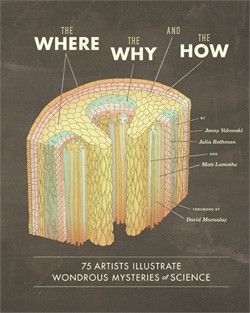
So I highly recommend The Where, The Why, and The How, 75 Artists Illustrate Wondrous Mysteries of Science, by Jenny Volvosky, Julia Rothman, and Matt Lamothe, Forward by David Macaulay, (Chronicle Books, 2012).  It provides a lot of scientific theory  and great splashes of color to illustrate what we can only speculate on. It’s promoted as “Science like you’ve never seen it before.”  The editors are partners in ALSO, a design firm based in Chicago and New York.  Julia Rothman is also author of the popular blog Book by It’s Cover. 

In the introduction, author and illustrator David Macaulay (The Way Things Work, Cathedral), talks about how we’ve become spoiled by an abundance of information.  “If you want to know anything, just Google it.”  He tells how a lively discussion about why eggs are shaped like eggs was abruptly ended by Wikipedia brought up on someone’s phone.  “The most fun, the period of wonder and funny guesses was lost as soon as the 3G network kicked in.  Fortunately, there are still mysteries that can’t be entirely explained in a few mouse clicks.  With this book, we wanted to bring back a sense of the unknown that has been lost in the age of information.  While scientists have figured out a great deal, much remains theoretical and sometimes opposing theories exist.”

Fifty scientists agreed to be a part of the project and explain theories around unanswered questions.  Then 75 of today’s “hottest” artists and illustrators were let loose to provide visual accompaniment — they were free to be as literal or imaginative as they liked. 

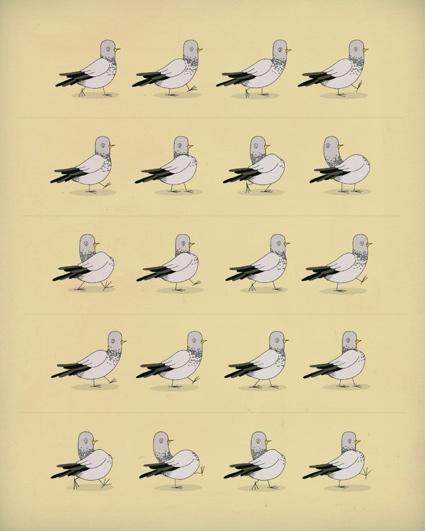
Often they seem to go off on an improvisational riff which can be both baffling and add to the general sense of wonder.  What is the origin of the moon?  What causes depression?  Why do pheremones work?   Why do humans have so much genome “junk”?   And there’s a lot of humor here.  Why do we blush?  Why do pigeons bob their heads when they walk?

The illustrations have a modern and retro feel.  “We chose a mix of well-known and up-and-coming illustrators, comic artists, fine artists and designers.”  It has a remarkable cohesion and sense of style without being too stylized.  The book is dense and has the heft and weight of a new text book and invites hours of perusal. 

You can see a video of the art of this amazing book here.
 http://vimeo.com/50786051#

While The Where, The Why and The How aims to rekindle curiosity,

Big Questions from Little People and Simple Answers from Great Minds, by Gemma Harris, (Ecco, 2012) is aimed at getting children curious as early as possible.  It’s a very entertaining and educational collection of short essays from philosophers, scientists, reporters, artists and doctors.  Harris collected questions from school children all over the world and then asked experts to answer them in a language the kids could understand.  The great minds include Mary Roach, Phillip Pullman, Sir David Attenborough and a host of other writers and scholars.  
Can animals talk?  Why can’t I tickle myself?  Are we all related?  Who invented chocolate?  Why are some people mean?  Do aliens exist?   
The editor is from Scotland, and the book originated in England, so many of the scholars are from England, Scotland, Wales, Australia and other English speaking countries. The book provides an opportunity to talk about how measurements and language differ in countries that speak “English.”
Both of these books will inspire wonder and give you a chance to think outside the electronic box.  They’re good to keep by the bed to inspire wonderful dreams.

From the Good Mountain Review


<!–[if !mso]>st1\:*{behavior:url(#ieooui) } <![endif]–>
Someone asked me a few days ago, why I read juvenile literature.  The only answer I could think of is, “Why not?”
I did stop reading such books in my teens, but when I had kids, I started again.  I was reminded of what great art is published in children’s picture books and what fine coming of age stories, historical novels, and great fiction are written for the juvenile market.  There is always a bit of poetry, magic realism and hopefulness in the books I read – I’ve kind of skipped over the whole dystopian young adult phenomena, just as I’ve try to choose “adult” literature that doesn’t leave me feeling bereft about humanity.
Children’s books are written by adults and most are purchased by adults, so the writers and illustrators keep that in mind.  These writers are adults who have kept their sense of play and wonder. 
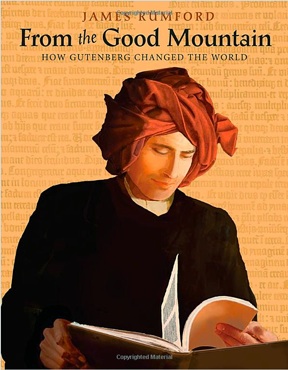
My latest favorite in juvenile literature is the picture book From the Good Mountain, How Gutenberg Changed the World by James Rumford, published recently by Roaring Brook Press.  
It’s illustrated like an illuminated book from 1450.  The book begins, “It was made of rags and bones, soot and seeds.  It wore a dark brown coat and was filled with gold.  It took lead and tin, strong oak and a mountain to make it.  What was it?”
The whole process of the first book is then told, from how the paper was made, to how the printing press was constructed, and how the pages were sewn together.  You really get a sense of the time and energy it took to make a book.  Although it was not a simple process, it did make books easier to publish and eventually made reading a skill available to even the poorest of people.
Rumford is an award winning author who spent over 2 years writing and illustrating this book.  He is also a papermaker, letterpress printer and binder.  His love of the book form is evident on every page.  But unlike many who fear the loss of the form, Rumford is excited about the way technology is leading to new kinds of books.  I love how the golden flora in the borders of the illustrations transform at the end into the circuits of a computer chip.
Each two page spread is illuminated like a 15thcentury incunabula, the term for the first printed books, which means “cloth in which you wrap a newborn baby.”  I found this out in the informative epilogue that gives a history of books, as well as some insight into why he chose to portray Gutenberg in an elegant red turban.  
The book begins with a portrait of the city of Mainz, Germany, where the first book was printed, and ends with the same scene lit by a rosy dawn.  The watercolor painting is gorgeous.
Much of the action takes place in margins.  The characters are beautifully painted anonymous workers all contributing to the production of the mysterious book.  On every page there is something surprising to learn about how a book is made. 
People are busily boiling rags and bones, processing ink, pressing paper.  Medieval times come to life with  dirt and glory.  Children work along side their mothers, ladies hold their noses against the smell of the tannery.  There is a lovely vignette of an African boy panning for gold for the gilding process.  Another scene shows children begging as workers troop by with printing supplies. The overall feel is active excitement as people work together to make this marvelous new thing.
The illustrations were done in pen and ink and painted with watercolor and gouache.  On his website, Rumford says:
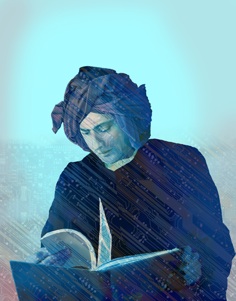
“I would make the look of the book as old-fashioned as it could be so that kids today could feel what it was like to hold a richly ornamented book in their hands. On each two-page spread I decided to show how each step in the bookmaking process was done—from paper making to gilding to typecasting and press-building. I would end the book by showing graphically how the old technology was being transformed into the new as I changed the gilded designs of the illuminated pages gradually into the circuits of a modern computer. To emphasize this, I painted a portrait of Gutenberg in the style of fifteenth-century illuminators on the front cover while on the back cover I digitally transformed the same picture into a portrait of a computerized man….Since the illustrations were to be like the miniatures done in medieval manuscripts, I decided from the start to rely heavily on the computer. This gave me the freedom to break up the image and work on each element separately….Thanks to the computerI was able to approximate the unique work of fifteenth-century illuminators.”
It’s an absolutely delightful book and a visual treat for anyone who loves art, books or a history.  The writing is crisp and rhythmic, and is fun to read out loud. I enjoyed the way each new page spread answered a question from the previous page.   It held the attention of my 5-8 year old audience, and the illustrations were great for prompting questions.  But I think I liked it best.  
James Rumford lives in Honolulu and runs Manoa Press, which makes handmade books.  He is the author of the award winning Silent Music, and Tiger and Turtle, both of which I hope to read soon.  James Rumford website is here:
And the website for his press is here:
As a side note, From the Good Mountain, reminded me of another children’s book that I love, Marguerite Makes a Book, by Bruce Robertson and illustrated by Kathryn Hewitt, published by J. Paul Getty Museum in 1999.  This is also done in the illuminated style of the 1400s.  A young girl helps her father make inks and illustrate prayer books for the nobility.  She journeys all over Paris gathering supplies from goose eggs, to vellum, to the minerals needed to make paint.   Kathryn Hewitt recreates the ornate luxury of a prayerbook.  It was inspired by a book in the Getty collection.  This book is still in print and widely available.    
So, literature had it’s beginning in conjunction with illustrations.  So don’t limit yourself.  Even if you are an adult with no kids in sight, let the magic of picture books back into your life.

Book Review: A Kiss Before You Go


<!–[if !mso]>st1\:*{behavior:url(#ieooui) } <![endif]–>

I can’t remember how I stumbled upon Danny Gregory’s book Everyday Matters.  It was around 2005, I was about 45.  I had just separated from my husband, my kids were grown.  I was living off disability in a room I rented from my best friend.  I was floundering around with my identity and searching for meaning in my life and desperately looking for inspiration.
Everyday Matterswas a simple, beautiful gift.  It’s essentially a guide to keeping an illustrated journal, and why that’s important, why everyday of your life matters and is worth recording.  It was an unusual kind of book for me because it emphasized drawing over writing.  It was filled images and reflections on the mundane and the sublime.  It was a record of healing, but there wasn’t some great transformation into an idealized picture of robust life.  Instead it showed life with its scars and pockmarks and all its homely color..
Of Everyday Matters, Gregory said:  “Two years before I started drawing, my wife was run over by a subway train. Sounds really terrible, I know. But, well, this book is about how art and New York City saved my life.”  His beloved wife, Patti, recovered, but had paraplegia and had to use a wheelchair for the rest of her life.  Gregory began to draw and keep a journal of their transition into their new life.  In learning to draw, he learned to see more vividly.  In learning to see more vividly, he reclaimed his sense of wonder.  And then he shared it.
Everyday Mattersimmediately went on my antidepressant book shelf, as well as my inspiration shelf.  I was tenuously starting to keep journals again but they were clogged with confusion, pain and exhaustion.  After reading Everyday Matters, I let myself be distracted from my inner turmoil by objects around the house, by plants and faces.  I let a life long habit of doodling become an obsession.  If I felt myself spiraling into self destructive writing, I drew instead.  I did lots of terrible little drawings.  And I enjoyed it.
I blame Danny Gregory for turning my compulsion to keep a journal into an addiction.  I gave copies of his book to many friends.  He then published The Creative License: Giving Yourself Permission To Be The Artist You Truly Are and An Illustrated Life: Drawing Inspiration from the Private Sketchbooks of Artists, Illustrators and Designers, both of which I revisit on a regular basis to keep my creative juices flowing.  I love his advice on better living through bad drawings.  His books are especially helpful after you see work that especially blows you away and you feel like a fraud for scribbling inanely on paper.  Gregory re-opens your eyes to your own unique vision and potential.
His latest book, published only a few months ago, is called A Kiss Before You Go: an Illustrated Memoir of Love and Loss.  This is the journal of his first year after his beloved Patti died.  It was a sudden death, the result of a fall.  It’s a poignant and unflinching look at grief.  


He said, “Patti and I shared so much over the twenty-four years we were together: her paraplegia, raising our son, lots of adventure, laughs, and love. When she died in a horrible accident, I had to face a completely new life and approach it day by day.  A Kiss Before You Go is an illustrated record of our years together and my first year alone. It covers sad events but ultimately it’s a book about loving and living, about beauty in its many shades.”

This is one of the most honest and immediate books on the grieving process I’ve read. There is almost an imperative in society to get over it but this journal instead honors the loss and is honest about the painful process of getting one’s balance back.  There is uplift, but there is a profound respect for the way grief reshapes us and hones our perspective. 
The illustrations are stunning.  As in his other books, the story is handwritten.  Gregory often uses a dip pen and the entries are published as they are written.  The written words are art.  There is a haunting page where he is writing in white ink on a blue background about the day of Patti’s death.  The nib of the pen seems to have split halfway through the entry, or is he retracing every word.  The letters and words seem to be falling apart, or like they have ghosts.  The entry ends with “Nothing seems real.”   
He paints an interpretation of Hokusai’s classic  the Great Wave with a hand form reaching out of the water in the undertow.  It’s a powerful rendering of the way grief comes in waves and “flattens” you.   
The drawings of his son and their dogs crackle with love and energy.
But this book doesn’t flatten you.  The honesty of it is refreshing and the beauty of life is evident on every page.   
Gregory addresses the ambivalence we have when spirits seem to visit us in dreams and in strange coincidences. There are funny moments, like when he spends time with a friend who has devolved into a sort of caveman without the company of women.  “I better watch it.”  And when he gets advice from a friend who tells him the universe is waiting to see what he will make of this, and Gregory’s response is, “Why can’t the universe just leave me the fuck alone?”
The book itself is well bound and opens flat so you can enjoy the two page spreads.  I always look at books without their jackets because I like to see how they are bound and I’m always hoping for a surprise.  This one has a lovely watercolor blue cover and a white ink drawing of kissing figurines.  And the back of the paper cover has a collage of pictures of Patti. It underscores how she lived fully and celebrated each day.
People like to think you get over loss, but I don’t think you do.  I think, instead you learn to grieve properly, to let grief have its place in the rhythm of your life.  This book invites you to feel loss in all its color and awkwardness.  The gift of grief is how it imbues everything around us with memory and magic. 
A year after Patti’s death, Gregory draws a beautiful tulip emerging from dark speckled earth.  He has had a terrible time keeping up her garden.  He writes, “P: The bulbs you planted are coming up again. I can’t always remember to water them but someone’s making it rain a lot instead.  Is it you?”
A Kiss Before You Go by Danny Gregory is published by Chronicle Books and is widely available.   Here is a wonderful trailer he did  for it that gives you a sense of what a work of art it is.

Danny Gregory’s website is http://dannygregory.com/  There is a link to his blog and he is a very accessible writer and artist who encourages us all to be creative everyday, because our lives and our losses matter.