From the Good Mountain Review


<!–[if !mso]>st1\:*{behavior:url(#ieooui) } <![endif]–>

Someone asked me a few days ago, why I read juvenile literature.  The only answer I could think of is, “Why not?”
I did stop reading such books in my teens, but when I had kids, I started again.  I was reminded of what great art is published in children’s picture books and what fine coming of age stories, historical novels, and great fiction are written for the juvenile market.  There is always a bit of poetry, magic realism and hopefulness in the books I read – I’ve kind of skipped over the whole dystopian young adult phenomena, just as I’ve try to choose “adult” literature that doesn’t leave me feeling bereft about humanity.
Children’s books are written by adults and most are purchased by adults, so the writers and illustrators keep that in mind.  These writers are adults who have kept their sense of play and wonder. 
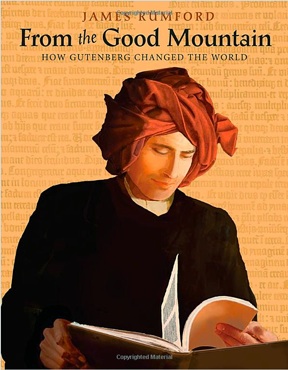
My latest favorite in juvenile literature is the picture book From the Good Mountain, How Gutenberg Changed the World by James Rumford, published recently by Roaring Brook Press.  
It’s illustrated like an illuminated book from 1450.  The book begins, “It was made of rags and bones, soot and seeds.  It wore a dark brown coat and was filled with gold.  It took lead and tin, strong oak and a mountain to make it.  What was it?”
The whole process of the first book is then told, from how the paper was made, to how the printing press was constructed, and how the pages were sewn together.  You really get a sense of the time and energy it took to make a book.  Although it was not a simple process, it did make books easier to publish and eventually made reading a skill available to even the poorest of people.
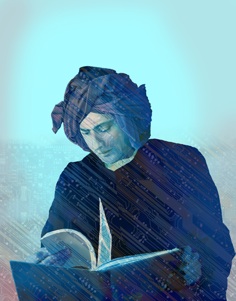
Rumford is an award winning author who spent over 2 years writing and illustrating this book.  He is also a papermaker, letterpress printer and binder.  His love of the book form is evident on every page.  But unlike many who fear the loss of the form, Rumford is excited about the way technology is leading to new kinds of books.  I love how the golden flora in the borders of the illustrations transform at the end into the circuits of a computer chip.
Each two page spread is illuminated like a 15thcentury incunabula, the term for the first printed books, which means “cloth in which you wrap a newborn baby.”  I found this out in the informative epilogue that gives a history of books, as well as some insight into why he chose to portray Gutenberg in an elegant red turban.  
The book begins with a portrait of the city of Mainz, Germany, where the first book was printed, and ends with the same scene lit by a rosy dawn.  The watercolor painting is gorgeous.
Much of the action takes place in margins.  The characters are beautifully painted anonymous workers all contributing to the production of the mysterious book.  On every page there is something surprising to learn about how a book is made. 
People are busily boiling rags and bones, processing ink, pressing paper.  Medieval times come to life with  dirt and glory.  Children work along side their mothers, ladies hold their noses against the smell of the tannery.  There is a lovely vignette of an African boy panning for gold for the gilding process.  Another scene shows children begging as workers troop by with printing supplies. The overall feel is active excitement as people work together to make this marvelous new thing.
The illustrations were done in pen and ink and painted with watercolor and gouache.  On his website, Rumford says:
“I would make the look of the book as old-fashioned as it could be so that kids today could feel what it was like to hold a richly ornamented book in their hands. On each two-page spread I decided to show how each step in the bookmaking process was done—from paper making to gilding to typecasting and press-building. I would end the book by showing graphically how the old technology was being transformed into the new as I changed the gilded designs of the illuminated pages gradually into the circuits of a modern computer. To emphasize this, I painted a portrait of Gutenberg in the style of fifteenth-century illuminators on the front cover while on the back cover I digitally transformed the same picture into a portrait of a computerized man….Since the illustrations were to be like the miniatures done in medieval manuscripts, I decided from the start to rely heavily on the computer. This gave me the freedom to break up the image and work on each element separately….Thanks to the computerI was able to approximate the unique work of fifteenth-century illuminators.”
It’s an absolutely delightful book and a visual treat for anyone who loves art, books or a history.  The writing is crisp and rhythmic, and is fun to read out loud. I enjoyed the way each new page spread answered a question from the previous page.   It held the attention of my 5-8 year old audience, and the illustrations were great for prompting questions.  But I think I liked it best.  
James Rumford lives in Honolulu and runs Manoa Press, which makes handmade books.  He is the author of the award winning Silent Music, and Tiger and Turtle, both of which I hope to read soon.  James Rumford website is here:
And the website for his press is here:
As a side note, From the Good Mountain, reminded me of another children’s book that I love, Marguerite Makes a Book, by Bruce Robertson and illustrated by Kathryn Hewitt, published by J. Paul Getty Museum in 1999.  This is also done in the illuminated style of the 1400s.  A young girl helps her father make inks and illustrate prayer books for the nobility.  She journeys all over Paris gathering supplies from goose eggs, to vellum, to the minerals needed to make paint.   Kathryn Hewitt recreates the ornate luxury of a prayerbook.  It was inspired by a book in the Getty collection.  This book is still in print and widely available.    
So, literature had it’s beginning in conjunction with illustrations.  So don’t limit yourself.  Even if you are an adult with no kids in sight, let the magic of picture books back into your life.

Book Review: A Kiss Before You Go


<!–[if !mso]>st1\:*{behavior:url(#ieooui) } <![endif]–>

I can’t remember how I stumbled upon Danny Gregory’s book Everyday Matters.  It was around 2005, I was about 45.  I had just separated from my husband, my kids were grown.  I was living off disability in a room I rented from my best friend.  I was floundering around with my identity and searching for meaning in my life and desperately looking for inspiration.
Everyday Matterswas a simple, beautiful gift.  It’s essentially a guide to keeping an illustrated journal, and why that’s important, why everyday of your life matters and is worth recording.  It was an unusual kind of book for me because it emphasized drawing over writing.  It was filled images and reflections on the mundane and the sublime.  It was a record of healing, but there wasn’t some great transformation into an idealized picture of robust life.  Instead it showed life with its scars and pockmarks and all its homely color..
Of Everyday Matters, Gregory said:  “Two years before I started drawing, my wife was run over by a subway train. Sounds really terrible, I know. But, well, this book is about how art and New York City saved my life.”  His beloved wife, Patti, recovered, but had paraplegia and had to use a wheelchair for the rest of her life.  Gregory began to draw and keep a journal of their transition into their new life.  In learning to draw, he learned to see more vividly.  In learning to see more vividly, he reclaimed his sense of wonder.  And then he shared it.
Everyday Mattersimmediately went on my antidepressant book shelf, as well as my inspiration shelf.  I was tenuously starting to keep journals again but they were clogged with confusion, pain and exhaustion.  After reading Everyday Matters, I let myself be distracted from my inner turmoil by objects around the house, by plants and faces.  I let a life long habit of doodling become an obsession.  If I felt myself spiraling into self destructive writing, I drew instead.  I did lots of terrible little drawings.  And I enjoyed it.
I blame Danny Gregory for turning my compulsion to keep a journal into an addiction.  I gave copies of his book to many friends.  He then published The Creative License: Giving Yourself Permission To Be The Artist You Truly Are and An Illustrated Life: Drawing Inspiration from the Private Sketchbooks of Artists, Illustrators and Designers, both of which I revisit on a regular basis to keep my creative juices flowing.  I love his advice on better living through bad drawings.  His books are especially helpful after you see work that especially blows you away and you feel like a fraud for scribbling inanely on paper.  Gregory re-opens your eyes to your own unique vision and potential.
His latest book, published only a few months ago, is called A Kiss Before You Go: an Illustrated Memoir of Love and Loss.  This is the journal of his first year after his beloved Patti died.  It was a sudden death, the result of a fall.  It’s a poignant and unflinching look at grief.  


He said, “Patti and I shared so much over the twenty-four years we were together: her paraplegia, raising our son, lots of adventure, laughs, and love. When she died in a horrible accident, I had to face a completely new life and approach it day by day.  A Kiss Before You Go is an illustrated record of our years together and my first year alone. It covers sad events but ultimately it’s a book about loving and living, about beauty in its many shades.”

This is one of the most honest and immediate books on the grieving process I’ve read. There is almost an imperative in society to get over it but this journal instead honors the loss and is honest about the painful process of getting one’s balance back.  There is uplift, but there is a profound respect for the way grief reshapes us and hones our perspective. 
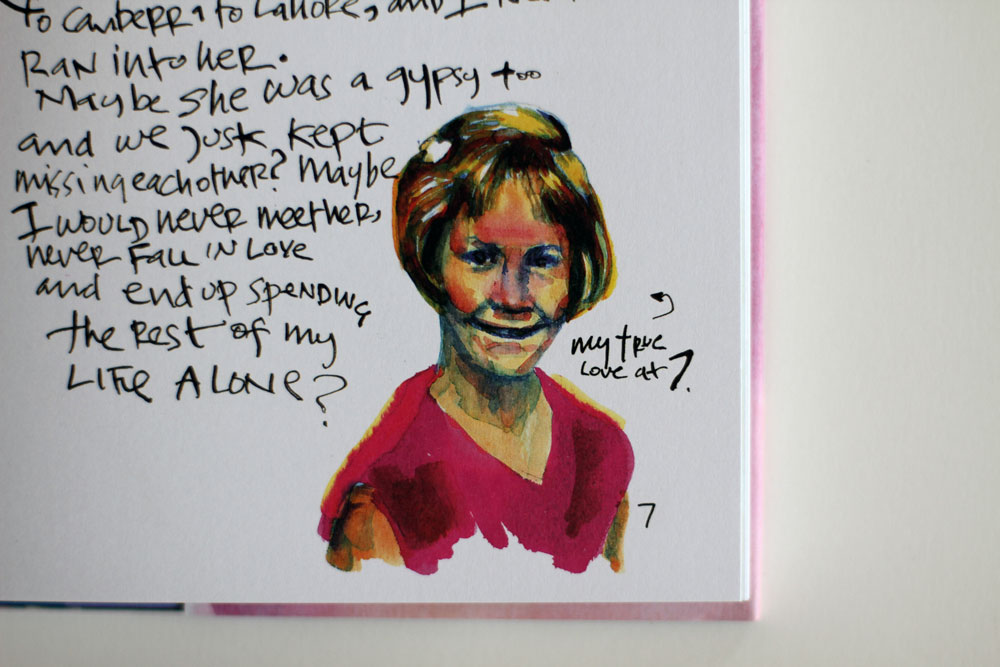
The illustrations are stunning.  As in his other books, the story is handwritten.  Gregory often uses a dip pen and the entries are published as they are written.  The written words are art.  There is a haunting page where he is writing in white ink on a blue background about the day of Patti’s death.  The nib of the pen seems to have split halfway through the entry, or is he retracing every word.  The letters and words seem to be falling apart, or like they have ghosts.  The entry ends with “Nothing seems real.”   
He paints an interpretation of Hokusai’s classic  the Great Wave with a hand form reaching out of the water in the undertow.  It’s a powerful rendering of the way grief comes in waves and “flattens” you.   
The drawings of his son and their dogs crackle with love and energy.
But this book doesn’t flatten you.  The honesty of it is refreshing and the beauty of life is evident on every page.   
Gregory addresses the ambivalence we have when spirits seem to visit us in dreams and in strange coincidences. There are funny moments, like when he spends time with a friend who has devolved into a sort of caveman without the company of women.  “I better watch it.”  And when he gets advice from a friend who tells him the universe is waiting to see what he will make of this, and Gregory’s response is, “Why can’t the universe just leave me the fuck alone?”
The book itself is well bound and opens flat so you can enjoy the two page spreads.  I always look at books without their jackets because I like to see how they are bound and I’m always hoping for a surprise.  This one has a lovely watercolor blue cover and a white ink drawing of kissing figurines.  And the back of the paper cover has a collage of pictures of Patti. It underscores how she lived fully and celebrated each day.
People like to think you get over loss, but I don’t think you do.  I think, instead you learn to grieve properly, to let grief have its place in the rhythm of your life.  This book invites you to feel loss in all its color and awkwardness.  The gift of grief is how it imbues everything around us with memory and magic. 
A year after Patti’s death, Gregory draws a beautiful tulip emerging from dark speckled earth.  He has had a terrible time keeping up her garden.  He writes, “P: The bulbs you planted are coming up again. I can’t always remember to water them but someone’s making it rain a lot instead.  Is it you?”
A Kiss Before You Go by Danny Gregory is published by Chronicle Books and is widely available.   Here is a wonderful trailer he did  for it that gives you a sense of what a work of art it is.

Danny Gregory’s website is http://dannygregory.com/  There is a link to his blog and he is a very accessible writer and artist who encourages us all to be creative everyday, because our lives and our losses matter.


Plant Hunters and Botanical Art

As winter sets in and my outdoor time is limited by bad weather and short days, I find myself enjoying a wonderful range of books on botany.

Two of the books I just read have the same name.  I looked for The Plant Hunters by Anita Silvey, which came out this year, at the library and also found The Plant Hunters by Carolyn Fry, which was published in 2009.  In fact, there are quite a few books with plant hunters in the title, and they all seem to promise great reading on a rainy or snowy day.

In the calm of a park or garden, one can hardly imagine the tumultuous history of the relationship between humans and plants.

The Plant Hunters: True Stories of Their Daring Adventures to the Far Corners of the Earth, by Anita Silvey, Farrar Straus Giroux, 2012, is aimed at children and young adults, but it’s a great read and visual feast for anyone interested in botany, gardening and the natural world. It is generously illustrated with botanical art, old maps and photographs.  Silvey works from primary sources — journals, letters, notes from the field — to bring the stories to life.

“One got eaten by tigers in the Phillipines; one died of fever in Ecuador; one fell to his death in Sierra Leone.  Another survived rheumatism, pleurisy, and dysentary while sailing the Yangtze River in China, only to be murdered later.  A few ended their days in lunatic asylums; many simply vanished into thin air.”

Collecting plants from all corners of the world became something of a mania, especially from 1700 to 1900, when Europeans were besotted not only with gardening, but with ideas of finding hardy food crops, medical plants and exploitable cash crops. I wonder sometimes who is in control of this evolution of plants — is mankind their servant?  Through our explorations and cultivation, plants like coffee, tea, tulips, corn, and potatoes have spread far beyond their original territory.  People have in turn reaped better food crops and been given the great gift of ornamental trees, shrubs and flowers.

Silvey’s writing is crisp and compelling.  The prose never gets bogged down but still provides a lot of information and history. The book briskly covers the time when Queen Hatshepsut of Ancient Egypt sent a convoy to Africa for frankincense trees up to modern times and the building of the Svalbard Global Seed Vault, in Norway, in 2006.  I loved reading about modern plant geeks and the surprising fact that hundreds of new plants are still being discovered every year.

This is an informative, fun and beautiful book for plant lovers of any age.

The Plant Hunters: The Adventures of the World’s Greatest Botanical Explorers, by Carolyn Fry, was published by Andre Deutsch, in 2009.  It’s in an album type binding and contains fold-outs and enclosures of  documents, journal entries, sketches and drawings.  Vellum and paper envelopes are attached throughout the book so you can handle facsimiles of  herbal manuals and Dutch tulip catalogs from the 17th century,  the oldest known map of the Kew Gardens, pages from Linnaeus’s Lapland journal and dozen more pieces of historical ephemera.  Here again are examples of botanical art that are just breathtaking.

Fry’s narrative is a bit more dense and detailed than Silvey’s.  Every turn of the page tells a new story and it feels like I’m touring a natural museum from my chair.  This book also delves more deeply into how the history of  plants is tied to imperialism and slavery.  However, most botanical adventurers were driven more by a love of nature, travel and adventure.

These books make the simple act of planting a tulip bulb or buying an orchid at the grocery store seem a little more miraculous.

I can’t let this opportunity to go by without promoting a favorite book of mine, Cultivating Delight, A Natural History of My Garden, by Diane Ackerman.  She takes us through her gardening process by season.  A poetic and discursive writer and natural historian, Ackerman’s book has been a huge comfort to me since I can no longer garden.  I let her do the gardening and enjoy the lush descriptions of flowers, wildlife and the antics of that most peculiar of species, the human gardener.

Since Ackerman has spent her life studying and writing about natural history, and is, as she states, an “earth-ecstatic,” I always get a deep appreciation for life on Earth whenever I read her work. Even something as seemingly simple as a backyard garden has a wealth of intricate beauty that she brings to light — although hers is a huge garden, with hundreds of roses and dozens of other plants.   Here is one of my favorite descriptions of rain, which shows her style of taking a detail and making it a whole universe:

“I’d call this a gentle rain, but no rain is gentle.  The shape of rain changes as it falls. Raindrops are never round for long; they’re high-speed shape-shifters.  Pulsating wildly 300 times a second, they become domed, flat-bottomed, elongated, egg-shaped, swollen, skinny, flat, pill-like, tall. Watching a raindrop fall in slow motion, I see the well-rounded peace of a tiny world, not furious crack-ups and mutations.  It reminds me of the gradualness of growth, biological or personal.  People appear to be whole, and yet they are countless small processes holding one another in equilibrium. Wishing to move beyond some outworn behavior, one might lament, “I’m not there yet,” without realizing that there isn’t a there there, since growth happens in minute increments.  A time may come when one says, apropos of an awkward incident, “Oh, I feel like I’m reacting differently than I used to,” but one never knows how one got there.  A thousand tiny oscillations were happening in every round moment.  It’s like the shape of rain, which is constantly changing, yet staying recognizably the same, though at times it may have assumed opposite forms.”

I read this book whenever I feel out of touch with the marvelous.

All this reading about plant hunters with their beautiful illustrations made me hungry for more botanical art, which I’ve always loved.  Luckily, there are great books out there for any botany-maniac that show the exquisite structures and colors of plants.

The Art of Instruction, Vintage Educational Charts from the 19th and 20th Century, Introduction by Katrien Van Der Schueren, Chronicle Books, 2011, has reproductions of amazing botanical and zoological anatomy charts.  I don’t think there were any like it in my schools — they are from Europe, mostly French and German publishers.  This oversize volume inspires a sense of wonder at the diversity of life — from the cross section of a tulip to the anatomy of a kangaroo.  This is a captivating look at the history of science, art, education and design.

David Attenborough’s Amazing Rare Things: The Art of Natural History in the Age of Discovery, with Susan Owens, Martin Clayton and Rea Alexandratos, Yale University Press, 2007, focuses on the natural history drawings of Leonardo Da Vinci, Alexander Marshal, Maria Sibylla Merian, and Mark Catesby from the Royal Library at Windsor Castle.  Practically every page has fantastic illustrations and insightful commentary on mankind’s desire to illustrate the natural world. It’s so interesting to see the way the styles and sense of perspective change with each artist.  The writing is as rich as the material presented.  From the precise chalk drawings of Leonardo Da Vinci to the almost surreal rich watercolors of Maria Merian, this book is a delightful journey and gives me a sense of what people thought about plant and animal life throughout history.

A New Flowering, 1000 Years of Botanical Art by Shirley Sherwood, Ashmolean Museum, 2005, is a book cataloging Sherwood’s collection of botanical art as they were exhibited by the Ashmolean Museum in Oxford, England.  Sherwood’s comprehensive collection contains work beginning with illuminated volumes from the 15th century to the present day.  Older works are published alongside the newer ones and it gives great perspective on the history of the art.  It’s amazing to me how drawings of the same plant can be rendered so differently and still be accurate.  Part of the delight of seeing all this work is the underlying insight it gives into how we see.  The reproduction are very clear and beautifully printed.

If you are missing the flowering of summer, any of these books will be a feast for your eyes.  And I got copies at that most marvelous of institutions, the Multnomah County public library.


Waking Up the Body with Matthew Sanford

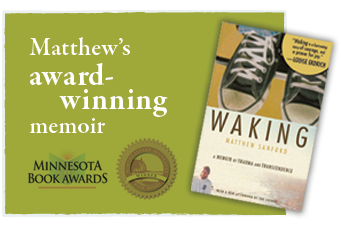
Among other things, I am re-reading the book Waking by Matthew Sanford.  It’s such a gift to those of us who have paralyzed parts — it gives me such a profound respect for the parts of my body that aren’t working, and also for the struggles I’ve had to endure in my family life.  
I have seen several wonderful photographic images lately of flowers wilting and losing their leaves, but I always want there to be one more image — that of the seed growing.  It comes clearer to me as I observe and experience life that with every change there is a new beginning.  Sometimes it’s excruciating to get from one phase of life to the next — and you never look the same.  But if you hold on to your soul, you will arrive.  I hang on to all my bad experiences, not out of bitterness anymore, but because they add to the content of my character, give me empathy and keep me aware of the miraculous nature of all nature, even human nature.
This is a repeat review from my old blog, Chronically Inspired.  It’s a great read for this season.  It puts things in perspective — the gift of life is rare and complex.  Kindness to oneself and others is the greatest gift we can pass on.

I recently became aware of the work of Matthew Sanford when a friend of mine sent me a link to an interview with him on Krista Tippet’s radio show On Faith (It’s now called On Being).  After listening to this wise and thoughtful man, I got his book at the library.
Waking: A Memoir of Trauma and Transcendence, was published in 2006, and is the story of Matthew’s journey to healing after being in a horrific car accident when he was 13.  His family’s car skidded off an overpass, killing his father and sister and leaving him paralyzed from the chest down.
Both his mother and his brother escaped serious physical injury but had to recuperate and reconstruct their lives along with Matthew.  The difficulty and horror of that journey is handled deftly and philosophically by a man who has looked very deeply into the workings of the body and soul.  He has intimately studied the mind-body relationship.  He eventually found a healing path through a yoga practice that got him back in touch with the silent part of his body.  Here’s a quote from the introduction:
“I now experience a different, more subtle connection between mind and body.  It does not require that I flex muscles.  It does not dissipate the presence of increasing inward silence.  In fact, the connection depends on it.  It does require, however, that I seek more profoundly within my own experience and do so with an open mind.  It means that I must reach intuitively into what may feel like darkness.
“Two important descriptive terms appear throughout my story: silence and healing storiesSilence is the word I use to describe the empty presence we experience within our experience – between our thoughts, between each other, between ourselves and the world.  We feel the silence when we daydream, when we appreciate the beauty of a sunset, or when the love of our life truly walks away.  It is an inward sense, often experienced as a longing or an ache.  It is a feeling of emptiness and fullness at the same time.  The silence is the aspect of our consciousness that makes us feel slightly heavy.  It is the source of the feeling of loss, but also a sense of awe.
“A healing story is my term for the stories we have come to believe that shape how we think about the world, ourselves and our place in it.  They can be as simple as “Everything happens for a reason” or as sharp as “How come nothing ever works out for me?”  Healing stories guide us through good and bad times; they can be both constructive and destructive, and are often in need of change.  They come together to create our own personal mythology, the system of beliefs that guide how we interpret our experience.  Quite often, they bridge the silence that we carry within us and are essential to how we live.”
What an incredible amount of wisdom. And that’s just one part of the introduction.  This memoir follows not only the trajectory of Matthew’s life after his injury, but also follows the creation of his healing story and personal mythology.  It gives exquisite insights on maintaining a soulful relationship with our bodies and with our awareness of death.  Death is such a scary and taboo subject.  I appreciate Matthew broaching it with such clarity, and articulating the healing nature of developing a relationship with death.
There are elegant passages about the connection each individual has to family and community.  Often this is as much a story about the healing of family as it is the healing of Matthew.  When the body has been mangled and will take years to recuperate, will never be the same and forever require assistance, there must be, for everyone, a desire to give up.  Young Matthew is buoyed by brother and mother.
His mother moved Matthew to another hospital after a group of nurses informed her that her son was not getting good care.  His neck wasn’t even stabilized.  The nurses mutinied behind the doctor’s back while the doctor was advising Mrs. Sanford to let her son die.
After a short, swift legal battle to get him transferred, Matthew’s mother and brother “poured everything imaginable – love, prayers, hope fear, desperation and, most powerfully, imprints of themselves – into my fragile state of being.  They needed to tip the balance toward living….  Finally I reached a place where I could grab the other end.  I pulled hard and fast.  I didn’t want to feel my body.  I wanted to feel my family instead.”
It required months of intensely painful healing and invasive medical intervention for Matthew to stabilize.   In the process, he learns the defensive technique of “leaving the body.”  His description of the pain he suffers is as harrowing as it is brilliant for his ability to shed light on what severe trauma does to a body.
After the worst of his suffering is over, though, he has to deal with the deadening effect of both his injury and his damaged psyche.  “This is an instance where the absence of a healing story is itself a healing story, although not a very good one.  The silence was left to fester.  The same thing occurs if we fail to stay present as we move into old age.”
What he never entirely loses is his belief that his paralyzed parts have feeling.  Every time he tries to discuss it with his doctors or physical therapists, they squash the idea for fear of making him think he might walk again.  But over a lifetime of dealing with “phantom” feelings, he begins to redefine what his feelings are and what it means to heal.
The practice of Iyengar yoga allows him to finally reconnect to his body.  The most important lesson of it, too, is to find balance, which he learns painfully after pushing himself so hard he winds up broken again.
The forces of life and death, of health and illness, of wholeness and brokenness are all with in us at any given moment.  Finding balance between the two and having compassion for our bodies are the most vital lessons we can learn – it’s an education that can take a lifetime.  Matthew’s story is incredible not only for the insight into life but into how a healing mythology can be created from chaotic and painful elements of life.  His story ends with the birth of his son which so fits the story of his life – life, death, transcendence and loss – that I knew I had been given a sacred story and a deep look into the mystery of life and death and eternity.
I am more connected to my body for having read it even though I doubt I will embrace yoga in the same way he has.  Right now, I’m happy with my chair exercises – although I did love being taught how to shake hands with my pained neurologically damaged feet.
What Matthew is emphatic about is that our bodies are not working against us.  Anyone with a long term illness or disability has to, at some point, hate and fight with their bodies.  I remember literally beating my lower abdomen when I developed neurological damage in my bladder, trying to get it to empty.  It never helped.  I had to have medical intervention – thank science for catheters – but it took me at least 20 years to stop thinking if I did more sit ups and Kegel exercises, I’d get those nerves back.
I will close with another quote from Matthew Sandford’s Waking.  It’s the quote I’m posting on my bathroom wall.  He is speaking of the body’s need for gratitude and appreciation for the trauma it absorbs and the beautiful effort it makes to adapt to injury.
“When I ‘left’ my body during my traumatic experiences, it was my body that kept tracking toward living.  It was my body that kept moving blood both to and from my heart.  Often, as we age and can no longer do what we once could, we say that our bodies are failing us.  That is misguided.  In fact, our bodies continue to carry out the processes of life with unwavering devotion.  They will always move toward living for as long as they possibly can.”
If you’d like to hear Krista Tippet’s interview with Matthew Sanford, follow this link.
If you’d like to see his website, follow this link.