
Today is my younger brother’s birthday. He would have been 53 today but he passed away from complications of the flu (we think) and massive organ failure. He had paranoid schizophrenia and refused to see a doctor about anything. This is the third work of short fiction I’ve written trying to understand his illness and its impact on his family. On me. At the end of this story, I’ve posted some links to another short ghost story I wrote about him and a few essays about him. I think I’ll continue to turn this subject around in my head often. Perhaps eventually, I’ll have enough stories and essays for a collection. Time will tell. Any feedback on this story would be greatly appreciated.

Jesus Dreaming
“If a man has lost a leg or an eye, he knows he has lost a leg or an eye; but if he has lost a self – himself – he cannot know it, because he is no longer there to know it.” – Oliver Sacks.
I was chopping veggies for gazpacho in the quiet of the kitchen. My husband was at work, my daughter at school. The kitchen was in the back of house and was like a sanctuary to me. I’d opened the windows and a spring breeze wafted in through the screens.
From the corner of my eye, I saw a bearded man pass by the window and wave. Next thing I knew, he’d opened the back door. He wore a brown robe tied with a rope. “God bless you, my sister,“ he said and came straight at me.
I pointed my knife at him. “Get the fuck out of my house!”
His laugh was like soft notes from an old lullaby. I dropped my knife. “Patrick?”
“Yes and no,” he said. I ran to him and hugged him. His robe was scratchy. He smelled musky like freshly turned soil. Boney, I thought, my brother is boney. His embrace was so strong I felt as if I was being swallowed by the earth.
“Oh my God, Patrick! Where have you been? We’ve been so worried.”
He stiffened and stepped back. “And who is your god, sister?” he asked softly.
“What?”
“This god you called on — Oh my God — you said. I heard gratitude in your voice so I know you were sincere. But I need to know, is this the great Yahweh God, Father of us all? Who is your God?”
“Just – you know – God.”
“I do know God. Do you know Him? Do you know His Son, who died for our sins?”
I chewed on my lip. I wanted to answer him correctly and not scare him away like I did last time — 10 years, 2 months and 4 days ago. “Jesus? Our Lord and savior?”
Patrick smiled. “Praise be His name. I prayed you would know me, know my Father.”
“I’m so glad you’re here. Are you hungry? Where have you been? Have you called Mom?”
“My Father told me to visit only you.”
“You saw Dad?”
“Your dad is not my father. My father is Jesus.”
“Of course. It’s better to think that way.”
I began pulling food out of the fridge.
“It’s not what I think,” he said. “It’s what I know. That man who claimed to be my father knew he wasn’t. He even said it. Remember? He said it all the time.”
“Sure. Do you want a sandwich? I’ve got some sliced turkey.”
He smiled. “May I sit? Is there water for a child of Jesus in this house?”
I gave him a glass of water. He drank it quickly, set down the glass and belched. “He used to say he found me under a rock.”
“What? Who?”
“The man who claimed to be my father. We thought he was just saying that. Tormenting me. But it’s true. He found me. Not under a rock, of course, but in a basket on the Wolf River.”
I sat down, light-headed and confused.
“He brought me home,” he said, “and said I was his son, but I never was. I was sent by my Father to comfort you and your mother, who were at the mercy of that demon. I failed, of course. But it’s because of the lies your father told. He took me from the basket and vowed I’d never know I was a child of Jesus. That Jesus created me on the banks of the Wolf River. Jesus was exhausted from walking the streets of Memphis looking for a bit of charity among the so-called Christians. He found only evil. Your father laughed at him. You were a child then. Jesus saw the evil your father planned for you.”
He talked fast and little bits of spit frothed around the edges of his mouth. I tried hard not to cry. He still heard voices, but he was alive. I wanted to hug him again. I wanted to get a word in edgewise.
Patrick wiped his mouth with the sleeve of his robe. He took my hand.
“Don’t cry, sister. I’m here for you. I know you need me. I won’t hurt you again.”
“You never hurt me. We were all just so worried when you disappeared, Patrick. We were only trying to help and….”
He laughed. “Patrick isn’t my name, you know. My true name is Jesus Dreaming — for that’s how I came to be. Jesus slept on the banks of the Wolf River and dreamed me into being. He has dreamed my whole life for me. I was blinded by your father, but now I can see the truth, the light, the dream that flows through me. Your father ridiculed me because he was jealous that I am that chosen one. I am not flesh and blood like you. I am Jesus Dreaming.”

~~~
Patrick lived with us for about a year before he disappeared. He came to us broke and homeless — his roommates had kicked him out. It didn’t take long for us to figure out why. He’d stay up at night late, locked in my studio turned guest room, drinking coffee, and cussing out someone who wasn’t there. My husband, Zeke, slept hard but it even woke him up.
It only took a few nights before he pounded on Patrick’s door, and told him to knock it off. The next day, Zeke woke Patrick at 5 a.m. and told him to get dressed, he was going to work.
Zeke ran his own construction company and he hired Patrick as a laborer. Zeke worked him hard, too. The noisy nights ceased. Patrick spent his first check on groceries for the family and cooked for us that week-end. He bought a pork shoulder and he and Zeke got up at dawn to start smoking it. They discussed infinite ways a pork shoulder should be cooked: the right herbal rubs, the best way to baste, what to put in the sauce. Between them they made barbeque that melted in your mouth, gave you something to chew on, and left a smoky aftertaste. It seemed like Patrick was finally going to be okay.
Whatever Patrick did when we were kids was wrong. Whatever Patrick did was wrong. If he did nothing, Dad would yell at Patrick for being lazy and call him Patty the Pussy in front of everyone. If he tried to do something Dad told him he would fail. But Patrick grew up tall and strong. He made quarterback on his junior high school football team. Whenever he had a winning season, Dad would say, “Now you think you’re hot shit. You think you’re better than us.” Even though by the age of 15, Patrick was taller than Dad, Patrick would whimper as soon as the insults started, roll his shoulders forward and chest inward, as if that would protect his heart. I’d hide in my room and plug my ears, but his cries came through. I was too scared to do anything but curl in bed and wait my turn.
Patrick was very good at hiding his bruises, but when his coach finally saw them, everything in our lives changed rapidly. He reported Dad and he was arrested. One of Dad’s drinking buddies paid his bail. Mom took us to her sister Clare’s house. Mom got so drunk, she passed out in the bedroom.
Dad came straight from jail and broke down Aunt Clare’s door. She, Patrick and I hid in the closet. Dad stomped through the house yelling that he was going to kill Patrick. He found Mom and tried to shake her out of her vodka coma. We might have stayed safe in the closet, but Patrick ran out. He pulled Dad off of Mom and punched him in the face.
Dad fell back unconscious, his nose gushing blood all over Aunt Clare’s beige shag rug. She’d called the police as soon as Patrick opened the closet. When he heard the sirens, Patrick panicked.
“They’re coming for me.”
We told him they would arrest Dad.
“No. He paid them to kill me. They’re coming for me.” And he ran.
That ended the sham of our family life. I was 17 and refused to leave Aunt Clare’s house. Patrick’s coach took him in for a while and tried to get Mom to get Patrick some help. But Mom took up with a man she met in a bar, and pretended she didn’t have a family at all.
Patrick began to fight at school. He ran away from the coach’s house, only to show up a few days later, saying Dad was chasing him. Patrick heard Dad threatening him on the school speakers and from radios. He saw Dad scowling at him through windows and through the television screen.
Eventually, Coach got Patrick put in a Christian halfway house, where he accepted the Lord and learned some building skills. He got jobs as a day laborer but they never seemed to last long.

~~~
I asked Patrick to help me chop onions. I thought maybe the sting from the onions would stop his chatter. I was already exhausted from trying to make sense of what he was saying. But even as tears rolled down his cheeks, he talked about how eating roots was once considered to be eating the devil’s food, since they grew in dirt.
“But mankind was made from dirt; roots are part of God’s goodness. The rumor was started by old Beelzebub himself to starve good people and addle the minds of the wealthy. Same with vegetarians today, mocking the order of things, even the blood Christ himself shed so that our souls should be nourished. Meat is essential, else we grow to be sieve-like and God’s power drains through us. In Eden, animals understand their fate. The lamb lies down with the lion, the lamb understands he shall nourish the lion. The lamb is reborn again and again to fulfill his sacred duty!” He took a deep breath and seemed surprised to be where he was, in the kitchen, with me. “Your dad thought I was a lamb. But who is the lion now?”
I put the gazpacho in the refrigerator. “I need to call Zeke and let him know you’ll be here for dinner.”
Patrick regally nodded and I escaped into the bedroom and shut the door. I called my husband and informed him that we had a schizophrenic prophet as a house guest.
“Are you okay? Should I come home?”
“I’m fine. Can you pick Lizzie up from school, though? Let her know what to expect.”
“What should she expect?”
“Oh, God, Zeke. I don’t know. He’s different. He seems safe. He’s talking crazy but it’s gentle. He’s sermonizing. I guess you can both expect to be preached at. I’m going to set up the air mattress in my studio.”
“Well, I guess the evening will be colorful. Do you think he’ll go to a doctor now?”
“Maybe a Christian one.”
We were silent. Ten years later and we still didn’t have a clue what to do about Patrick.
Back then, he’d worked with Zeke for a few months, but his paranoia and night-time episodes started up. On the drive to work with Zeke, Patrick would mutter about how other members of the crew made fun of him. He’d threaten to kill them. Then he’d babble an apology and talk about how the Lord would take vengeance for him. Zeke told him he had to be quiet when they got to work and he was. But he’d cuss through the night, threatening the other crew members as if they were in the room with him. Zeke could only get him to shut up for a few hours.
We were exhausted. Lizzie was 2 then. We didn’t feel safe. I pleaded with Patrick to get some help.
“There’s nothing wrong with me! They sneak in through the window and when they hear you coming to check on me, they run away.”
One night we were watching the news together and he leapt up and shouted. “See? You heard that! They can go in and out of a room without a door! They confessed right on the news! Now you see. They’re out to get me.”
Lizzie started to cry. Zeke said, “That’s enough! If you can’t control yourself, you can’t stay here.”
Patrick stormed off to his room but he was quiet through the night and went to work the next day.
I talked to a friend who had a friend who did intake for mental patients at one of the hospitals in town. He said all you had to do was call the police and they’d take him in to the Memphis Mental Health Center. They’d get him on medication there.
My mom agreed to come over and help us explain what was happening. Patrick was in his room and we called the police.
Their footsteps rattled the house.
We told them what had been happening but they didn’t seem to understand.
“Is he violent?” one of them asked.
“No. He’s never hurt anyone. He threatens, but it’s because he’s hearing voices.
Patrick walked into the room. “Oh Martha,” he wailed. “I never thought you were one of them. I trusted you.”
“We called them for your own good,” Zeke said.
“You need help,” Mom said.
“All of you,” Patrick said. “All of you are Satan’s minions.”
“Look Buddy,” a cop said and stepped right up to him, right in his face. “You’ve been causing a lot of trouble here. I suggest you get your things and move on.”
“You’re going to take him to the hospital right?” I asked.
Patrick barked out a laugh and stomped into his room.
“Lady, we’re not social workers. All we can do is get him out of the house.”
Patrick had stuffed his clothes into a pillow case, walked past us all and out the front door. Then he started to run down the street.
“You’ve got to take him in for help,” I pleaded. “He’s sick. We were told you’d take him to the hospital.”
They shook their heads. “You were told wrong.”
“If he comes back and he’s violent, or tries to break in, we can take him to jail,” said the other.
And they left. I ran down the block in the direction Patrick had gone. But I couldn’t find him. It was as if he disappeared. He did, actually.

~~~
After hanging up with Zeke, I went back to the kitchen, Patrick wasn’t there. I found him sitting on the front porch, finishing off a large bowl of gazpacho. An empty sliced turkey package – enough for the family’s lunches for the week — was on his lap.
He smiled at me. “It’s time for me to go back to work. I just wanted to stop by and say hello.”
“Where do you work? Where do you live?”
“After wandering this wicked country up and down and round and round, I have finally gone back to live at the place of my birth, at the banks of the Wolf river. From there I can walk into the city and spread the word of God. Those who have open hearts give me alms. Those with closed hearts shun me. I listen to my Father’s voice. I am his child and his scribe.”
“Will you let me drive you home? I’d love to see your place.”
Patrick pondered his callused, filthy feet for a bit, then said. “I’d love for you to see what God has provided me. But Martha, you must promise, as God is our witness, you must never tell another soul, neither your husband nor children. Not your father especially. Not even your mother.”
“I don’t even know where Dad is. But Mom, you know, she’s quit drinking. She even got saved. She’s been a member of the Christ United Bible Church for almost 5 years and sober the whole time.”
“You mean that church of bigots and misers?”
I laughed. “Well, she needs the structure, I think. Keeps her from drinking.”
“And you, sister, where do you worship?”
I wanted to answer in a way that wasn’t a lie. My family seemed to be driven in crazy circles between religious fanaticism and alcoholism. My dad even blamed his behavior on his soul being held captive by a coven of witches. He was born again while he was in prison. He wrote me long letters in care of my mother. I wouldn’t let her tell him where I lived. He could rot in the hell he created as far as I was concerned. When he got out, he ran off with a 17 year old girl. I never heard from him again.
I sat down in my wicker rocker next to Patrick. He seemed to have lost all his edges. The beard and mustache filled out his gaunt features. He had a few little crow’s feet wrinkles but his eyes were big and bright, with impossibly long eyelashes.
I’d always been jealous of his eyelashes, and his hair which hung in soft thick curls down to his shoulders.
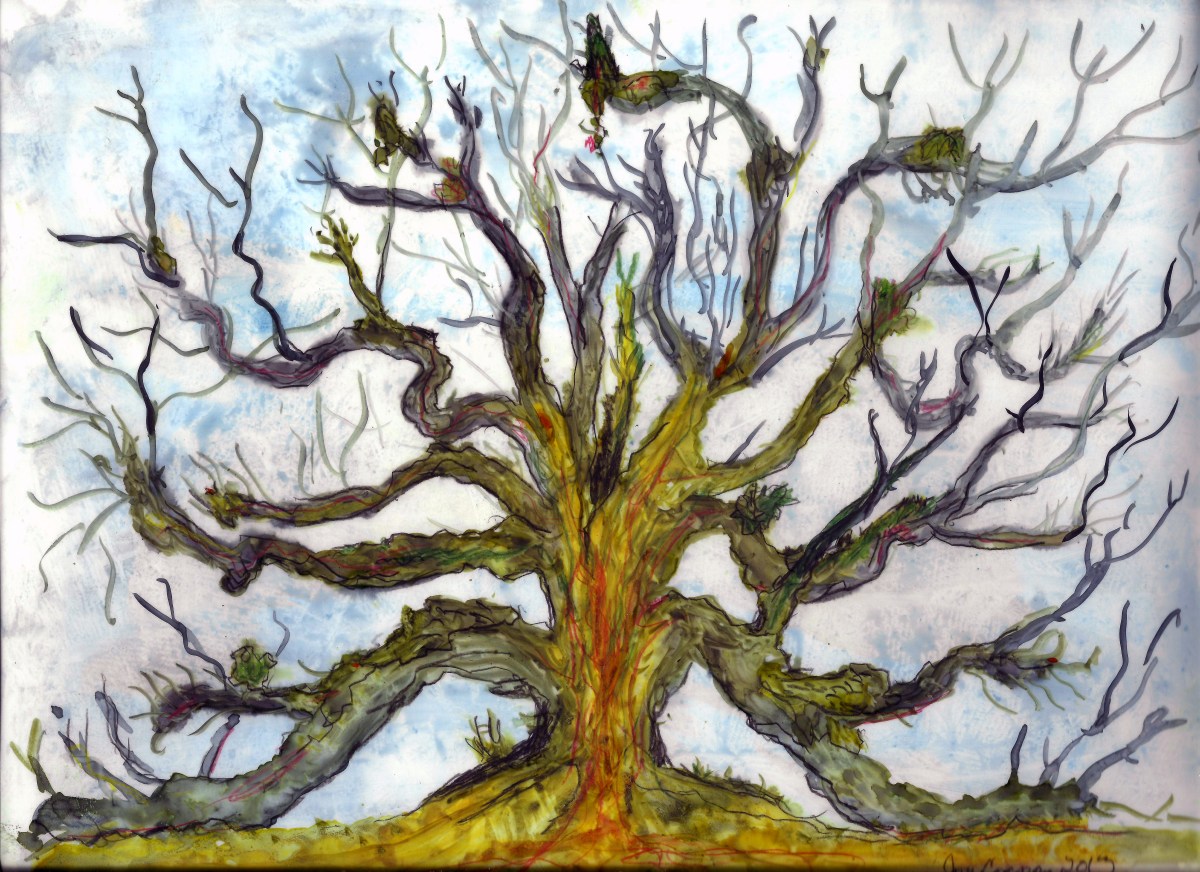
“Every morning,” I said, “I sit out here and marvel at this old oak tree. I mean, even in winter, when it’s so cold I can only bear to be out here for a few minutes, I take a minute and sit here under it. And in the summer, it rustles in the wind and cools me. I’m so grateful to be here. To have this peaceful house and a sweet daughter and good husband. Patrick, I’m sorry, it’s all I can do. I sit in this peace on this porch and pray it never goes away.”
“In the sheltering arms of the Lord,” Patrick said. “By His works, ye shall know Him. It’s better to be here in God’s pure bounty than in the nest of vipers that call themselves a church. Come now, and I will show you my home and church.”
Through a series of complicated directions, we drove to the outskirts of downtown. We were close to where the Wolf River and the Mississippi converged. We had to park and hike through a convoluted pathway for about half a mile. It was getting to be the hottest part of the day and everything was steamy from recent spring rains. Mud seeped up into my sandals. Patrick walked with a practiced gait and I stumbled behind him. Just as I was about to ask Patrick to stop, I needed to rest, we reached the river bank.
He’d strung up tarps over tree limbs like a bower. Inside there was an old mattress, milk crates filled with bibles, and some pots and pans. Several stumps surrounded a fire pit filled with ashes.
“Here is my home, my church, my destiny,” he said. “I was kept from such beauty for too long. Now the Lord has led me home.” He gestured all around. Ancient magnolias, oaks and pines stood guard — a green cathedral over his crude tent.
At the river’s edge, I saw a boat made of small logs, boards, and rope staked to the shore. Water sloshed around inside and around it, though the river barely rippled.
“You don’t use that boat do you?”
“Patience, sister. In the world of the Lord, things take time. I am still gathering what I need for my boat. Now I fish by the shore. Soon I’ll fish in the deep water. Who knows but I might catch enough to feed those starving on your city streets.”
I left him there and followed the trail back to my car. I planned to go straight to a sporting goods store and buy him a proper tent. As I tried to figure out ways of helping him, I tripped over a root, fell forward into the mud, and had the wind knocked out of me.
I writhed around, tried to stand up. I made it to my knees and gasped and gulped for air. The canopy of trees floated down like a green blanket, suffocating me.
Where was Patrick, God damn it! If he was such a fucking child of Jesus, shouldn’t he hear me struggling? Shouldn’t he help me?
I got up and staggered forward. I’d skinned my hand. Bright blood pooled on my palm.
Wasn’t I just in my cool sunlit kitchen? Wasn’t I opening a window to a sweet breeze?
Mud clung to me. I tried to rub it off but only ground it further into my clothes, my skin, my soul. I lurched down the path, found my car, and sped home.
Zeke waited on the porch. I ignored his questions and rushed to bathroom to shower it all off and to be alone, but Zeke followed me. He helped me peel off my clothes. He stripped and got in the shower with me. He tenderly soaped me up and I started to weep. The water poured on us and between us, until I let myself be saturated with the illusion of cleanliness and safety.
How did I find such a good man?
He dried me tenderly and told me he’d given Lizzie the barebones story of Patrick’s return. She already knew I had a mentally ill brother who went missing 10 years ago.
“She expected to find Jesus waiting here but instead she got the swamp monster mom.”
“Oh no! Where is she?”
“I said she could watch anything she wanted on the VCR. She didn’t even see you. She won’t notice anything til her movie’s over.”
We went out for burgers. I drank many beers when I got home while Zeke told me stories and made me laugh. I slept in his warm embrace with no dreams at all.

~~~
Zeke came from a country where children were loved and educated and urged to be happy. I am a refugee from a parallel country where parents beat and raped their children, then taught them to behave as if they were native to Happy-Family-Land.
Zeke had a weak heart as a child. When he was a teenager, he started lifting weights and working hard. He thought if the heart was a muscle, he should be able to build it up. When I met him, his weak days were a distant memory. He was only in his early thirties and already owned his own construction company. He worked alongside the crew savoring the heaviest work. He’d gotten a contract to renovate the building that housed the student studios for the City College of Art.
I’d gotten a scholarship there and was obsessed with being their most prolific student. My art was minimalist but the canvases were big – 48 by 48 inch squares with gradations of pale colors and small animals hidden in the darkest hues.
He came in to survey the room at about 6 in the morning when no one was supposed to be there. But I was always there when I wasn’t at work or in classes. I’d learned to pick the lock.
Even when they started construction in the summer, I came. I let the dust settle into the paint. It added a mysterious texture to what I was doing.
He asked me to dinner. Over burgers and beer, he said, “I bet you’ve got a lot more to say than that little bit of squiggle you’re putting in those paintings.”
“Those little squiggles are the reason I got my scholarship. They said it showed depth and lacked the excess of many young artists. My style has potential.”
“I know you’ve got potential,” he said. “I just hope you don’t shrink it up so small you don’t get to say what you mean.”
“I didn’t think construction workers were supposed to have opinions on art.” I sneered. “Unless it’s pin-ups.”
He cocked his head and stared straight into my eyes. “I think you know as well as I do there ain’t no such thing as supposed to.”
Once I fell into the deep pool of his warm, kind eyes, once I fell in love, my paintings got smaller and were filled with giant blossoms. They didn’t get much praise from my professors, but they sold better.
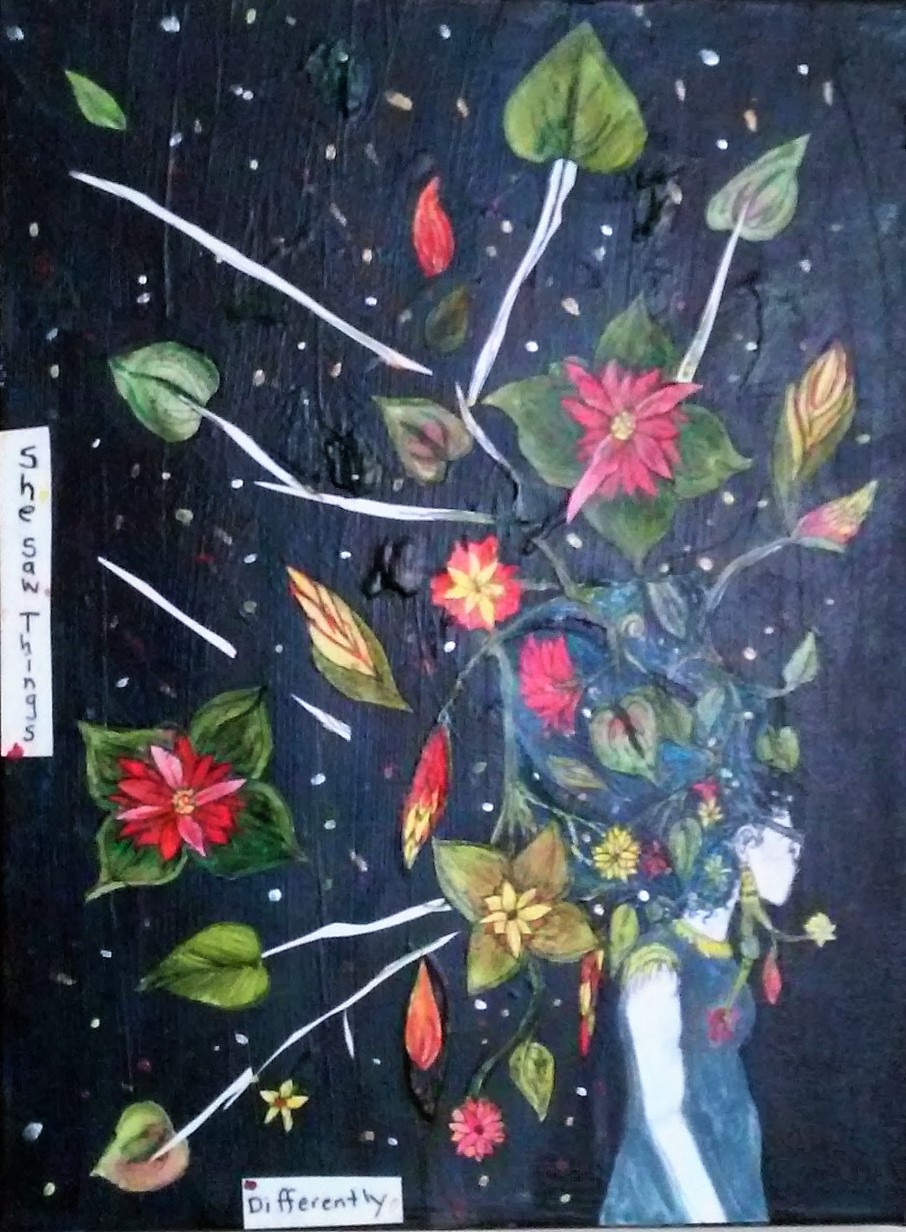
Zeke accepted the challenge of having a refugee from a broken family as his wife. He didn’t mind that I was broken. He was a fixer. A renovator. He dealt with my dark times the way he did his own heart. He built me up. He got me out into nature. He took me hiking, taught me to identify plants and birds. He taught me to kayak. We went to the ocean for our honeymoon. We learned to snorkel. Held by the warm salty water, I saw a world I’d been blind to. I’d never be that blind again.
~~~
I went to see Patrick every day. He refused the pop-up tent I bought him. “This bower is all I need. The Lord my Father shelters me.”
I took him one of our kayaks. Zeke offered to go with me, but I couldn’t let him. I’d told Patrick I wouldn’t tell anyone where he lived. I showed Zeke the general area, but I had to keep my word. I figured if I kept the secret for the first few weeks, Patrick would relent.
I felt worried and restless all the time. A spring storm could flood out the little bit of riverside he camped in. He got dirtier and smellier. His teeth were rotting. He constantly scratched his head. I offered to take him home and give him a lice treatment. He only laughed at the annoyances of God’s little creatures.
I took him leftovers from dinner and sandwiches. I couldn’t bring too much food because he had no way to store it.
Usually he was sitting in the tent, under the tree, reading one of his bibles, but one day I went to visit early. Lizzie’s class was going to the zoo and I needed to be at the school by 9 to chaperone.
Patrick sat on the ground using a stump as a desk. He had a dip pen and bottles of colored ink. He was so intent on his work that he didn’t notice me approach.
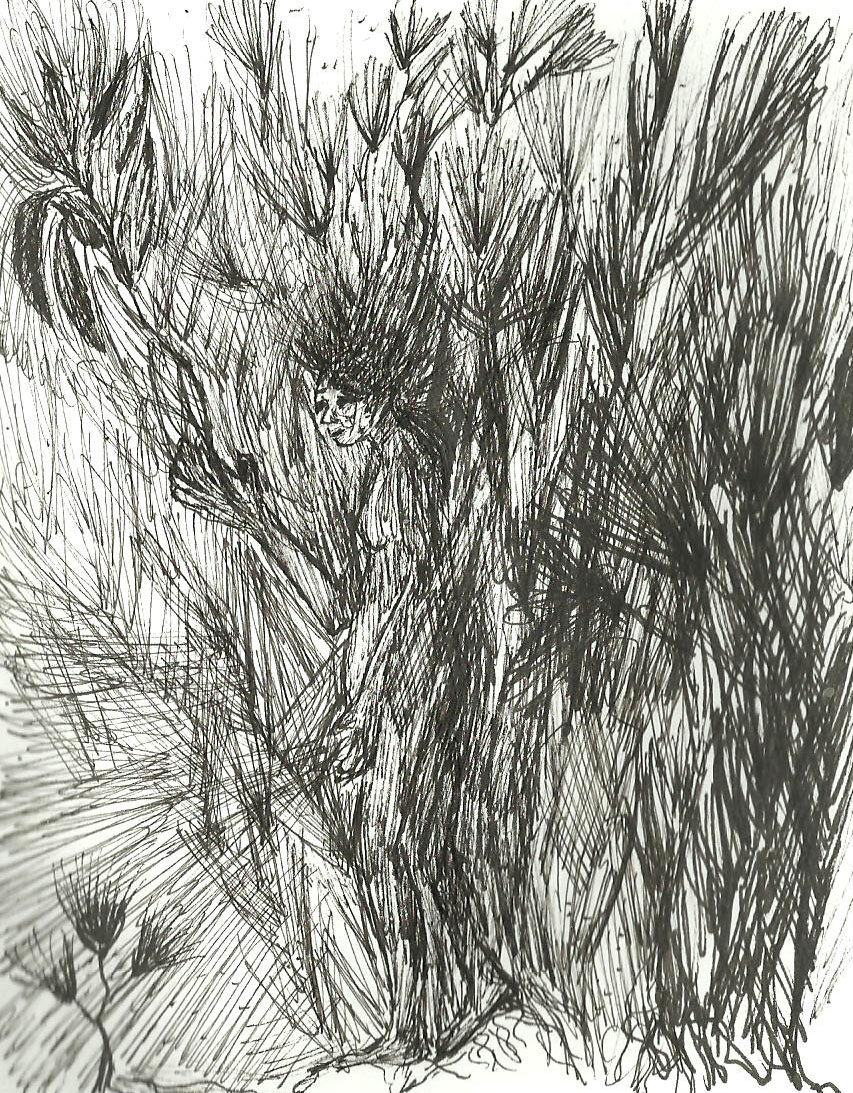
He wrote – or rather drew – colorful symbols in circles around the paper, turning it as he drew. Small birds spiraled in the center, bold letters circled them, lions and tigers and dragons circled the letters. I say letters, but they only had the vague shape of letters, like some ancient alphabet that was still part hieroglyphs.
I watched fascinated. Some of the work was smeared, but animated — like a swirl of color that was slowly revealing a story I could almost understand.
“What are you doing here?” Patrick suddenly shouted.
“I came early because I have to help out at the school. Patrick, this is great. You’re a real artist.”
Patrick hissed and spit and pulled the paper up to his chest. “You can’t see this. This is mine. This my sacred work, dictated by MY Father, not yours. Go! Go!”
“But it’s great work. You could sell work like that, make some money.”
He screamed words I couldn’t understand, his breath was hot and rank. I stepped back. He grabbed a limb and shook it at me. I turned and ran. He didn’t follow me but I could hear his rage as I raced back to my car.
I started the car and sped away. It was too much. I didn’t know what I was doing or why. I couldn’t help that man. That boy. My lost little brother.
I was a wreck when I reached the school. Lizzie’s teacher asked if I was okay. I said I had allergy problems, that’s why my eyes were red. I used my singsong voice, I’m fine. She said I didn’t have to be a chaperone for the trip if I felt bad, but I had to. I had to be somewhere besides in my head. I had to walk along with children, to be normal.
I am a normal mother walking with her normal daughter through a zoo. I think Lizzie sensed there was something wrong with me. She didn’t walk alongside me, she stayed with her friends, slumping around in their 12 year old, “moms are so weird” way. I smiled and nodded at the small talk of the other mothers, of the teachers. In each cage I saw my brother pacing. I saw myself throwing meat to an animal that really wanted to rip into me for dinner.
Patrick was on the front porch when I got home. I was afraid to get out of the car, but he came out to the driveway to greet me. He carried a bouquet of wild flowers.
I rolled down the window.
“Sister, please, forgive me. I didn’t mean to scare you. I was out of order. I am so sorry, Martha. I am still learning to do my Father’s will.”
He handed me the bouquet. The stems were shredded from his tight grip. “Please continue your visits. My Father will visit me at night so you won’t disturb us.”
And he walked away.
I didn’t tell Zeke or Lizzie what had happened.
I visited Patrick the next day. He seemed delighted to see me.
“I got the boat finished. I caught 2 catfish out in the deep river. I’ll feed you today. I found bread, too. My Father has provided loaves and fishes.”
He urged me to sit in the shade of the tent as he built a fire and heated oil a cast iron skillet over the fire pit. As he busied himself, I noticed a bit of paper peeking out from under his mattress. I reached for it and suddenly Patrick stood over me. I jumped.
“It’s okay. It’s the word of my Father,” Patrick said. He pulled a few pages from under the mattress. He took out a milk crate from between the mattress and tarp. There were hundreds of pages of illuminated and chaotic spirals. “It all brings grace to the savage chaos of our time. I can’t tell what my Father means, but he guides my hand. He will tell me when the time comes to share it. Then the meaning will fly from the center of the page and into the hearts of man. See how the doves start each page, each page starts in the center? That’s our soul, that’s what our eyes will see, the dove of our souls flying into the hearts of the beasts. See?”
My heart leapt as he showed me each page. If only I could paint like that. It was fluid and geometric at the same time. The paper was torn newsprint he’d painted over with white acrylic. To see the faint ghosts of news articles and ads behind the drawings added an eerie element to the composition.
“Where are you getting your supplies?”
“I spread the word of God. People give me alms. I buy what is needed to be my Father’s scribe.”
He left me and went back to tending the fish. I pulled out two pages from the bottom of the pile and slipped them into my bag.
We were quiet as we ate the fish with our fingers off of newspaper. I noticed the bread had a bit of mold on it and didn’t eat it. “I ate before I came,” I said.
Patrick smiled. “I guess you weren’t expecting to find such bounty here,” he said, then ate my bread.
I looked at the finished boat. He’d nailed wooden patches over parts of it. On each patch, he’d painted the words Jesus Dreaming.
“Please let me give you my kayak,” I said. “Your boat is so rickety. I’m afraid you’ll drown.”
He sighed. “If it’s my time to join Him, my boat will make the journey as well as yours. Besides, you know in your heart I’ve always had the power of God within me. Remember when I brought that bird back to life? It was after your father hurt you. You found a dead robin in the backyard and you cried and cried. It hadn’t been dead long. I knelt down with you. I held the bird to my heart. It stretched its wings and it flew around our heads. I told you then, every bird has a claw but not every claw has wings. It made you laugh. Remember? Why sure you do!”
I nodded but I didn’t remember any such thing. I left him and went home to wash the fish smell off of me. Then I went to the College of Art. Even though I dropped out, I was still good friends with my professor. I showed him the drawings.
He was as taken by them as I was. He called a friend of his who ran an outsider art gallery. I went there and showed him Patrick’s art. I told him a little of his story. “He says he’s taking dictation from God. I’m pretty sure he wouldn’t want to be part of a show, but I could get his works together and help write a bio.”
The gallery owner said he had a collector who would almost surely pay top dollar for Patrick’s work.
I could finally help Patrick. I knew he would be resistant at first. I planned to let him get angry, then take Zeke out to see him. Zeke could calm Patrick down and tell him that showing his art was a way of getting God’s word out to people and a way of supporting himself.
When I got to Patrick’s camp the next day, he’d taken his tent and bed apart. He squatted on the ground rifling through his art, muttering and hissing.
“Are you okay?”
“I’ve lost part of The Word. Or Satan has stolen it. I didn’t see him come. I slept too much. I can’t find it. Without the entire stream, The Word makes no sense.”
“What are you talking about?”
“Pages are gone! Pages are gone from my Father’s word.”
“Oh Patrick, don’t be upset. I took them. I showed them to a gallery owner. They want to do a show. It’ll make you lots of money. You won’t have to live like this anymore. It’ll get the word out, too.”
He lunged at me and grabbed me by the shoulder. “Get them back. Now! You have to get them back! My Father is angry!”
He shook me hard and pushed me toward the path to my car. “Go!”
I did as he asked. I went to the gallery got the paintings back. The owner was upset. I was sweating and talking fast. He may have thought I was the one who was crazy.
Maybe I was.
I took the pages back to Patrick. He grabbed them from me and looked over them, chanting, turning them in circles. He loosened his robe. The rest of his work was tied to his chest with a rope. He stuffed the pieces I returned into the pile.
“Patrick, you’ll damage them. These are great works of art. They can help you live a better life. Maybe that’s what God’s message is. Maybe that’s why I’m here, why He sent you to me, so I could help you through the art, so you could…”
“Help me? You think by being a thief you can help me? You are a whore! I am NOT Patrick and you are NOT my sister. I trusted you but it was you all along, you were the devil in it all. You ruin everything.”
He pushed me to the ground and strode away into the woods.
I don’t know how long I lay there. I wanted him to come back. I was afraid that he would.
I eventually gathered myself up and went home.
I halfway expected the next day he would show up with another bouquet but he didn’t. Or the day after that.
Zeke wouldn’t let me go back by myself, so we went together. Everything was gone – the bower and all his stuff. The boat. The only thing left were ashes in the fire pit.
I ran around looking for trails he might have made moving his stuff to another camp site. There was nothing. I ran along the river’s edge. Zeke tried to keep up with me. He was talking steady and low, but I couldn’t hear what he said. I ran in circles. Patrick had vanished again. And again it was my fault.
I saw a piece of wood floating in the river. It was almost as brown as the water itself, but there was some color to it. I waded out to get it. On the sodden dark wood I could read the bright blue paint: Jesus Dreaming.
The Wolf River undertow pulled at my legs, gnawed at my calves. Was this why they called it a wolf? I heard it growling. No, it was Zeke calling. He guided me out of the water.
I don’t remember much about what happened next. We drove to the police station. It was hard convincing them to come look at the camp. They only wanted us to file a missing person report.
I kept insisting they needed to dredge the river, that my brother had drowned. The desk officer asked Zeke for a description of Patrick, but Zeke had never actually seen Patrick. I’d kept my brother’s secret too well. The clerk eyed me wearily but he sent a cop to survey the scene with us.
That cop talked a lot to Zeke. They walked all around the site, but the cop saw no “real evidence” that there was a camp, that there was a drowning.
There would be no dredging, no further search. Zeke was urged to take me home.
The days after were a blur. I had to go back into counseling. I went back on meds so I could keep from crying in front of my daughter all of the time. I spent a lot of time laying on the floor of my studio. I knew I should try to recreate what Patrick had shown me, but my efforts were no more than scribbles that I tossed away.
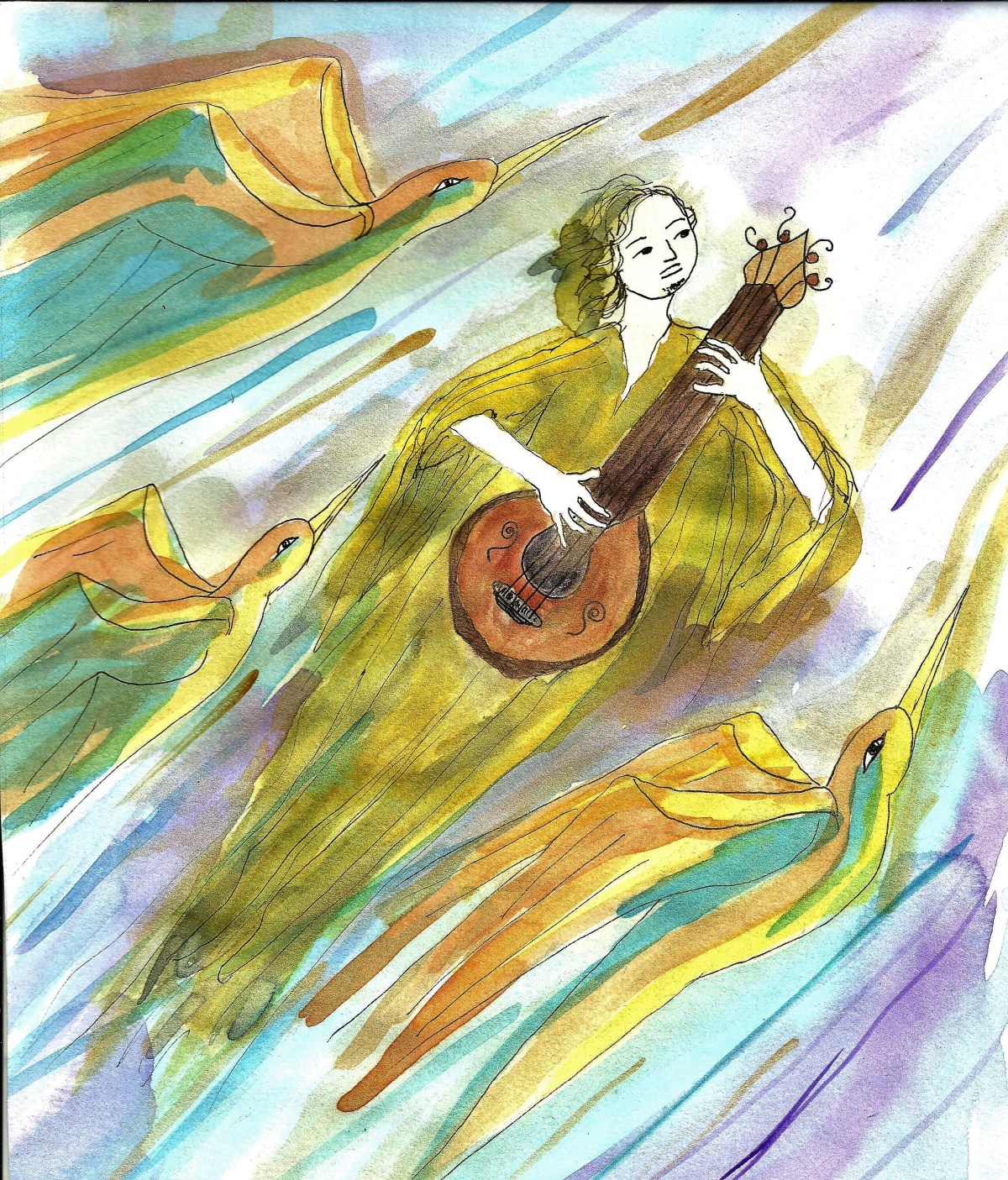
About once a week, now, I take my kayak down to the Wolf River. My oars slice through the brown waters. I go up and down and round and round. I peer over the edge of the kayak but instead of my own reflection I see his – like when he was a child — as if he’s sleeping in the water, his eyelids rippling with unfathomable dreams.
***
Thanks for reading this story. It’s a work of fiction. Though my brother had times of deep spiritual beliefs, he never believed he was a savior. I have known other people with schizophrenia who did, so I’ve jumbled up family stories and stories I’ve heard from others. I’ve gotten comments from several readers of this story about not being sure of the reliability of the narrator. What do you think?
Here are links to other posts I’ve written about coping with schizophrenia in the family and the loss of a younger sibling:
Essays:
Passages, Mourning and Halloween
This short story was written out of need to make a benign ghost story, since most ghost that I’ve imagined have been much more helpful than many mortals I know 🙂
~~~
If you’d like to support my art and writing, please consider becoming a donor on Patreon:
https://www.patreon.com/user?u=8001665
If you prefer to make a one time donation, you can do so at paypal.com My paypal account is set up under my email at joyzmailbox@gmail.com If you have any questions you can email me.
You can get prints and cards of my work on Redbubble:






 joy murray art~stories~life