"All The Messy Glory"

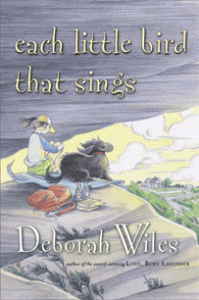
Sometimes the perfect book comes along at the perfect time.  When I was in Memphis for my mom’s funeral last week, I stayed with a dear friend who is a children’s librarian.  She urged me to read Each Little Bird that Sings, by Deborah Wiles.  It’s the story of 10 year old Comfort Snowberger, who lives with her eccentric and endearing family in a funeral home in Snapfinger, Mississippi.

The Snowbergers have a good honest relationship with death, and Comfort has attended 247 funerals.  She reports on the funerals, hoping one day to get in the local paper for her obituaries which are much more exciting than the boring things that do get published.  She feels it is her duty to keep everyone’s spirits up.  It’s her contribution to the general family attitude of  being of service. 

However, Comfort is finding it too hard to be of service to her bratty cousin Peach.  She hates him and his whiny ways.  She also finds out that her best friend, Declaration, is in the process of dumping her for cooler girls.  Declaration is being mean and  has begun to taunt her for being around dead people all the time.  Her best friend, it seems, is her dog, Dismay. 

Then Uncle Edisto dies.  Then Aunt Florence.  These elders of the family take with them the wonderful sense of security that Comfort has grown up around.  That’s 249 funerals.  Who will be number 250?  Aunt Florence promised a sign for Peach at her funeral.  What happens takes Comfort so close to the reality of death that it impacts the whole family.  It portrays the changing nature of  friendship in a delicate but realistic way.  Life altering events, in fact, alter lives. 

This book was engaging and funny and sad.  It was also a reassuring companion as I navigated my mother’s funeral.  It helped me appreciate the deeper meaning of the hymns and the sermons and the rituals we went through to honor my mother. 

When we were young, our family was torn apart by divorce, alcoholism and poverty.  We never really got proper training in how to handle funerals, weddings or any other public rituals.  I never know what to do.  My mother had the foresight and faith to arrange her own Christian funeral, and my sister, who took care of Mom, dealt with all the final details.  All I had to do was go, mourn and commune with family and friends. 

My friend who gave me the book, it turns out, went to funerals all the time with her family.  One of the reasons she loved Each Little Bird that Sings, is that it reminded her so much of her childhood experience with beautiful funerals and the camaraderie that can happen around them.  Her family would decorate and clean the graves of family members and loved ones. They took extra flowers to decorate graves for neighbors who could no longer make the trip to the cemetery. 

I never really saw myself as a person to visit graveyards, but sure enough, now I want to visit my brother, my grandmother and my mother every time I go to Memphis.  The funeral provided a closure, but it also provided a gateway.  The small plots of ground that contains my family’s bones seem like passageways now — I can’t quite make it through to them, but I know they are there, removed from what Uncle Edisto refers to as the “messy glory” of life, but not gone from my messy life.

Each Little Bird That Sings has all the charm and culture of a small Mississippi town, or any rural town.  The names and phrasings and insights and humor seem unique to the South and this book highlights all the goodness that can be a part of Southern life.  Even though Memphis is a big city, it’s on the border of Mississippi and in the Mississippi River delta.  Reading this novel took me back home in so many ways that when I got back to Portland, Oregon, the first thing I did was order my own copy.  

Here’s a link to an excerpt on NPR:
http://www.npr.org/templates/story/story.php?storyId=4699100

From her website:
 http://deborahwiles.com/site/
Deborah Wiles is the author of two picture books, ONE WIDE SKY and FREEDOM SUMMER, and four middle-grade novels:  LOVE, RUBY LAVENDER, EACH LITTLE BIRD THAT SINGS (a 2005 National Book Award Finalist), THE AURORA COUNTY ALL-STARS, and her new novel, COUNTDOWN, book one of The Sixties Trilogy for Young Readers.
Her work has received the Ezra Jack Keats New Writer Award, the PEN/Phyllis Reynolds Naylor Working Writer Fellowship, and the E.B. White Read-Aloud Award. She has taught writing workshops to thousands of children and teachers all over the country. She teaches in the MFA in Writing for Children Program at Vermont College and lives in Atlanta, where she grows the world’s most beautiful zinnias, climbs Stone Mountain, and avoids the Atlanta traffic.

Diminished Scale

I’m still somewhat in a daze after the death of my mother.  The veil between life on earth and the afterlife still seems thin.  It’s a time of growth, contemplation and reconnection.  So much love is available to me through my friends and family that I am unable to write clearly about it.  I spent a week in Memphis where I’m from and where my mom spent her entire life.  Everything flowed together like a golden river — grief, affirmation, and growth. 

I got back home to Portland, Or,  the day before Valentine’s day, which is my wedding anniversary — 3 years and still on our honeymoon.  My husband was so great — he had vacuumed and cleaned the apartment, bought flowers and made himself available to my every need.  We had a subdued celebration of our love with moments spent honoring my mother.

 It happens that the Portland Jazz Festival occurs in February, so we went to see an interview/masterclass with pianist Barry Harris last night.  I sketched while he talked and realized it’d been almost 2 weeks since I’d done any drawings from life.

I decided to post this sketch of Mr Harris for Paint Party Friday as my work in progress — my sketchbook, which will never be more than a work in progress.

Mr. Harris is 84 now, slightly stooped from age, but exudes an ephemeral strength.  He’s a kind and forthright teacher, with a great love of  jazz.  He said it hurts him when he goes to other countries and sees musicians that sound better than Americans — “Jazz is our music.”  We should always be the best — this was his way of urging students to practice, practice and learn the standards.  He was very clear that musicians, even if they weren’t accompanying a singer, should know the lyrics so they know more meanings of the songs. 

I usually don’t post my quick sketches of people because I worry that I don’t capture them accurately.  But this week I am not so much concerned with accuracy as I am with energy, and in this pencil sketch, I like the energy.  Barry Harris has such elegant hands but they look rough in this sketch because he moved them all the time, as if he was plucking music and meaning out of the air.  I hope I captured that energy.

I didn’t get my favorite quote on this sketch:

“The diminished scale is the world.”

In the diminished scale the music is more alive — that was such a good thing to hear when my life seems diminished by a loss and yet more lyrical for having honored that loss.

Let me know what you think.

Barry Harris – The diminished scale IS the world

Go to Paint Party Friday for links to a whole world of art created in the past week.

For My Mom

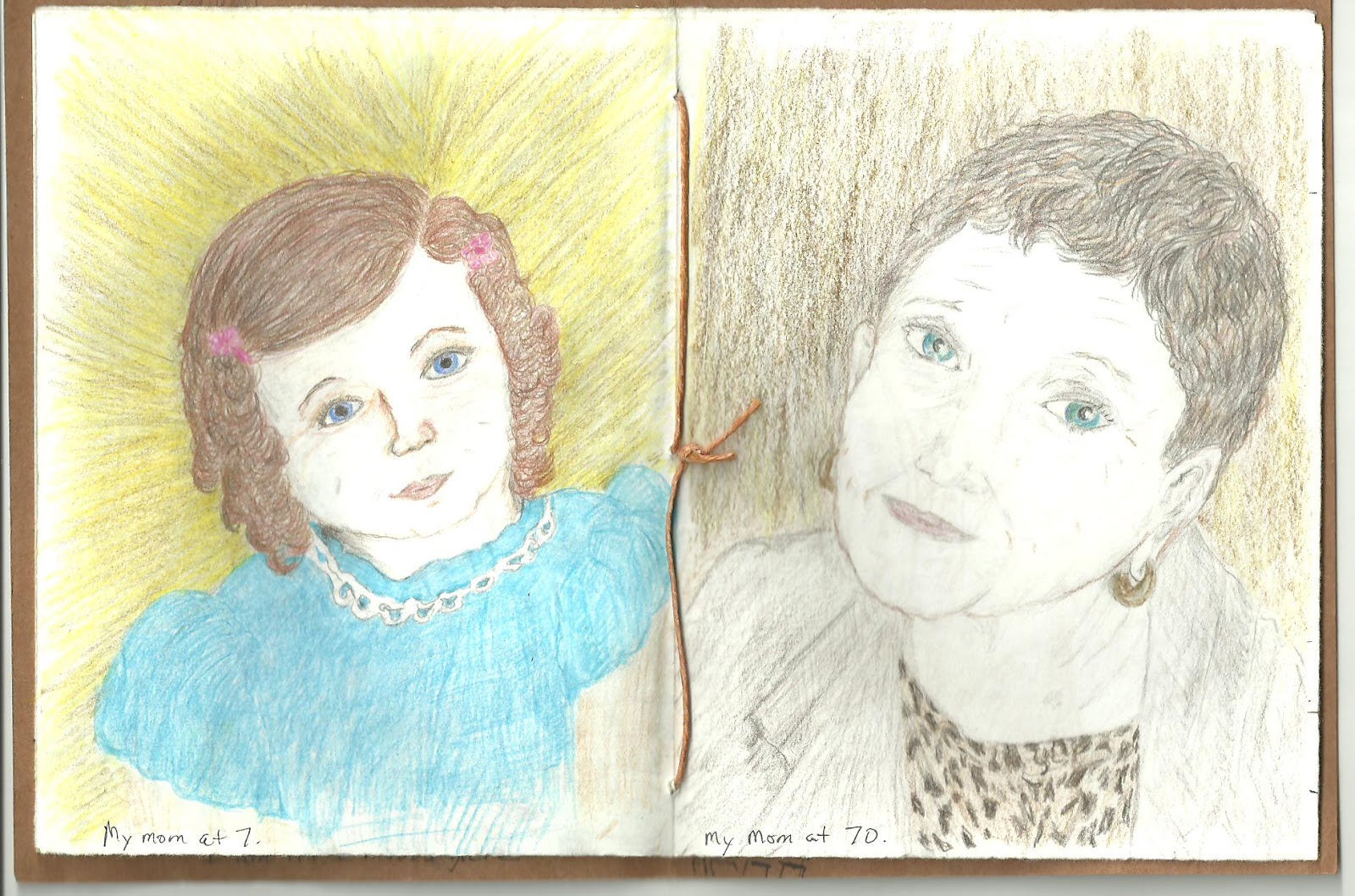
I will be off line till February 13th or so.  I’m traveling to Memphis to celebrate my mom’s life.  She passed away peacefully in her sleep February 4.  We will miss her bright eyes and sweet smile, but she will always be with us.

Elaine Murray Bullard  1939 -2013

Review: Summer of the Mariposas

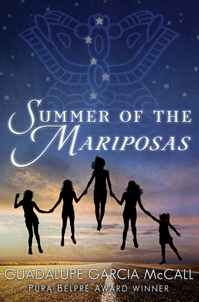
I was a little skeptical about the premise of this book.  It was hard to believe that a group of girls would plot to transport the corpse of a stranger from their home in Texas to his home in Mexico.  However, the story is based on the Odyssey, and promised magic and divine encounters, so I gave it a try.  I was hooked from the first page.

The Summer of the Mariposas, by Guadalupe Garcia McCall, (Tu Books, 2012) tells the story of 5 sisters set adrift one summer after their father has abandoned the family and their mother is always at work.  Odilia, the eldest at 16, is responsible for the supervision of the sisters, but the story gives each sister a distinct voice and personality.  One of the many things I liked about this book was how well McCall handled the personality of the sisterhood.  It’s easy to have one main character, and Odilia is that, but her personality and character can’t be separated from those of her sisters.  McCall integrates the multiple views seamlessly.   

The town itself has entered a kind of enchantment, beset by a plague of butterflies.  There are echos of One Hundred Years of Solitude, but the butterflies here are a symbol of metamorphosis for the Garza girls.

Their life takes on a macabre turn when they are at their favorite forbidden swimming hole and the body of a dead man floats into their lives.  Hurting from the loss of their father, they devise a scheme to take the body back to his home in Mexico.  Odilia is visited by La Llorna, the weeping woman, who is said to have drown her children.  She encourages Odilia to take the journey and gives her a gift to help her along the way.

The story just zooms along from there.  The real journey is one of the heart to get back to the place of family, but the physical and metaphorical journey of returning a body, finding a grandmother, and getting back home, is the adventure of the book.  McCall is a colorful and poetic writer with a keen sense of plot.  She is quite sly and adept at replacing Greek gods with Aztec and Mexican ones. 

But where Greek mythology often has a sense of fated doom, this book is shot through with hope and merriment. That is not to say the girls don’t encounter real danger, terrifying beasts and bouts of immaturity.  The girls bicker, they forget the lesson they just learned, they yearn for candy.  The twin sisters have a private bond and want to be television stars.  One of the reasons they don’t call the cops is a fear they’ll look terrible on camera — they want to go home and change clothes first.  Little bits of humor like this kept the characters real even in their most surreal circumstances. 

This book also portrays a deep respect and love for the blending of cultures, the strength of families and the tenacity of women, young and old. The girls learn the power of kindness and forgiveness, as much as they learn to trust their own strengths.  It’s marketed as a Young Adult novel, but I recommend for any age.  In fact, an 89 year old friend is reading it now.  I hope you get to, too.

McCall won the Pura Belpre Award for her first  novel, Under The Mequite, which I’ll be reading soon.  She is also a published poet and school teacher.  

Here is a link to the publishers site with a great interview with Guadalupe Garcia McCall.
http://www.leeandlow.com/books/484/pb/summer_of_the_mariposas?oos=hc&is=pb